Showing posts with label gratitude. Show all posts

Monday, January 25, 2010

Robert C. Solomon

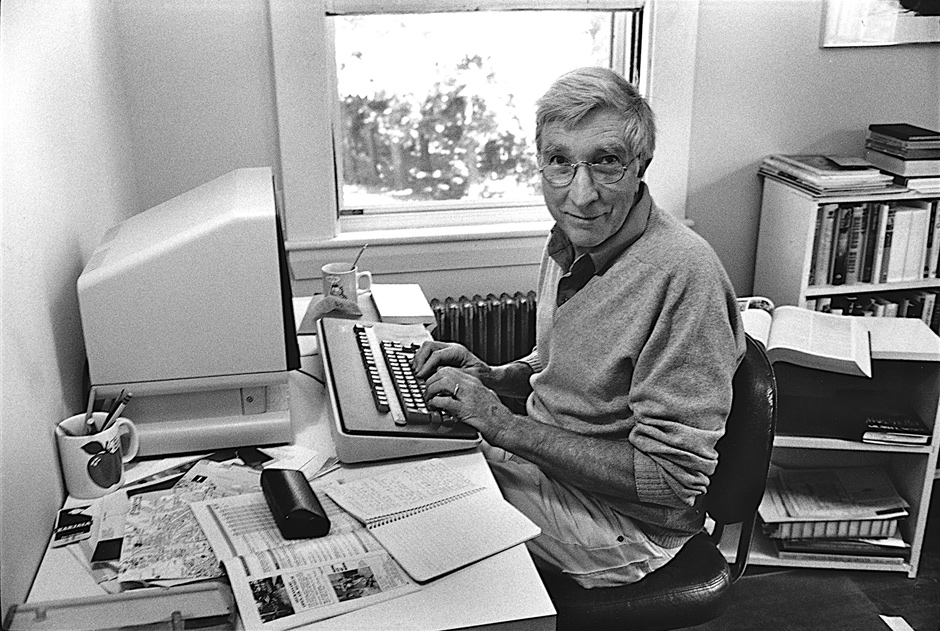
Bob Solomon's life ended suddenly in the airport in Zurich, Switzerland on January 2, 2007. A victim of pulmonary hypertension, he was dead at 64.


A former student said he was "more aware than most people how fragile and finite life is. He would tell students that if there were some things they wanted to do, to not hesitate to do them." And, he told them to be grateful every day.


"Gratitude, I want to suggest, is not only the best answer to the tragedies of life. It is the best approach to life itself. The proper recognition of tragedy and the tragic sense of life is not shaking one's fist at the gods or the universe in scorn and defiance. Whether or not there is a God or there are gods to be thanked, however, seems not the issue to me."

He was a teacher who clearly loved his calling. He reached  past the confines of his university (Texas) to teach countless autodidacts around the world who found him, and will continue to find him, through The Teaching Company. My great regret: I won't get to find him anymore at his favorite Austin pub, The Dog & Duck.

In my classrooms we'll continue to engage his instruction via Passion for Wisdom and Spirituality for the Skeptic.

Thursday, November 12, 2009

Matthew Chapman

Matthew Chapman, author of Trials of the Monkey, is an atheist (but not a "new" one), a lineal descendant of Charles Darwin, a successful Hollywood screenwriter, a respectful observer of life in Dayton, Tennessee, and a respecter of the humanity of those fellow humans who happen to believe in a divine universal creation. He believes atheists and religious believers should be able to coexist (his answer to the question posed over at the other blog this morning.) Evolution is "everybody's story," but not everybody warms thankfully to it as the spiritual core of our common narrative. Darwin's boy thinks that may be okay.

Here he is at the Southern Festival of Books in Nashville, in 2001. (btw: I was on the program that year too, plugging my then-new William James book. Wish I'd got his autograph!)

Sunday, August 30, 2009

Starbucks saved his life

Journals do sometimes become books, films, and college lecture tours...

Michael Gates Gill is convocation speaker at Middle Tennessee State University this afternoon, recounting his fall from Master of the Universe at J. Walter Thompson to Starbucks barista, in his sixties. But the happy moral of this story is that the fall was really a rebirth. "Leap to a new life" is his exuberant Kierkegaardian counsel:

"I could never have gotten out of the box I had created for myself [joblessness, unhappiness] if I hadn't leapt without thinking... You can't think your way out of a box. You have to leap, and leap with faith that if you do take a chance, there will be angels of grace who will catch you and help you on your way."

Reading that, I knew why my colleague said Gill's book was bad. But though I'm no Kierkegaardian irrationalist, I disagree. This is a good piece of practical wisdom, for all of us in uncertain times. You can land on your feet and come up smiling, if you're willing to stretch and bend a bit. That's a strong message.

But I won't be endorsing the general proposition, in the classroom, that thinking is a waste of time. Even an irrationalist has to think about the ground he leaps from, if he wants to give himself a fighting chance of landing right-side-up.

My colleague probably also resisted the saccharine homiletic notes in Gill's book, but I think a little sprinkle of pluralism neutralizes the cloying sweetness. I have to agree with Gill on this one too: "By truly seeing each person I met as a unique individual, I discovered a world of amazing variety and surprising wonder..."

Most importantly: "I discovered so late in life that trusting your own heart is your greatest--and only--path to real happiness. It was only through trusting my heart as my guide that I discovered this. I believe everyone is given a unique path to happiness..."

Gill's Dad, btw, was Brendan Gill of The New Yorker.

Here's Michael Gates Gill featured on CBS Sunday Morning, "so much happier serving than I ever was being served." And here he is, speaking with gratitude, at the Google campus:

Sunday, July 26, 2009

A deathbed non-conversion

"I would love to believe that when I die I will live again, that some thinking, feeling, remembering part of me will continue. But as much as I want to believe that, and despite the ancient and worldwide cultural traditions that assert an afterlife, I know of nothing to suggest that it is more than wishful thinking...the world is so exquisite, with so much love and moral depth, that there is no reason to deceive ourselves with pretty stories for which there's little good evidence. Far better, it seems to me, in our vulnerability, is to look death in the eye and to be grateful every day for the brief but magnificent opportunity that life provides...Five thousand people prayed for me at an Easter service at the Cathedral of St. John the Divine in New York City, the largest church in Christendom. A Hindu priest described a large prayer vigil for me held on banks of the Ganges. The Imam of North America told me about his prayers for my recovery. Many Christians and Jews wrote me to tell about theirs. While I do not think that, if there is a god, his plan for me will be altered by prayer, I'm more grateful than I can say to those, including so many whom I've never met, who have pulled for me during my illness. Many of them have asked me how it is possible to face death without the certainty of an afterlife. I can only say that it hasn't been a problem. With reservations about feeble souls, I share the view of a hero of mine, Albert Einstein: I cannot conceive of a god who rewards and punishes his creatures or has a will of the kind that we experience in ourselves. Neither can I, nor would I want to, conceive of an individual that survives his physical death. Let feeble souls, from fear for absurd egotism, cherish such thoughts. I am satisfied with the mystery of the eternity of life and a glimpse of the marvelous structure of the existing world, together with the devoting striving to comprehend a portion, be it ever so tiny, of the Reason that manifests itself in nature." Carl Sagan

Monday, July 13, 2009

Gratitude

I love Dan Dennett's thoughts on gratitude, in his recent conversation with Richard Dawkins and in "that thing" he wrote about surviving heart failure, "Thank Goodness" - his naturalistic humanism did not merely survive the ordeal but was greatly strengthened by it.

Yes, I did have an epiphany. I saw with greater clarity than ever before in my life that when I say "Thank goodness!" this is not merely a euphemism for "Thank God!" (We atheists don't believe that there is any God to thank.) I really do mean thank goodness! There is a lot of goodness in this world, and more goodness every day, and this fantastic human-made fabric of excellence is genuinely responsible for the fact that I am alive today. It is a worthy recipient of the gratitude I feel today, and I want to celebrate that fact here and now...

The best thing about saying thank goodness in place of thank God is that there really are lots of ways of repaying your debt to goodness—by setting out to create more of it, for the benefit of those to come...

Active gratitude is something pragmatic meliorists understand implicitly, happily paying forward what some of us don't mind calling a spiritual debt, not to a God but to the conditions favorable to life. Just as gratitude does not require a divine object, neither must it target specific persons, typically. But there are always persons to thank, those closest to us certainly, but also those "strangers" whose contributions to medical science, for instance, as in Dennett's case, are literally life-sustaining.

Ronald Aronson has interesting things to say about this too:

So much and many to thank: my parents, people on the other side of the world, those who set aside and today preserve this area as a state park, and on and on. One's map of dependence stretches in every possible direction and across every possible plane, but it is always real and it is always concrete. And it sketches the paths for one's gratitude. It tells, after all, the story of our connections with the world and the universe, and it gives us a core of obligations and a core of meaning. To give thanks is to honor this.


Sunday, July 12, 2009

Dawkins and Dennett on Darwin and spirituality

"Can we be spiritual but not religious?" Jesus and Mo say no, I say yes... and I have strong ("bright") allies in Richard Dawkins and Dan Dennett.

If by "spiritual" you mean something like, "outside of space and time, and continuous with the same conscious memories and experiences forever," they agree: No, we can't.

But, if by "spiritual" you mean something more like "alive to our actual place in an evolving cosmos, unblinking in the face of personal mortality but fully open to the possibility of some naturalized sort of transcendence or other," they agree emphatically: Yes, we can.

(But be forewarned: the video techs intrude themselves regrettably into this uncut post, and really disrupt the flow of a very engaging conversation, about ten minutes before the end; but stick with it, or "ff" thru it... the end is well worth suffering the annoyance. Dawkins' reading from his Unweaving the Rainbow definitely belongs in an anthology of humanist "hymns" that will certainly include Carl Sagan, John Dewey, Bertrand Russell, and all my other favorite philosophers. But, somebody please slap those techs for me!)

Oh, by the way: Dan Dennett, like Jackie Robinson and William James and many others on whose shoulders we humanists proudly stand, is another pragmatic meliorist in the rich American tradition: there's plenty of goodness is the world, but it needs more. Let's make some.

Thursday, November 22, 2007

Gratitude

Thanksgiving is one of my two favorite holidays, the other being Independence Day.

Richard Ford's wonderful novel The Lay of the Land (Knopf, '06) expresses much of my feeling about this day, and about the hard-won "acceptance" that comes with loving life while still deploring loss. I love and accept a lot, but not everything: so, on some accounts, I thus lack the deepest form of gratitude and spirituality. But I agree with Ford: "a practical acceptance of what's what, in real time and down-to-earth, is as good as spiritual if you can finagle it..."

Another of my favorite sources on this topic is the philosopher Loyal Rue, who has written:

By the grace of these improbable [cosmic] events we inherit the opportunity of a lifetime. Even if we cannot imagine some One to give thanks to, we are nonetheless rendered thankful by the bountiful conditions of our existence. And in the measure of our gratitude we acquire a sense of obligation. The more we learn about the Epic of Evolution the more we are motivated to repay the generosity of the past by seeding hope for the future. http://www.earthlight.org/personal26.html

In other words: pay it forward.

Tuesday, April 24, 2007

Gratitude

David Halberstam died yesterday in an automobile accident in California. He was a first-rate journalist and author, best known for The Best and the Brightest. My favorite Halberstam work is The Children, an account of the courageous college students who organized protests in Nashville and elsewhere in the heyday of the Civil Rights movement. I also like his baseball books, especially his account of the 1964 season that culminated in a Cards-Yanks World Series. I'm grateful for Halberstam's life and contribution,.

Halberstam's death seems an appropriate occasion to express my gratitude for another personal hero who left us too soon, Robert Solomon.

I'm on record as being generally unimpressed by the the academic/philosophical/Continental expression of Existentialism, much preferring literary versions like Walker Percy's and Richard Ford's. But I make an exception for Solomon, the University of Texas philosopher who collapsed and died in a Swiss airport in January.

Gratitude was one of Solomon's recurrent themes:
Gratitude, I want to suggest, is not only the best answer to the tragedies of life. It is the best approach to life itself. This is not to say, as I keep insisting, an excuse for quietism or resignation. It is no reason to see ourselves simply as passive recipients and not as active participants full of responsibilities. On the contrary, as Kant and Nietzsche among many others insisted, being born with talents and having opportunities imposes a heavy duty on us, to exercise those talents and make good use of those opportunities. It is also odd and unfortunate that we take the blessings of life for granted -- or insist that we deserve them -- but then take special offense at the bad things in life, as if we could not possibly deserve those. The proper recognition of tragedy and the tragic sense of life is not shaking one's fist at the gods or the universe "in scorn and defiance" but rather, as Kierkegaard writes in a religious context, "going down one one's knees" and giving thanks. Whether or not there is a God or there are gods to be thanked, however, seems not the issue to me. It is the importance and the significance of being thankful, to whomever or whatever, for life itself.
-Robert C. Solomon, "Spirituality for the Skeptic" (New York: Oxford University Press, 2002)

Carlin Romano wrote last week in The Chronicle of Higher Education:
Above all, Solomon exuded appetite, endless appetite, for philosophy that matters, problems, in the Jamesian sense, that make a difference for real people.

Halberstam and Solomon, thankfully, left us a legacy of words and ideas by which we can continue to be instructed and inspired, and for which I am profoundly grateful.

KurzweilAI.net Accelerating Intelligence News