Well written, Mr. Lipps! (And thanks for the link, Dean.)
Re “Heaven and Nature,” by Ross Douthat (column, Dec. 21):
Mr. Douthat tells readers that in the absence of an “escape upward” from heartless Nature into the arms of a God willing to “take on flesh and come among us,” human existence is a tragedy. He further says that we are “beasts with self-consciousness” who “stand half inside the natural world and half outside it.”
Really, now. There’s more to Nature than the “suffering and death” that Mr. Douthat assigns to it. “Nature red in tooth and claw” is a cliché outmoded for generations. Birth, growth, healing and nurturance are all parts of the natural order, too, even among “beasts.”
Religion is an attempt to make sense of the world. That much is necessary for survival. But “numinous experience” is not a requirement. At the risk of being a Christmas killjoy, let me suggest it can actually be a liability, by encouraging people to reject reason for divine revelation.
And let me suggest: "numinous" experience takes many forms, and is often mistaken for pedestrian ordinariness. Mysteries abound, transcendence is just a step away. Don't short-change the possibilities inherent in the everyday.
Showing posts with label religion. Show all posts
Showing posts with label religion. Show all posts
Monday, December 28, 2009


Tuesday, December 15, 2009
prickly
Here is an illustration of why atheists are tired of cowering quietly in the closet, and why I'm tired of people ridiculing Unitarians. If I ever get elected to anything, just swear me in on the Constitution-- or on Why I am Not a Christian, tabbed to "A Free Man's Worship."
==
==
Conservatives warn of lawsuit as atheist takes office in N.C. city
Tenn.'s constitution contains similar ban
RALEIGH, N.C. — Asheville City Councilman Cecil Bothwell believes in ending the death penalty, conserving water and reforming government — but he doesn't believe in God. His political opponents say that's a sin that makes him unworthy of serving in office, and they've got the North Carolina Constitution on their side.
Bothwell's detractors are threatening to take the city to court for swearing him in, even though the state's requirement that officeholders believe in God is unenforceable because it violates the U.S. Constitution.
"The question of whether or not God exists is not particularly interesting to me, and it's certainly not relevant to public office," the recently elected 59-year-old said.
Bothwell ran this fall on a platform that also included limiting the height of downtown buildings and saving trees in the city's core, views that appealed to voters in the liberal-leaning community at the foot of the Appalachian Mountains. When Bothwell was sworn into office on Monday, he used an alternative oath that doesn't require officials to swear on a Bible or reference "Almighty God."
That has riled conservative activists, who cite a little-noticed quirk in North Carolina's Constitution that disqualifies officeholders "who shall deny the being of Almighty God." The provision was included when the document was drafted in 1868 and wasn't revised when North Carolina amended its constitution in 1971. One foe, H.K. Edgerton, is threatening to file a lawsuit in state court against the city to challenge Bothwell's appointment.
"My father was a Baptist minister. I'm a Christian man. I have problems with people who don't believe in God," said Edgerton, a former local NAACP president and founder of Southern Heritage 411, an organization that promotes the interests of black Southerners...
In 1961, the U.S. Supreme Court reaffirmed that federal law prohibits states from requiring any kind of religious test to serve in office when it ruled in favor of a Maryland atheist seeking appointment as a notary public.
But the federal protections don't necessarily spare atheist public officials from spending years defending themselves in court...
Bothwell was raised a Presbyterian but began questioning Christian beliefs at a young age and considered himself an atheist by the time he was 20. He's an active member of the Unitarian Universalist Church of Asheville, and he still celebrates Christmas, often hanging ornaments on his fishhook cactus... Merry Christmas!
Thursday, December 3, 2009
goodness

"Humanists have always understood that striving to make the world a better place is one of humanity's most important responsibilities. Religion does not have a monopoly on morality -- millions of people are good without believing in God." Seems like something that would go without saying, but saying it on subways and busses will stir up lots of animosity. Will the humanists' new ad campaign also provoke intelligent discussion, in class at least? I'll get back to you on that.
But on a related front: how good are we, really? Students repeatedly report ("this is just my opinion, but...") that on their view humans will never learn to cooperate with those of different background and ethnicity, or to tolerate those with different religious or political views.
As I said in class: let's keep the books open on that, new research seems to indicate that we're natively more sympathetic towards others than convention supposes. We have it in us, in germ, to be better people.
“We’re preprogrammed to reach out,” primatologist Franz de Waal writes. “Empathy is an automated response over which we have limited control. In fact, I’d argue that biology constitutes our greatest hope. One can only shudder at the thought that the humaneness of our societies would depend on the whims of politics, culture or religion.”
Yup. Politics, in particular, has lately been a let-down. (I write while still absorbing the disappointment of what looks like a ramping-up, and not the beginning of the end, of what has now become Obama's war in Afghanistan.) If we're going to keep hope alive we may have to trust ourselves more than my students' reports indicate we should. Can we take it on faith, folks-- and on accumulating evidence!-- that we can do better?
Yes, we can.
Thursday, November 26, 2009
atheist with a soul

First had come the book, which he had entitled The Varieties of Religious Illusion, a nod to both William James's The Varieties of Religious Experience and to Sigmund Freud's The Future of An Illusion. The book had brought Cass an indecent amount of attention. Time Magazine, in a cover story on the so-called new atheists, had ended by dubbing him "the atheist with a soul." When the magazine came out, Cass's literary agent, Sy Auerbach, called to congratulate him. "Now that you're famous, even I might have to take you seriously. ...
Rebecca Goldstein, 36 Arguments for the Existence of God: A Work of Fiction (excerpted at edge.org)
Saturday, November 21, 2009
critical thinking
We were talking in Happiness 101 about the decline of critical thinking among the young, the devout, and the credulous... prompted by popular worries about a looming apocalypse, the antichrist, etc. J & M don't really want to be part of the solution.

Monday, November 2, 2009
humanists and atheists


"Humanists are right to think that there is more to life than atheism, but wrong to think that they are the ones to provide it," says humanist Austin Dacey (and D.J. Grothe agrees). The gist of his view, I gather, is that humanism is not an alternative religion and should not aspire to be one. "The point should be to make the mainstream culture more secular and humanistic, not to create a new secular humanist subculture."
Well ok, I guess. We'll talk about it in the "Atheism and Spirituality" course. But it seems to me there's no reason why humanists should not be happy to embrace the claim that a more humanistic mainstream culture would also be more (naturalistically) "spiritual." And there's every reason why they should be averse to reinforcing the popular prejudice that humanists, atheists, and secularists generally are best defined by their aversions. Tell the people what you're for, if you really want to move the culture forward.
But maybe such sentiments mark me as a spiritual humanist, rather than a secular one. Guess it's time to go back to the old Humanist Manifesto, the movement's seminal (non?-) sacred text.
But wait... those humanists called themselves "religious." (Their first affirmation: "Religious humanists regard the universe as self-existing and not created.")
Is there such a thing as a humanist fundamentalist?! This is going to be a very interesting course, I can't wait.
Sunday, October 4, 2009
almost true

Also in the news this Sunday:
The Times features no funnies, but this is fun: Monty Python turns 40 (!) this year, will reunite at the Ziegfeld Theater on October 15 (sans the late great Graham Chapman), and starting on the 18th the Independent Film Channel will devote a week to the Pythons, broadcasting an episode a day of a new documentary called "Monty Python: Almost the Truth (The Lawyer's Cut)"...
"Now for something completely different":
Parade reports that 25% of Americans call themselves "spiritual, not religious," and half of them say they never go to church. 60% think "all religions have validity," and 66% expect they'll connect with the dead on the Other Side.
Or on this one. What many understand by "spiritual" includes psychic swindlers like James van Praagh and John Edward, the latter featured this morning on CBS Sunday Morning. 20% say they've already been in touch with spirits. Coincidentally, that's how many watch Edward and van Praagh on TV.
The oddly one-sided emphasis of the CBS report was on reconciling belief in psychic phenomena with one's religious or spiritual prejudices, as opposed to squaring it with (say) logic, reason, and evidence.
What fun the Pythons could have with all this. Oh yeah, they did already (in "Life of Brian"). Well, here's Michael Shermer having some fun.
Friday, October 2, 2009
"You lie!"
The new Ricky Gervais film The Invention of Lying debuts with perfect timing: we commence our discussion of the Truth chapter on Monday. But NPR's film critic says Ricky (or more likely the studio) pulls its punches, in abject fear of inflaming a reaction from an audience that won't be amused by the insinuation that religion would not exist in a world where lying was impossible.
Mark [Ricky] visits his mother in her retirement home (the sign reads: "A Sad Place Where Homeless Old People Come to Die"), and finding her frightened of oblivion on her deathbed, he makes up an afterlife, where he says she'll be happy.
Because no one lies, she dies with a smile. Then Mark looks up, and sees the doctors and nurses looking stunned. They want details.
So Mark has to basically invent religion on the spot. He says there's a Man in the Sky who takes care of folks who've died, and who's also responsible for everything on Earth.
"Even my cancer?" wonders someone, and ... well, let's just say Mark's ad-libbed improvisations have to get more complicated.
OK, so it walks right up to the edge of edgy and backpedals. What else do we expect from Hollywood? But this still looks like fun. See you at the multiplex...
where I'll probably skip the Coens' "A Serious Man," a re-telling of the Biblical tale of Job that sounded promising but is apparently "intolerable" and "hell to sit through," if you trust David Denby (and the trailer does look a bit lame): "Larry [Job] applies to a series of Rabbis for help, and the rabbis, vain of their wisdom, either miss the point of his troubles or tell elaborate parables that illuminate nothing... one might say that all filmmakers, distributing rewards and punishments, come close to playing God. Surely the arbitrary and ruthless Coens are the only deity in sight." Denby's usually on target but sounds a bit like an apologist here. May have to seek another opinion.
Thursday, September 24, 2009
Atheism and Spirituality
Hot off the presses:

New course, Spring 2010-
Philosophy 4800.3 -- Readings in Philosophy: Atheism and Spirituality. TTh 2:40--4:05, JUB 202.
"I'm not religious. I'm spiritual."
We've all heard people say that. Perhaps you've said it yourself. But what does it mean? Can an atheist say it? What, precisely, do atheists believe-- and believe in? What makes a non-religious person "spiritual"?
This course will tackle these and many other questions drawn from reflection on philosophical texts from Epicurus, Pascal, David Hume, Kierkegaard, Nietzsche, Bertrand Russell, and  John Dewey (among others), as well as more recent writings and public polemics involving "New Atheists" Richard Dawkins, Christopher Hitchens, Sam Harris, and Daniel Dennett.


John Dewey (among others), as well as more recent writings and public polemics involving "New Atheists" Richard Dawkins, Christopher Hitchens, Sam Harris, and Daniel Dennett.We''ll hear from Julia Sweeney about "letting go of God" and gaining new spiritual perspective. We'll look at the humanistic and skeptical traditions of doubt, and we'll also consult the wisdom of the late Carl Sagan, whose posthumous Varieties of Scientific Experience echoes, honors, and complements William James's Varieties of Religious Experience.
Contact Dr. James P. Oliver (poliver@mtsu.edu, 898-2050, 307B JUB) for information and further details.
Wednesday, September 2, 2009
cosmic religion
Very interesting discussions today, centering on Einstein's 1930 New York Times Magazine essay exploring what he called the "cosmic religious feeling,"
the strongest and noblest motive for scientific research. Only those who realize the immense efforts and, above all, the devotion without which pioneer work in theoretical science cannot be achieved are able to grasp the strength of the emotion out of which alone such work, remote as it is from the immediate realities of life, can issue. What a deep conviction of the rationality of the universe and what a yearning to understand... A contemporary has said, not unjustly, that in this materialistic age of ours the serious scientific workers are the only profoundly religious people.
Einstein famously endorsed "Spinoza's God," and a pantheistic universe the uncovering of whose laws is the object of all that rational devotion. That led us to consider the oft-bandied claim that atheists are paradoxically religious in their irreligion. That seems a stretch. But I'm happy to call them "spiritual," a term they may find no more agreeable than "religious"... but read Unweaving the Rainbow. Is that not a devout, inspired book?
Sunday, August 23, 2009
"grand bargain"
Robert Wright is adamantly not an atheist, he told Colbert. Apparently he's a Jamesian accommodationist instead. Wright's "most emailed" piece in today's Times implicitly poses the Rodney King question: Can't we just all get along? Wright's essay concludes:
"William James said that religious belief is 'the belief that there is an unseen order, and that our supreme good lies in harmoniously adjusting ourselves thereto.' Science has its own version of the unseen order, the laws of nature. In principle, the two kinds of order can themselves be put into harmony — and in that adjustment, too, may lie a supreme good."
Thursday, August 13, 2009
Scientologists
There was already a "celebrity centre" here on Music Row, now there's another large scientology encampment in the old Fall School building at 8th and Chestnut, near Greer Stadium. A bus-bench ad spotted yesterday in Hillsboro Village encourages all to attend an "Open House" at their convenience. I may just have to drop in before my next Sounds' game, just to get the insiders' account of *Xenu and L. Ron Hubbard.
Hubbard was once quoted as saying that if you want to get rich in America, start a new religion. So he did.
Rolling Stone peeked under the Hubbardites' roof a while back.

This is the "centre" in Hollywood... not too far, coincidentally, from the Magic Kingdom.
What I find especially pernicious about the Scientologists, but possibly not qualitatively distinctive about them in comparison with the more conventional and mainstream ideologies, is the way they compromise their members' ability to think for themselves. "Cult" is the mainstream term of denigration, but we're all cultish to some degree or other... or have cultish tendencies we need to guard against. Insular, single-track, defensive, reactionary "thinking" makes fools of us all. These guys, though, really are over the top.
*In Scientology doctrine, Xenu (alsoXemu or the modern day "Emu" or "Elmo") is an alien ruler of the "Galactic Confederacy" who, 75 million years ago, brought billions of aliens to Earth in DC-8-like spacecraft, stacked them aroundvolcanoes and blew them up withhydrogen bombs. Their souls then clustered together and stuck to the bodies of the living, and continue to wreak chaos and havoc today.» — Wikipedia
Saturday, August 1, 2009
"Altar call"
We''ve really heard more than enough about the "worries" of angry gun-toting, tea-tossing Christian conservatives, spouting venom about the "Obama-Pelosi-Reed axis of evil," issuing "marching orders to slay the socialist monster" and "altar calls" imploring ill-informed Christian jihadists to smite the Democratic infidels. ("Altar call confronts worries of Christian conservatives," Nashville Tennessean August 1)
We've heard barely a peep, however, from politicians and the press in condemnation of such histrionic hate-mongering.
"Some of the audience wore [para-military] uniforms, and brought their guns."
Terrific. Our legislators said they could, after all.
The Tennessean has done part of its job, reporting the story. When will it do the rest of its job, and take an unequivocal editorial position against hateful and incendiary religious displays? When will its "religion reporting" stop providing an unchallenged platform for hate speech?
If your conscience needs a guide, Tennessean, look to the report Bill Moyers aired last week ("Rage on the airwaves," July 24) and then ask yourself what John Seigenthaler would do.
Sunday, July 12, 2009
Dawkins and Dennett on Darwin and spirituality
"Can we be spiritual but not religious?" Jesus and Mo say no, I say yes... and I have strong ("bright") allies in Richard Dawkins and Dan Dennett.
If by "spiritual" you mean something like, "outside of space and time, and continuous with the same conscious memories and experiences forever," they agree: No, we can't.
But, if by "spiritual" you mean something more like "alive to our actual place in an evolving cosmos, unblinking in the face of personal mortality but fully open to the possibility of some naturalized sort of transcendence or other," they agree emphatically: Yes, we can.
(But be forewarned: the video techs intrude themselves regrettably into this uncut post, and really disrupt the flow of a very engaging conversation, about ten minutes before the end; but stick with it, or "ff" thru it... the end is well worth suffering the annoyance. Dawkins' reading from his Unweaving the Rainbow definitely belongs in an anthology of humanist "hymns" that will certainly include Carl Sagan, John Dewey, Bertrand Russell, and all my other favorite philosophers. But, somebody please slap those techs for me!)
Oh, by the way: Dan Dennett, like Jackie Robinson and William James and many others on whose shoulders we humanists proudly stand, is another pragmatic meliorist in the rich American tradition: there's plenty of goodness is the world, but it needs more. Let's make some.
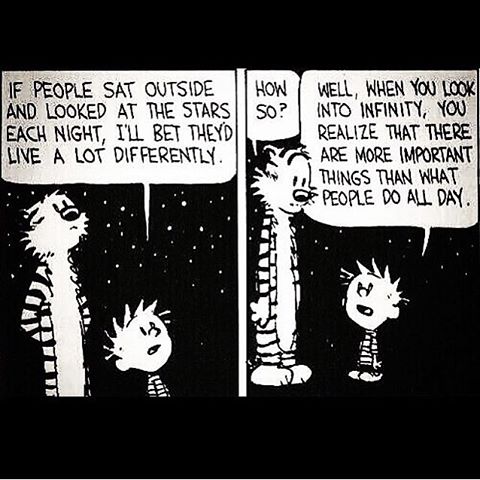
Calvin, Twit of the Year
 The Calvin I like (& his pal Hobbes) express my feelings about Bad Calvin, who despite having said that newborn infants deserve eternal damnation seems to be enjoying an appalling "revival" among young people who think their only "spiritual" options range from mega-smiley Pastor Osteen to the long dead Dark Lord of TULIP (that's "Total depravity, Unconditional election, Limited atonement, Irresistible grace, and Perseverance of the saints," for those fortunate enough to have escaped that particular form of child abuse.)
When will we have the sense to recognize the value of philosophy, and share it with our kids, before they're so miserably "saved" by the Prophets of doom?
But you gotta love this:
[Calvin] stressed total depravity — the idea that human beings are completely sinful, and can't do anything to earn God's favor. That's a relief to many students who've grown up in church, said Kevin... [wait for it] Twit, who oversees the Reformed University Fellowship at Belmont. Calvinism gives them permission to fail.
"They've been trying to live by their own will power — to be fired up for Jesus. By the time they got to college, they are worn out," Twit said.
Worn out by bad theology. Tell me about it.
Wednesday, March 7, 2007
"Darwin's God"
From Sunday's NYT Magazine, "Darwin's God" (I'm just catching up, having been precoccupied with my own transcendental pursuits here in Florida)--
Call it God; call it superstition; call it... “belief in hope beyond reason” — whatever you call it, there seems an inherent human drive to believe in something transcendent, unfathomable and otherworldly, something beyond the reach or understanding of science...
Lost in the hullabaloo over the neo-atheists [meaning Dawkins, Dennett, & Sam Harris -- though none of them is "neo" in this regard] is a quieter and potentially more illuminating debate. It is taking place not between science and religion but within science itself, specifically among the scientists studying the evolution of religion. These scholars tend to agree on one point: that religious belief is an outgrowth of brain architecture that evolved during early human history. What they disagree about is why a tendency to believe evolved, whether it was because belief itself was adaptive or because it was just an evolutionary byproduct, a mere consequence of some other adaptation in the evolution of the human brain.
Which is the better biological explanation for a belief in God — evolutionary adaptation or neurological accident?
I'm not sure that's 's quite the right question, but I incline to James's observation as the beginning of an answer: the impulse to transcendence is not about God, it's about life. People reach for religious and other magic because they want a more intense and satisfying experience of mortal life (and the quest for immortality is satisfying for them). Transcendence is a natural phenomenon, and the invocation of transcendent entities, powers, potentialities, etc., is natural too. This is what I've called "global naturalism."
More on this later, I have miles to go and one more stop on my baseball junket.
Tuesday, February 27, 2007
Dawkins, Dennett, & James on religion
Is religion one of our species' most valuable "springs of delight," even when it veers (as so often it does) into absurdity and unreasoning dogma? (I don't share Richard Dawkins' view that it pretty much lives there permanently, though he scores plenty of points in that direction in The God Delusion).
William James thought religion to be one of our most important cultural achievements, even while admitting the absurdity of its many and contradictory doctrinal intransigences. In Varieties of Religious Experience (1902) he defined religion as "the feelings, acts, and experiences of individual men in their solitude, so far as they apprehend themselves to stand in relation to whatever they may consider the divine." Elsewhere James wrote that religion is not about God, it's about life and our quest for a richer, more meaningful experience thereof.
By sharp contrast with James's neutrality about supernaturalism in religious persons' designation of their own sense of "the divine," Daniel Dennett in Breaking the Spell proposes to define religions as "social systems whose participants avow belief in a supernatural agent or agents whose approval is to be sought... a religion without God or gods is like a vertebrate without a backbone."
I confess some ambivalence about all this. I like the open-endedness of James's receptivity to all kinds of religions, which for him really was just a way of saying "hands off" other people's personal enthusiasms. But I also find myself cheering many of Dawkins' and Dennett's acid repudiations of casual supernaturalism and mysticism, their "Bright"-ness (see www.the_Brights.net).
I plan to discuss some of this tonight, when I teach the second and last installment of an adult evening (fundraiser) course at my kids' school. It'll probably come up in class this afternoon, too, at ESU (my particular Enormous State University) -- today's topic is "the problem of evil." That always provokes students' religious reflexes, and often instigates discord, not a bad thing in a philosophy classroom if it can be constructively harnessed. I look forward to good conversations today.
Subscribe to:
Posts (Atom)




 Charles Darwin (

 Posts