Showing posts with label Carl Sagan. Show all posts
Showing posts with label Carl Sagan. Show all posts
Monday, February 27, 2012


Saturday, December 24, 2011
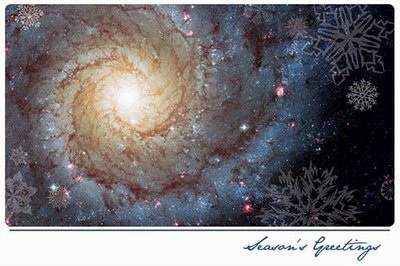
Merry Cosmic Christmas

Wednesday, November 9, 2011
Happy Sagan Day!
It's his birthday, and groups from Australia to Alaska are planning star parties, astronomy lectures, science fairs, teacher workshops and more to say thanks to Dr. Sagan and bring his work to the next generation of "star stuff."
My longtime view about Christianity is that it represents an amalgam of two seemingly immiscible parts: the religion of Jesus and the religion of Paul. Thomas Jefferson attempted to excise the Pauline parts of the New Testament. There wasn't much left when he was done, but [the Jefferson Bible] was an inspiring document." Carl SaganThe clip above is from Cosmos episode 10, "The Edge of Forever"
Monday, September 19, 2011
More perspective
This evokes for me the same feeling Carl Sagan was trying to awaken, from further out: a sense of ourselves as voyagers on Starship Earth, a single species hugging a fraction of a dot, with the solar winds in our sails.
A time-lapse taken from the front of the International Space Station as it orbits our planet at night. This movie begins over the Pacific Ocean and continues over North and South America before entering daylight near Antarctica.
Visible cities, countries and landmarks include (in order) Vancouver Island, Victoria, Vancouver, Seattle, Portland, San Fransisco, Los Angeles. Phoenix. Multiple cities in Texas, New Mexico and Mexico. Mexico City, the Gulf of Mexico, the Yucatan Peninsula, Lightning in the Pacific Ocean, Guatemala, Panama, Columbia, Ecuador, Peru, Chile, and the Amazon. Also visible is the earths ionosphere (thin yellow line) and the stars of our galaxy. Raw data was downloaded from;As Jerry Coyne comments, "This should give you a 'spiritual' experience." Amen. Pass the plate, NASA.
The Gateway To Astronaut Photography of Earth "http://eol.jsc.nasa.gov/sseop/mrf.htm ". Virtualdub was used to create the final movie. You can see more beautiful images of our universe at: http://infinity-imagined.tumblr.com/
Friday, September 16, 2011
Who moved my wallpaper?
Kat did, replacing the desktop image in our classroom with a clever scene involving pious fish who can't imagine anyone but a God stooping to care for their fishbowl.
She's right, mine was a bit blurry. After all, it was taken from a distance of 3.7 billion miles.
It's really Carl Sagan's adjoining text, though, more than the image of a miniscule fraction of a dot, that's meant to convey clarity. So let me restore my sense of perspective, mine and Matthew Beckler's, here and now.

She's right, mine was a bit blurry. After all, it was taken from a distance of 3.7 billion miles.
It's really Carl Sagan's adjoining text, though, more than the image of a miniscule fraction of a dot, that's meant to convey clarity. So let me restore my sense of perspective, mine and Matthew Beckler's, here and now.
From this distant vantage point, the Earth might not seem of any particular interest. But for us, it's different. Look again at that dot. That's here, that's home, that's us. On it everyone you love, everyone you know, everyone you ever heard of, every human being who ever was, lived out their lives. The aggregate of our joy and suffering, thousands of confident religions, ideologies, and economic doctrines, every hunter and forager, every hero and coward, every creator and destroyer of civilization, every king and peasant, every young couple in love, every mother and father, hopeful child, inventor and explorer, every teacher of morals, every corrupt politician, every "superstar," every "supreme leader," every saint and sinner in the history of our species lived there – on a mote of dust suspended in a sunbeam... Pale Blue Dot

Thursday, July 21, 2011
The gift of Apollo
Atlantis has come home. The shuttle program was impressive but became redundant. The memory of its predecessor may be more inspiring, more likely to make us feel at home in the universe.
Saturday, April 9, 2011
Wednesday, March 23, 2011
Olber's Paradox
Here's the video on Olber's Paradox that wouldn't load for Jason. Let there be light.
And here's the opening from Contact. I don't know if it has anything to do with what Jason was saying about fractals. I just like it.
But remember: extraordinary claims require extraordinary evidence.
And here's the opening from Contact. I don't know if it has anything to do with what Jason was saying about fractals. I just like it.
But remember: extraordinary claims require extraordinary evidence.
Wednesday, December 15, 2010
tables turned
We were talking about the future of music the other day with Kevin, then Harrison
 asked if I had a turntable. Therein lies one more brief cautionary tale about the future in general.
My old console stereo, with built-in LP "changer" (called that, I think, because you could pile a stack on the spindle and another record would drop onto the platform in turn as the needle withdrew from each terminal circuit) died while I was still in High School in Missouri in the '70s.
I made do for a time, it was the 8-track era and that's what I listened to in the car. I loved the chunka-chunka sound of the track switching every three songs. When I think of it I mostly imagine "Magical Mystery Tour" playing as I rolled down I-70 to or from my first college semester at UMSL (U of Mo - St. Louis), in the '72 Dart.

Eventually I bought a nice cheap Technics turntable, which carried me to grad school in Tennessee. I didn't buy many new records; cassettes and the Sony Walkman were big now. And then compact discs.
And then, at some point-- I'm hazy on (or traumatized by) the details, maybe it was in the fog of preliminary exams-- I became convinced that I no more needed that turntable and those LPs and 45s and tapes than I needed an Edsel.
So I gave 'em away.
Dumb dumb dumb.
Now my music is on a large, neglected stack of CDs, on an iPod, and in the clouds of Sirius and Pandora. I miss my records!
The moral, of course: don't give away your rich, textured (ok, scratchy and hissy) and memory-laden past, in the present, for the unsecured promise of perfection in a shiny but hypothetical future. And don't assume that new and different is always necessarily better.
But: keep aiming for the stars anyway.
Postscript. Thank you, Harrison & class, for this wonderful parting gift. It was pressed by Third Man Records in Nashville, whose leader says "people are paying a couple hundred bucks each" on Ebay for this very rare item. Wow. I'm now officially shopping for my next turntable.


That's the great thing about the future: you don't know what you're gonna get!
 asked if I had a turntable. Therein lies one more brief cautionary tale about the future in general.
My old console stereo, with built-in LP "changer" (called that, I think, because you could pile a stack on the spindle and another record would drop onto the platform in turn as the needle withdrew from each terminal circuit) died while I was still in High School in Missouri in the '70s.
I made do for a time, it was the 8-track era and that's what I listened to in the car. I loved the
 chunka-chunka sound of the track switching every three songs. When I think of it I mostly imagine "Magical Mystery Tour" playing as I rolled down I-70 to or from my first college semester at UMSL (U of Mo - St. Louis), in the '72 Dart.
Eventually I bought a nice cheap Technics turntable, which carried me to grad school in Tennessee. I didn't buy many new records; cassettes and the Sony Walkman were big now. And then compact discs.
And then, at some point-- I'm hazy on (or traumatized by) the details, maybe it was in the fog of preliminary exams-- I became convinced that I no more needed that turntable and those LPs and 45s and tapes than I needed an Edsel.
So I gave 'em away.
Dumb dumb dumb.
Now my music is on a large, neglected stack of CDs, on an iPod, and in the clouds of Sirius and Pandora. I miss my records!
The moral, of course: don't give away your rich, textured (ok, scratchy and hissy) and memory-laden past, in the present, for the unsecured promise of perfection in a shiny but hypothetical future. And don't assume that new and different is always necessarily better.
But: keep aiming for the stars anyway.
Postscript. Thank you, Harrison & class, for this wonderful parting gift. It was pressed by Third Man Records in Nashville, whose leader says "people are paying a couple hundred bucks each" on Ebay for this very rare item. Wow. I'm now officially shopping for my next turntable.


That's the great thing about the future: you don't know what you're gonna get!
Wednesday, November 17, 2010
thin film of life
I love the coincident cosmopolitan serendipity of today's two FoL reports, converging as they did on Carl Sagan and Pale Blue Dot on our first day with Bill McKibben's Eaarth. Marie commented on Jeremy Rifkin's "empathic civilisation" and quoted the passage beginning: "There are places... where the natural world has all but disappeared." Our "thin film of life" is all we've got. Why do we fight over it so incessantly?
Then Jason played the Symphony of Science's "unbroken thread"...
...heralding a more "glorious dawn."
Is there intelligent life on earth? Well, there was. Maybe there will be again, in the future.
Or, maybe we should just say: there can be a future only if there is... only if we're still evolving.
P.S. I hunted for the Flaming Lips Bonnaroo video you said I'd like, Harrison, is this it? Guess you had to be there. But the Alan Watts "conversations" are unquestionably great.
Then Jason played the Symphony of Science's "unbroken thread"...
...heralding a more "glorious dawn."
Is there intelligent life on earth? Well, there was. Maybe there will be again, in the future.
Or, maybe we should just say: there can be a future only if there is... only if we're still evolving.
P.S. I hunted for the Flaming Lips Bonnaroo video you said I'd like, Harrison, is this it? Guess you had to be there. But the Alan Watts "conversations" are unquestionably great.
Saturday, November 6, 2010
Happy Sagan Day!


We humans have set foot on another world in a place called the Sea of Tranquility, an astonishing achievement for creatures such as we, whose earliest footsteps three and one-half million years old are preserved in the volcanic ash of east Africa. We have walked far.
Our loyalties are to the species and to the planet. We speak for earth. Our obligation to survive and flourish is owed not just to ourselves but also to that cosmos ancient and vast from which we spring! Who Speaks for EarthCarl spoke for Earth, and for the insight that beyond all our personal and cultural particularity we are still one species. He was a cosmopolitan.
We're at a crucial decision-point: will we choose the path of cooperation, mutuality, and hope? Or will we break the social contract, revert to a primitive and combative state of nature, and destroy ourselves over our selfish differences?
Carl hoped we'd lift the veil of destructive egoism and look to the future, to the stars, to our longest and deepest identity as children of light. We are billions, and we are one. Per aspera ad astra.
Wednesday, November 3, 2010
lumberjacks
Really enjoyed Kayla's report on transcending gender in FoL today, and the "spacecollective" video that so nicely anticipated Carl Sagan Day this weekend:
Here's another:
How we got from male-female yin and yang to outer space to lumberjacks, I'm not sure. But here you go, Kevin:
Here's another:
How we got from male-female yin and yang to outer space to lumberjacks, I'm not sure. But here you go, Kevin:
Thursday, September 30, 2010
cosmic anniversary
From the Center for Inquiry:
 Happy Birthday, COSMOS!Thirty years ago today, millions of Americans sat down in their living room and watched a revolution in television programming: the first episode of Carl Sagan’s masterpiece, COSMOS. Written by Sagan, Ann Druyan, and Steven Soter, the 13- part series won an Emmy and a Peabody Award, and was the most watched PBS series in the U.S. for twenty years.
Since then, COSMOS has gone on to reach almost a billion viewers in over 60 countries, and it’s still the most widely-watched PBS series in the world.
 But of course it didn’t just transform television, it transformed us, our understanding of ourselves and our place in the cosmos. It taught us some physics, some history, some chemistry and biology, and lots of astronomy, but it’s greatest gift was teaching us—us Earthlings sitting at home watching television—how to feel at home in the cosmos. But of course it didn’t just transform television, it transformed us, our understanding of ourselves and our place in the cosmos. It taught us some physics, some history, some chemistry and biology, and lots of astronomy, but it’s greatest gift was teaching us—us Earthlings sitting at home watching television—how to feel at home in the cosmos.Using state-of-the-art effects and the tools of both modern science and ancient storytelling, COSMOS eased an entire generation from the abyss of cosmic insignificance to an understanding of our unique significance to each other. We’ve been reveling in the cosmos ever since, and it’s that wonder and appreciation that we celebrate today, thirty years later. Join us over the next few months as we take out our COSMOS DVD’s and gather for viewing marathons, astronomy lectures, and star parties. We've made some beautiful pendants to commemorate the Anniversary, and we might even have an apple-pie baking contest (from scratch, of course!)
Look for events already planned near you and check back with us for updates atcarlsaganday.org!
Happy Birthday, Carl! — Carl Sagan Day 2010 Next, be sure to wrap up the Anniversary with your very own Carl Sagan Daycelebration, November 9th, Sagan’s birthday. Last year’s inaugural event in Ft. Lauderdale was a fantastic success, and now groups around the world are planning their own tributes with science fairs, planetarium shows, teacher workshops, and more, all to say “Thanks!” to Sagan, and to bring his gifts to another generation of “star stuff.” Next, be sure to wrap up the Anniversary with your very own Carl Sagan Daycelebration, November 9th, Sagan’s birthday. Last year’s inaugural event in Ft. Lauderdale was a fantastic success, and now groups around the world are planning their own tributes with science fairs, planetarium shows, teacher workshops, and more, all to say “Thanks!” to Sagan, and to bring his gifts to another generation of “star stuff.”Whether you're an independent skeptics group, an astronomy club or a science department, a researcher, a teacher, or a student, let us know how you're planning to commemorate Carl Sagan Day 2010 and we'll add your event to our Carl Sagan Day event calendar to help spread the word. Please email your event information tograssroots@centerforinquiry.  COSMOS imagery and logo copyright © 1980 Druyan-Sagan Associates, Inc. formerly known as Carl Sagan Productions, Inc. This material cannot be further circulated without written permission of Druyan-Sagan Associates, Inc.
For more information about CFI or Carl Sagan Day, please visit carlsaganday.org or emailgrassroots@centerforinquiry.
|
Monday, September 27, 2010
speaking for earth
The cosmos is ancient and vast. Its time is our responsibility. The only "sacred truth": there are no sacred truths. So, why do some people want to put a clock in a mountain? Out of loyalty, and love.
Wednesday, September 1, 2010
future assignments
Next time in Future of Life:
The cosmic calendar, & ch1 in Pale Blue Dot ("You Are Here");
Michael Chabon, "The Omega Glory";
Martin Rees, "Life's Future in the Cosmos"-- [video]; and
(For Monday 9.13) Bill Joy, "Why the Future Doesn't Need Us"
The cosmic calendar, & ch1 in Pale Blue Dot ("You Are Here");
Michael Chabon, "The Omega Glory";
Martin Rees, "Life's Future in the Cosmos"-- [video]; and
(For Monday 9.13) Bill Joy, "Why the Future Doesn't Need Us"
Monday, May 24, 2010
Hypatia
The great but little-known Hypatia gets her due in Agora, a new film reviewed yesterday in the Times. Carl Sagan raised her profile in Cosmos... (text); maybe now she'll make it onto the Top Female Philosopher lists where she should have been all along.
She said: To teach superstitions as truth is a most terrible thing.
She said: To teach superstitions as truth is a most terrible thing.
Monday, May 10, 2010
lost in the cosmos?

I was a Percy fan, though I was no fan of his Catholicism or his jabs at my hero Carl Sagan. "Vulgar scientism," really?!
But weird though it may be, Lost in the Cosmos is worth a look if (like me) you're a naturalist and humanist with a "spiritual" feeling for the stars. We need critics like Percy to keep us sharp.
He was a lifelong pal of the Civil War historian Shelby Foote. They built a stone "teahouse" pavilion together on a hill in Sewanee, Tennessee in the 1930s. I'll see if I can dig up the photo I took there, what, fifteen years ago already?
Thursday, May 6, 2010
unbroken thread
Will the thread remain unbroken? That's the great mystery the future poses.
The secrets of evolution/Are time and death/There's an unbroken thread that stretches/From those first cells to usThe fourth installment in the Symphony of Science series, which I missed somehow back in January and February in my haste to discover "the poetry of reality":
Sunday, February 14, 2010
Happy V-day

Sunday, January 31, 2010
SJG on NOMA

But he's worth reading on NOMA too, not because there aren't deep conceptual problems with the view but because it reflects the large soul and spirit of an atheist (he calls himself "agnostic" but I think he's just being polite) who is entirely civil and entirely unthreatened by the existence of people who see the world differently. Good for him, and good for us that he's left such a vast body of work to pull off the shelf on a snowy winter's eve.
I also like the sweet post-script tribute to Carl Sagan.
Just as religion must bear the cross of its hard-liners. I have some scientific colleagues, including a few prominent enough to wield influence by their writings, who view this rapprochement of the separate magisteria with dismay. To colleagues like me—agnostic scientists who welcome and celebrate thc rapprochement, especially the pope's latest statement—they say: "C'mon, be honest; you know that religion is addle-pated, superstitious, old-fashioned b.s.; you're only making those welcoming noises because religion is so powerful, and we need to be diplomatic in order to assure public support and funding for science." I do not think that this attitude is common among scientists, but such a position fills me with dismay—and I therefore end this essay with a personal statement about religion, as a testimony to what I regard as a virtual consensus among thoughtful scientists (who support the NOMA principle as firmly as the pope does).
I am not, personally, a believer or a religious man in any sense of institutional commitment or practice. But I have enormous respect for religion, and the subject has always fascinated me, beyond almost all others (with a few exceptions, like evolution, paleontology, and baseball). Much of this fascination lies in the historical paradox that throughout Western history organized religion has fostered both the most unspeakable horrors and the most heart-rending examples of human goodness in the face of personal danger...
I believe, with all my heart, in a respectful, even loving concordat between our magisteria—the NOMA solution. NOMA represents a principled position on moral and intellectua] grounds, not a mere diplomatic stance. NOMA also cuts both ways. If religion can no longer dictate the nature of factual conclusions properly under the magisterium of science, then scientists cannot claim higher insight into moral truth from any superior knowledge of the world's empirical constitution. This mutual humility has important practical consequences in a world of such diverse passions.
Religion is too important to too many people for any dismissal or denigration of the comfort still sought by many folks from theology. I may, for example, privately suspect that papal insistence on divine infusion of the soul represents a sop to our fears, a device for maintaining a belief in human superiority within an evolutionary world offering no privileged position to any creature. But I also know that souls represent a subject outside the magisterium of science. My world cannot prove or disprove such a notion, and the concept of souls cannot threaten or impact my domain. Moreover, while I cannot personally accept the Catholic view of souls, I surely honor the metaphorical value of such a concept both for grounding moral discussion and for expressing what we most value about human potentiality: our decency, care, and all the ethical and intellectual struggles that the evolution of consciousness imposed upon us.
As a moral position (and therefore not as a deduction from my knowledge of nature's factuality), I prefer the "cold bath" theory that nature can be truly "cruel" and "indifferent"—in the utterly inappropriate terms of our ethical discourse—because nature was not constructed as our eventual abode, didn't know we were coming (we are, after all, interlopers of the latest geological microsecond), and doesn't give a damn about us (speaking metaphorically). I regard such a position as liberating, not depressing, because we then become free to conduct moral discourse—and nothing could be more important—in our own terms, spared from the delusion that we might read moral truth passively from nature's factuality...
Here, I believe, lies the greatest strength and necessity of NOMA, the nonoverlapping magisteria of science and religion. NOMA permits—indeed enjoins—the prospect of respectful discourse, of constant input from both magisteria toward the common goal of wisdom. If human beings are anything special, we are the creatures that must ponder and talk. Pope John Paul II would surely point out to me that his magisterium has always recognized this distinction, for "in principio, erat verbum"—"In the beginning was the Word."

Carl Sagan organized and attended the Vatican meeting that introduces this essay; he also shared my concern for fruitful cooperation between the different but vital realms of science and religion. Carl was also one of my dearest friends. I learned of his untimely death on the same day that I read the proofs for this essay. I could only recall Nehru's observations on Gandhi's death—that the light had gone out, and darkness reigned everywhere. But I then contemplated what Carl had done in his short sixty-two years and remembered John Dryden's ode for Henry Purcell, a great musician who died even younger: "He long ere this had tuned the jarring spheres, and left no hell below."
The days I spent with Carl in Rome were the best of our friendship. We delighted in walking around the Eternal City, feasting on its history and architecture—and its food! Carl took special delight in the anonymity that he still enjoyed in a nation that had not yet aired Cosmos, the greatest media work in popular science of all time.
I dedicate this essay to his memory. Carl also shared my personal suspicion about the nonexistence of souls—but I cannot think of a better reason for hoping we are wrong than the prospect of spending eternity roaming the cosmos in friendship and conversation with this wonderful soul.
But on the other hand, there's this guy. Talk about a "cold bath." I much prefer Gould's tone, but Hitchens is right.
But on the other hand, there's this guy. Talk about a "cold bath." I much prefer Gould's tone, but Hitchens is right.
Subscribe to:
Posts (Atom)




 Charles Darwin (

 Posts
Posts