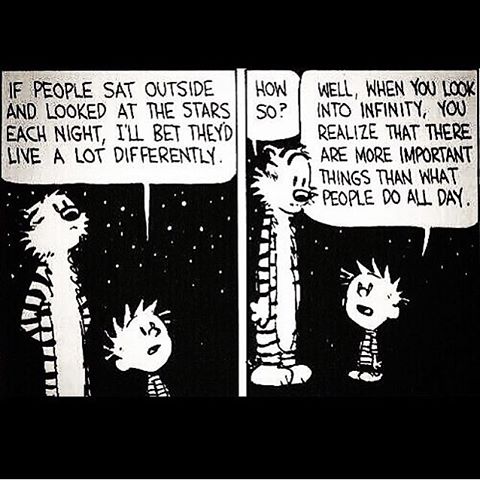
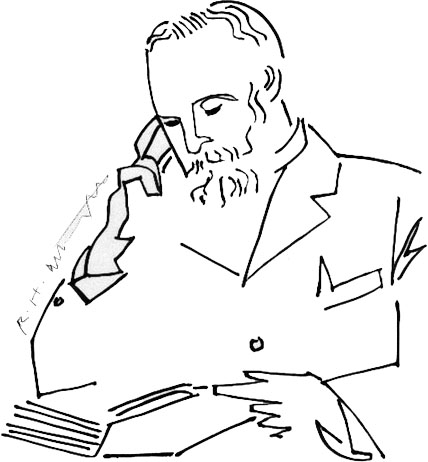
Frazz
The Harvard philosopher and psychologist William James was fascinated by the 31-year-old Indian and quoted at length from Vivekananda’s writings in his seminal work, “The Varieties of Religious Experience.”“A very nice man! A very nice man!” Vivekananda reported after his first meeting with James, who called his new friend “an honor to humanity.”The novelist Gertrude Stein, then a student of James’s at Radcliffe, reportedly attended Vivekananda’s 1896 talk at Harvard — which so wowed the college’s graybeards that they offered him the chairmanship of Eastern philosophy. He declined, noting his vows as a monk.
If you want really to do your best in an examination, fling away the book the day before, say to yourself, “I won’t waste another minute on this miserable thing, and I don’t care an iota whether I succeed or not.” Say this sincerely, and feel it; and go out and play, or go to bed and sleep, and I am sure the results next day will encourage you to use the method permanently. William James, “Gospel of Relaxation“
It is needless to say that that is not the way to do it. The way to do it, paradoxical as it may seem, is genuinely not to care whether you are doing it or not.
Hegel’s progressive unfolding [of rational consciousness, geist, Utimate Reality] thrived on conflict, what Hegel’s popularizers (but rarely Hegel himself) referred to as “thesis and antithesis.” Hegel stuck to lofty abstractions like Being (thesis), Nothing (antithesis) and Becoming (synthesis.) Henry Brokmeyer, not so much. His unimpeachably practical list of theses and antitheses encompassed nearly every aspect of American life: religion vs. science, abolitionism vs. slavery, St. Louis vs. Chicago.It just so happens that St. Louis defeated Chicago on Sunday to keep their flickering MLB postseason hopes alive. What could be the "world-historical" significance of that? Or of the fact that the lowly Astros knocked the Cards off last night, dropping the Braves' magic number to 2?
"No words, but only savage inarticulate cries can express the gorgeous loveliness of the walk I have been taking....How often my dear old Harry wd. I have given every thing to have you by my side to enjoy the magnificent landscape of this region."Wm seems to be feeling better. The plea for H'ry's company is a motif that runs through the entire correspondence. Though he claims that words can't express the loveliness of his walk, much of the letter sets out to achieve just that. The return address reads "Original Seat of Garden of Eden."
 |
| Lonely, but feeling adventurous |
Each, from his peculiar angle of observation, takes in a certain sphere of fact and trouble, which each must deal with in a unique manner... Each attitude being a syllable in human nature's total message, it takes the whole of us to spell the meaning out completely.
--William James, The Varieties of Religious Experience
Eric Weiner has a lighter take on the subject, in his Geography of Bliss. His experience in a Netherlands "hash cafe" is very funny, and this observation seems right to me:James: "It is part of the deeper mystery and tragedy of life that whiffs and gleams of something that we immediately recognize as excellent should be vouchsafed to so many of us only in the fleeting earlier phases of what in its totality is so degrading a poisoning." Varieties of Religious Experience
...at least half the fun of engaging in illicit activity is the illicit part and not the activity part. In other words, smoking hash legally in Rotterdam is not nearly as much fun as doing it illicitly in your college dorm room with Rusty Fishkind, knowing that at any moment you might get caught.Still, though, he wonders: "What if I felt like this all of the time. Wouldn't I be happy all of the time?"
Brains are surprisingly good at inventing reasons for being angry, even if the original reason has gone away and the only real remaining cause is the adrenaline in the bloodstream. It can bephysically impossible to let go of anger until your body has settled down. The rate at which your body returns to its baseline non-angry state varies from person to person. Being in this state of reinforced physical anger is what we call the William James zone, and how long it takes you to get out of that zone is your “William James threshold.” The philosopher William James predicted this effect long before the science of biology was able to confirm it, which is why we named this effect after him... The Usual Error Project

"If you want really to do your best in an examination, fling away the book the day before, say to yourself, "I won't waste another minute on this miserable thing, and I don't care an iota whether I succeed or not." Say this sincerely, and feel it; and go out and play, or go to bed and sleep."
William James, "The Gospel of Relaxation" (in Talks to Teachers on Psychology; and to Students on Some of Life's Ideals)
"Prepare yourself in the subject so well that it shall be always on tap: then in the class-room trust your spontaneity and fling away all further care."And: don't feel guilty for watching Ken Burns' "Tenth Inning" again tonight.
Today, if someone claims that science is by nature a human activity, we can refute them by imaginatively appreciating the possibility of extra-terrestrial scientists.Umm, no. We can extend and deepen their claim, not refute it, by noting that human activities bear the potential to open us up imaginatively to worlds we've barely begun to dream of.
The world may be saved, on condition that its parts shall do their best. But shipwreck in detail, or even on the whole, is among the open possibilities.Drive safely. Or fly. Or, you could walk.

And I do totally agree: many of us don't feel a need for Jesus to furnish our lives with meaning, though we admire his message-- which was not exclusively his, of course-- of hope and charity and love and forgiveness etc. But like William James and Adam Gopnik I must also acknowledge the "double feeling" of so many others for whom sweet reason seems not to be enough.3:35[Comment From Osopher]Thanks for clarifying the end of the essay. But it still bothers me that you evoke a "mystery" surrounding this man, rightly credited by Jefferson with moments of moral sublimity but also documented by Bart Ehrman and others as having been almost uniformly misunderstood. So my question: what do you see as the unsolved mystery about Jesus of Nazareth?3:36Adam Gopnik: By "unsolved mystery" I meant only that there are aspects of the Jesus myth that are just never going to be susceptible to rational judgment, and that faith, as everyone says, remains a leap -- foolish or necessary -- but a leap past reason. [...]3:38[Comment From Osopher]So the mystery might be more about us: why do so many find reason so uncongenial?3:39Adam Gopnik: Because our lives are bounded by the certainty of death, I suppose, and what reason can give us seems, to some -- to so many -- unsatisfying. I'm with Darwin on this one -- enough in life to give anyone meaning, if we make it hard enough -- but I understand the opposite feeling. Much the best account of this, I think-- this double feeling --is in William James's "Varieties Of Religious Experience" [...]3:42[Comment From Osopher]Totally agree about Darwin and James. Thanks for the chat and for the review, I've got to go and pick up the kids now.3:43Adam Gopnik: Pleasure sharing views; even in this odd and pixeled forum.
In Turin and elsewhere Nietzsche often wrote in his head while out walking, believing that 'a philosopher [is] a man who constantly experiences, sees, hears, suspects, hopes, dreams extraordinary things; who is struck by his own thoughts as if from without...Nietzsche in TurinAndre Comte-Sponville is drawn to Nietzsche's walking side too, in his Little Book of Atheist Spirituality. Walkers are affirmers and accepters, participants in "the innocence of becoming," lovers of fate and what is. Amor fati, not because the universe and reality are uniformly good but simply because "nothing else exists." Take it or leave it? "Wise men take it." This is Nietzsche's cosmic optimism.


"Hello, babies. Welcome to Earth. It's hot in the summer and cold in the winter. It's round and wet and crowded. At the outside, babies, you've got about a hundred years here. There's only one rule that I know of, babies—God damn it, you've got to be kind." God Bless You, Mr. Rosewater (and see Mr. Rogers, below)

"Love may fail, but courtesy will prevail."
Jailbird, prologue

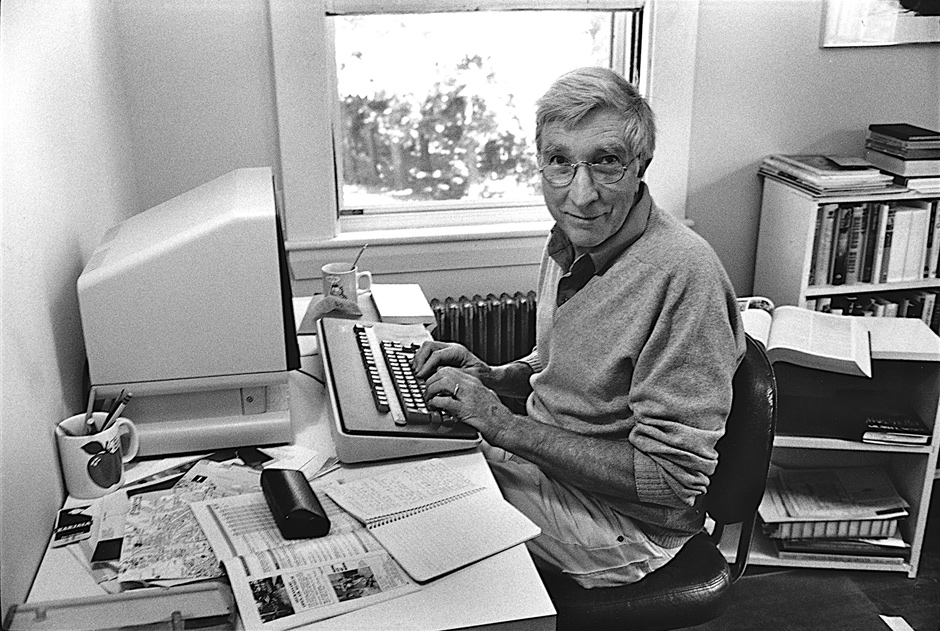
When asked in 1978 about his writing process, Updike said, “I’ve never believed that one should wait until one is inspired because I think that pleasures of not writing are so great that if you ever start indulging them, you will never write again.”
After the birth of his third child, he had rented an office above a restaurant in Ipswich, and spent several hours each morning writing there. Throughout his 50-year career, he remained devoted to that schedule, writing about three pages every morning after breakfast, sometimes more if things were going well. He said: “Back when I started, our best writers spent long periods brooding in silence. Then they’d publish a big book and go quiet again for another five years. I decided to run a different kind of shop.” WA


 | Alain de Botton (@alaindebotton) |
Why ‘Earthrise’ Matters thebookoflife.org/why- | |
 | Five Books (@five_books) |
The 'father of science fiction' HG Wells suffered terribly from class anxiety. Huxley and Woolf thought him 'vulgar' == Five books on... | |


 Charles Darwin (@cdarwin)1/11/15, 6:51 AM
"And maybe this is what I have learned more than anything from my great-great-grandfather: to keep my eyes and my mind open, to enjoy the wonders of nature and never cease to ask questions." Sarah Darwin, foreword to "A Modest Genius: The story of Darwin's life and how his ideas changed everything" by Hanne Strager



 Posts
All Comments
Posts
All Comments


 Posts
All Comments
Posts
All Comments