Showing posts with label intro quiz. Show all posts

Tuesday, April 26, 2011

a hunger for philosophy

Existentialcomix


Logicomix 5-6, PW -128
1. (Entracte) What philosophical confusion does Aeschylus suggest to Apostolos?

2. What was Russell's vision of heaven?


3. What did young Wittgenstein say to Russell (at their first meeting)about facts and certainty, and (later) about mathematical reality? What does Russell later say about the habit of analyzing everything? What part of himself did he say Wittgenstein brought to the surface?

4. In what did Russell find "redemption" from the fear of dying? How did it affect his interest in the philosophy of mathematics? What "immunized" him against nationalistic war-mongering? What did war teach Russell about language? What does it (finally) teach Wittgenstein about meaning? What does he tell Russell is the "real issue" beyond thought and language?


5. (Ch.6) What did Russell fear would be the outcome of the collapse of the pre-war world's values? Why did he dislike Wittgenstein's view that logic results only in tautologies? What unexpected joy had philosophy not prepared Russell for?


6. What did the Vienna Circle credit Russell with helping to make possible? Who pointed out to him his "failure"? What will there "always be"? How did Wittgenstein think the Vienna Circle misunderstood him? What was its "tragic final act"?

7. How does Russell characterize his stance towards doubt and certainty? What does he conclude about "Leibniz's dream"? What is the message of his "cautionary tale"? What position does he come to share with Wittgenstein?

8. What, according to Christos, is "our prime hope for peace, democracy, and freedom"?


9. Heidegger said he was a ___________ like his teacher Husserl, but most consider him an ____________ like Sartre. His invented term for persons was _______, or "there-Being."

10. Jean-Paul Sartre said ______ precedes ________, leaving us free to invent ourselves. Those who deny their freedom are guilty of ___ _____.

11. Simone de Beauvoir opened up a new wave of ________ that questioned philosophy's commitment to women's freedom. She wrote __________, one of the most influential books of the 20th century.

12. (T/F) "One must consider Sisyphus happy," according to Albert Camus.

13. According to Postmodernists, _______ no longer exists.

14. ___ ___ philosophy shows a continuing need and hunger for philosophy.

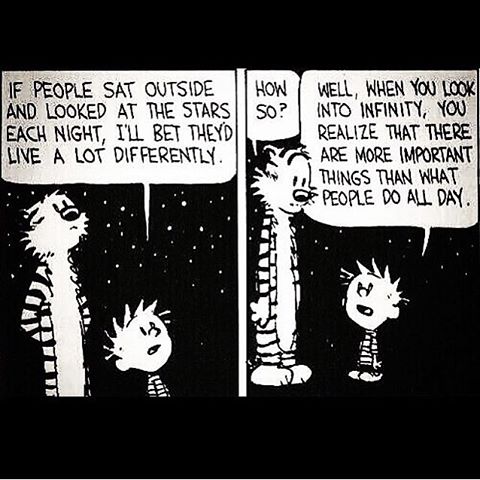
The point, Calvin (and Calvin)... the point is to live.

Wednesday, April 20, 2011

"turtles all the way down"

Logicomix 3-4


1. What is the principal habit of logicians?


2. What did Frege say was the aim of logic? What kind of language did he want to create? What did Russell think Cantor had discovered? What did Russell discover about Cantor?


3. What did the Eiffel Tower symbolize to Russell? Who did he encounter in Paris?


4. What was subverted by non-Euclidean geometries?
5. "Ignorabiumus" means what?


6. How do sets relate to numbers? What is Russell's paradox? What form of reference invites paradox?

7. What was Russell's collaborative project with A.N. Whitehead? What famous principle of simplicity did Russell endorse? What did he call "the right way to philosophize"?

8. What did Russell mean by his turtle analogy? What irony was too hard for Russell to bear?

Tuesday, April 19, 2011

logicomix


Logicomix 1-2


1. What quest is this graphic novel about? When does the story begin? Why did the authors choose this genre? Why did they choose to write about Bertrand Russell?


2. What does "manga" mean in Greek?

3. What is the topic of Russell's speech? He compares what to being "your brother's keeper"?


4. Who was Russell's grandfather? What did his grandmother love? What was young Russell's "greatest mystery"? What overcame his fear?
5. (T/F) The "forbidden books" in his grandfather's library included all nature and philosophy books?


6. What was "magic" about Russell's first day with his math tutor?
7. What showed Russell the "only way towards reality"? What was it? Where did its power come from?


8. What "terrible secret" did he learn about his parents?
9. What moment ignited Russell's life? How did the "hope of Reason" save it? Where did he study? What did he discover there? What did he see in nature?


10. What philosophers' trait did he wish mathematicians would emulate? How did he wish philosophers were more like mathematicians?


11. What does "calculemus" mean? How did Russell hope to clarify philosophical thinking?
12. Which philosopher's dream revealed Russell's vocation to him? What was it? What is a tautology?

13. How did mathematics resemble the Indian cosmos?

Thursday, April 14, 2011

Americans, Wittgenstein, Russell...

PW 108-119


1. What school of philosophy thrived in St. Louis in the 19th century? What is the sensibility of traditional ("classic") American philosophy? 


2. Which Puritan minister echoed John Calvin's view that all humans are born depraved and deserving of eternal punishment?


3. Which American revolutionaries do our authors name as "philosophically talented thinkers"? What has been the "routine" stance of the American public towards philosophy?


4. Which American "anarchist" inspired Gandhi and King? Which American follower of Kant and Hegel promoted humanism and self-reliance and considered nature inherently spiritual? 


5. How did the new American philosophy distinguish itself from the European tradition? What was its unique style? What was it called?


6. Which logician rejected "eternal" and "a priori" beliefs as practically useless, and spurned the label "pragmatist" when he was credited with being the movement's founder? 


7. Who was the "radical empiricist" and pluralist who said religious beliefs may be justified if they help us navigate our experience and make sense of our lives? What is "pluralism" in philosophy? How does it reflect the American experience?


8. Who began as an "evangelical" Hegelian, rejected reductionism and dualism in philosophy, and insisted that children learn best by doing? 


9. Which Harvard student of James's defended "black pride"? 


10. Which German philosopher most influenced "the linguistic turn"? Which English philosopher was not content merely to memorize the arithmetic tables but wanted to show that they could be derived from logic? Who was his collaborator in this endeavor? To what kind of "atoms" did he try to reduce the world's complexity? What other kind of philosophy was he known for?


11. Which German philosopher founded a new approach to the study of consciousness that attempted to describe its essential structures? What did he mean by "intentional"?


12. Which student of Russell's proposed a "picture" theory of meaning and emphasized the "unsayable"? Why did he leave philosophy? What did he say when he came back?


13. What were Freud's pro- and anti-Enlightenment ideas? Why were his ideas considered outrageous?


14. What did Max Weber say about Calvinism?

Tuesday, April 12, 2011

Peirce to Wittgenstein


O 138-152

1. America's new philosophy, represented by Peirce, James, and Dewey, was called __________. Dewey also called his view ____________, especially as applied to __________. 

2. Which major American philosopher (a colleague of William James's at Harvard, btw) did not like pragmatism? Name a recent American pragmatist. And: what recent Harvard philosopher wrote A Theory of Justice and opposed inequality? Which of his colleagues disagreed vehemently? And which other recent Harvard philosopher (who I met in one of my professors' kitchen in 1978, btw) said experience is a "web of belief"?

3. What French "vitalist" said there's a "life force" powering "creative evolution" in the universe? (William James loved this guy.)


4. What German thinker opposed Cartesian rationalism, said we don't know ourselves or our minds well at all, and emphasized the hidden power of sexuality... but is still not considered a peer, by many philosophers?

5. Gottlob Frege rejected what starting point in philosophy, and founded what new movement? What was his view of mathematics? What did he mean by "sense and reference"?

6. Who were the two English philosophers Frege inspired to try and define math in terms of logic? Who said mathematical systems cannot be entirely defined and are necessarily incomplete?

7. Which branches of analytic philosophy is Ludwig Wittgenstein mainly associated with? What did he claim he accomplished with his Tractatus? What did he consider the proper relation between language and the world? What was his last philosophical pronouncement (for awhile)?

8. Carnap and the Vienna Circle Positivists said all philosophical problems are really about the structure of language, or  _______. Who did they hate? What is the Verification Principle? What did Karl Popper turn it into?

9. When he began philosophizing again, how did Wittgenstein see language and the role of the philosopher? 

Thursday, April 7, 2011

Where to, humanity?


PW 101-108


1. What did Kierkegaard think is the purpose of existence? What philosophical movement did his view help to establish? What did he mean by "subjective truth"?

2. What did Feuerbach mean by "Man ist was Man isst"? Was he talking mainly about food?

3. What did Feuerbach and Marx do to Hegel's philosophy ("dialectic")?


4. "Man does not live for pleasure. Only the Englishman does." Which Englishmen in particular did Nietzsche probably have  in mind? What principle was at the heart of Mill's liberalism? How did Mill's empiricism impact biology and challenge Aristotle?

5. What theory, now famously associated with whom, did Alfred Russell Wallace nearly claim as his own? What momentous questions does it pose?

6. Nietzsche suggested that humans are a bridge from what to what? What did this throw into question? What did he mean by "the last man"? What ethical philosophy would "the last man" exemplify?

7. Why did Nietzsche like the ancient Greeks' view of suffering, and what did he like about Greek tragedy? What did he dislike about Christian redemption, Schopenhauer's pessimism, and scientific optimism? What was his view of technology? What did he consider the meaning of life?

8. How did Nietzsche think "eternal recurrence" might alter one's view of life? Why didn't he like Plato?


Tuesday, April 5, 2011

Kierkegaard to Spencer

O 115-137


1. Which Christian philosopher criticized the idea of trying to capture all of objective reality while allowing the real, existing individual to "slip through the holes of the dialectical net," contending instead that truth is subjective? (Hint": he was called "The Melancholy Dane" and the grandfather of existentialism. He urged a "leap of faith.")

2. Which German philosopher anticipated Marx and "brought Hegel down to earth"? 

3. What is Marx's third stage of consciousness, and fifth epoch? What characterizes the fourth epoch? Did he agree that free competition creates free individuals?

4. (T/F) Nietzsche was probably a Nazi, though he thought of philosophy as a benign vocation.

5. What did he see as the central problem of modern man? Who were his greatest early influences?

6. (T/F) Nietzsche said his critique of Christianity was a temporary mask, reflecting the flux and transiency of everything.

7. What is the fundamental distinction in Nietzsche's theory of art?

8. What did Nietzsche call Christianity? Why? What did he call Kant and Mill? What did he mean by "Ubermensch"? Which of Nietzsche's ideas did Freud like?


9. What is Utilitarianism? What are some of the leading objections to it? How did Mill differ from Bentham?

10. What was the main principle of Mill's On Liberty?

11. Who invented a "religion of humanity" but also predicted that his optimistic and socially progressive philosophy, called _________, would replace religion? What stages did he say would lead to that development?

12. Which philosopher coined the phrase "survival of the fittest" and (according to most mainstream evolutionists) badly misapplied evolutionary ideas to society in general?

Tuesday, March 29, 2011

Kant to Schopenhauer


O 98-114, PW 89-101


1. What did the Romantics emphasize? What was their view of rationalism and empiricism?


2. How did Herder describe Germany's cultural heritage?  What did Goethe's "Faust" sell his soul for?

3. What did Immanuel Kant "synthesize" (i.e., what philosophies and what kinds of statements?)? Where did he live? What did he do every day (that his neighbors noticed)? Who was his favorite French author? Who "awakened him from his dogmatic slumbers"? (And what does that mean?)

4. What are Kantian "categories"? Appearance and reality correspond to what "worlds"? Which did Kant say was knowable? How? What did he say was unknowable?

5. What did Kant find awesome? How did he answer ethical questions (such as whether it's ever acceptable to tell a lie)? 

6. Who said there's no such thing as the thing-in-itself? Who said architecture is frozen music? Who loved dogs and introduced Kant to the French?

7.Who said "the real is the rational & the rational is real," also denied the existence of unknowable things in themselves, and said everything is intricately related (like a jigsaw, or a giant organism)?

8. What historical process did Hegel claim connects spirit, nature, and mind? What are its parts? When does it end? 

9. According to Hegel, what's another term for "Time-Spirit"? What is history? What's the creative source of reality?

10. What blind, irrational force did Schopenhauer, "starting from Kant," say is the "thing-in-itself" and the source of evil? How did he think wisdom could be achieved?
--
11. Kant was originally a follower of who?

12. Kant proposed to limit what, to make room for what? What "great ideas" did he hope to place beyond the reach of science?

13. What, according to Kant, do we do to the objects of our experience, with the result that we don't have to infer or prove the existence of an external world? (TIP: This is a useful mnemonic, worth remembering.) To whom was this a direct response?

14. How did Kant reconceive Descartes' conception of self, or "thinking thing"?

15. How did Kant say we demonstrate our freedom? When are we unfree?

16. Why did Kant think faith in an unproven God a "rational postulate" (though not knowledge)?

17. Who did Hegel call "world history on horseback"? What did he consider philosophy's final goal?

18. What was Hegel's term for what he considered the all-enveloping "cosmic soul" that includes us as part of all nature and history? What did he see as its most important implication?

19. What Kantian thesis about knowledge and consciousness did Hegel reject? What Aristotelian thesis did he accept? What does this imply about the self? What "sensibility" did he embrace?

20. What was Hegel saying about philosophy when he spoke of the "Owl of Minerva"?

21. What kind of hero were the young Romantics looking for? Who did they find? What did their hero most despise in Hegel's philosophy?

22. How did Schopenhauer adapt Kant's philosophy to his own? What was his view of the point or purpose of existence? What did he share with the Buddhists? How did he think we could break free of the controlling and all-consuming Will?

Thursday, March 24, 2011

Spinoza to Smith


PW 76-88

1. When Spinoza and Leibniz "played off" Descartes's view of substance, what were they really talking about?

2. How did Spinoza earn his living? How did he die? What, besides the mind-body problem, was his philosophy an attempt to solve? What did he say is illusory?

3. What is determinism? In Spinoza's view, what is it pointless to want? What does this imply about our freedom? [Hint: see recent Schopenhauer tweet .] What attitude should we seek? What emotion attends it?

4. What did Leibniz mean by "monad" and "pre-established harmony"? What did he say about mind-body interaction, and interaction generally? Was his own life socially interactive, by comparison with Spinoza's? What was the basic principle of his philosophy?

5. What kind of world did Leibniz say we inhabit? How did his philosophy answer the problem of evil?

6. What "tension" troubled Newton? He's considered the greatest what of all time?

7. In what did Enlightenment philosophers put their greatest trust? They considered themselves citizens of what? To what did they think humanity was advancing?

8. What tradition began with John Locke? [Not LOST's John Locke] What was his view of rationalism and its confidence in reason? What was his assumption about the human mind? What did he say we know about "things-in-themselves" and the world beyond our senses?

9. How does Berkeley's idealism resemble Leibniz's monadolgy?

10. What was David Hume's view of the Enlightenment philosophers' confidence in reason? How did he apply this view to morality? How did he think we could be moral? What did he think takes reason's place in motivating human virtue?

11. What did Locke say is the basis of property rights? How did his social contract view of democracy, and individuality defy traditional authority?

12. Who were the two most prominent French Enlightenment philosophers? What was Rousseau's view of human nature?

13. What political concept did Thomas Jefferson invent?

14. Who was David Hume's best friend? How has he been misunderstood?

15. A decent free-enterprise system is possible only in the context of what kind of society, according to Smith? What does this imply for our contemporary politics ("tea party" libertarianism, etc.)?


Tuesday, March 22, 2011

Spinoza to Rousseau


O 76-97

1. From what temporal point of view did Spinoza say it is mind's nature to perceive things?

2. How did Spinoza out-geometrize Descartes? How many substances did he say there are in the universe? He was a  _________ , (solipsist, mystic, pantheist). What did he say was the difference between God and nature, and between mind and body?

3. (T/F) Because he thought everything is necessary and determined, Spinoza denied that humans can be happy or free.

4. Gottfried Wilhelm Leibniz was caricatured by whom, as Dr. ________, for saying that everything is perfect? 

5. How many substances did Leibniz say there are? What did he call them? How do they appear to us? What metaphorical property do these alleged immaterial, non-interactive soul-entities lack?

6. What principle did Giambattista Vico assert? What conventional idea about human nature did he reject?

7. Empiricism, related to Thomas Hobbes' __________ theory of language, contends that knowledge and ideas must be based on experience. What was Hobbes' opinion about words?

8. John Locke said the mind originally is a tabula rasa, or _____ ____, until experience furnishes what kinds of  ideas?  Whose metaphysical speculations in particular did he imply were "rubbish"?
9. Ideas, for Locke, are produced by objects having what two qualities?What did Locke intend to distinguish, with these qualities?

10. Why did Bishop George Berkeley object to Locke's quality distinction?

11. What does "esse ist percipi" mean? If this is true, how do we know that things continue to exist when we're not perceiving them?

12. What was Johnson's refutation of Berkeley? Is it successful?

13. David Hume said we experience only what, instead of causes?  To what do they give rise? What does his philosophy pull the proverbial rug out from under? Was he distressed by these conclusions, and unhappy about them?

14. For  Hobbes the state of nature is a state of ___, but the natural law is to seek ______.

15. John Locke inspired American constitutional democracy and the French enlightenment, marked by the spread of what ideas? He identified which inalienable rights?

16. What did Voltaire want philosophy to be? How did he try to split the difference between optimism and pessimism? What did he say about the great Lisbon earthquake?

17. Leaders of the French Enlightenment rejected the Calvinist idea of innate ________ and said the aim of life is what?

18. What did Tom Paine say governments owed the people?

19. Who said mind has no sex, and rights have nothing to do with gender?

20. Who said economic freedom would lead to the "greater welfare of all"? Who said we're born naturally good ("noble savages"), in harmony with nature, but are corrupted by society and its institutions?

Thursday, March 17, 2011

Renaissance to Descartes (2)


PW 69-75

1. Who was burnt at the stake in 1600 for supporting heliocentrism, and who was forced to recant it? When did the Catholic Church acknowledge its truth?

2. What was the "shocking" central insight of the new humanism? Who first  formulated the "scientific method"? What are its main components? How did he differ with Aristotle?

3. What kind of world did Thomas Hobbes say we live in? What did he mean by a "state of nature"? How did he think we could escape it? How did Hobbes and Machiavelli differ with Aristotle?

4. Who was the first "modern" philosopher to emphasize subjectivity as the road to objective knowledge? Which French philosopher of this period was a skeptic, dubious that humans are capable of achieving objective knowledge and truth? What did he see as the positive benefit of denying ultimate objectivity?

5. What result did Descartes hope to gain from his method of doubt? Why is "I think therefore I am" an important premise in his philosophy? How does he "know" there's no "evil genius" deceiving him?

6. Why was Descartes' emphasis on subjectivity so important? What is Cartesian dualism? Why did he want to keep mind and body separate?

Tuesday, March 15, 2011

Renaissance to Descartes


O 58-75

1. Among the notable developments of the  15th-16th century Renaissance were shifts from astrology to __________ and   from _______ to chemistry.

2. Machiavelli distinguished himself from his medieval predecessors how? What was his view of republican democracy?

3.Which New Humanist criticized professors and Popes in an earthy, vernacular style. Who (like Plato) envisioned an imaginary utopia"with no private property"?

4 Who led the Protestant Reformation, upheld the authority of the Bible, and reviled priests? He defended faith against what, and opposed what church practice? 

5. Who else defended predestination, and claimed that even newborns deserve eternal damnation?

6. Copernicus advocated ________, (geocentrism, heliocentrism, pantheism) which means what?

7. Who confirmed Copernicus' theory with his new telescope?

8.  Who practiced constant critical inquiry and said we can't even create lowly worms but still think nothing of creating gods?

9. Who said "knowledge is power"  and is believed by some to have written Shakespeare's plays?
10. ______, a determinist, said life in a state of nature would be "solitatary, poor," and what else?


11. Rene Descartes _______ (wanted, rejected) certainty in life. He sought to provide, via reason, what metaphorical basis for knowledge? His famous "Meditations" deployed what method?

12. Descartes' first rule: accept only what kind of ideas?

13. Why did Descartes supposed nothing is as it appears? He thought he could be hallucinating, dreaming, or deceived by what?

14. "Cogito ergo sum,"the "first principle" of Descartes' philosophy, means what?

15. How did Descartes think mind is related to body? This view is called __'ism. 

16.Relying on a version of Anselm's ontological argument to guarantee the reliability of clear and distinct ideas, Descartes' argument seemed too what, to some critics?

17. What was Descartes' view of (non-human) animals?


Thursday, March 3, 2011

ineffable

These aren't J&M's only words on that which can't be spoken...


PW 51-69
1. What Christian idea was "shocking," in contrast to the traditional Jewish view of God as transcendent?

2. What event alleged to relieve humans of ultimate responsibility and "put things right" with God is contrary to ordinary ideas about justice?


3. What is the cornerstone of Christian philosophy?

4. How did Philo reinterpret Bible stories? 


5. Who first interpreted Jesus as God's son, and declared the crucifixion an atonement for human sins?

6. (T/F) Plotinus said even the lowest forms of existence are spiritual?

7. Augustine thought free will was a ______. (blessing, curse, illusion) His significance for later philosophy is seen in his ________ turn, an attempt to gain self-knowledge which would also lead to knowledge of God.

8. Muhammad identified Allah as _____________ (the same as, different from) the God of Christianity and Judaism. Islam originally was _________ (open to, hostile to) Christians and Jews.

9. _____ (Like, unlike) Christians, Muslims believe individuals have immortal souls and that the problem of evil is solved by free will.

10. _____ (Like, unlike) Platonists and neo-Platonists, Muslims say they consider the material world real and good.


11. Mysticism is the deliberate transformation of consciousness in an attempt to gain access to what? Do you think ordinary or everyday thought, experience, and language are incapable of grasping reality?

12. What are the names for Jewish and Islamic mysticism?

13. "What is the sound of one hand clapping?" is an example of what?

14. Zen Buddhism says all things depend on what? What do Buddhists think this reveals about reality?

15. Admirers of Aristotle who walked around with him as he lectured were called what?

16.What Arabic philosopher said literalism was good enough for ordinary people but that the educated required persuasive, reasoned argument?

17. Moses Maimonides attempted to reconcile what?

18. Whose motto was "Faith seeking to understand"? What was the purpose of his ontological argument for the existence of God?

19. Abelard was a __________, contending that only individuals exist. He said those who deny this are tricked by what?

20. Aquinas (like Aristotle) said what should not be accepted in philosophy or theology?


21. What was resurgent in the Renaissance?


22. What was Martin Luther's main philosophical concern? What church practice did he most object to?


23. Who deserves damnation, according to Calvin? Do you agree?


24. What did Erasmus say about happiness? [ATTN: sec. 15. Would he have liked Radiohead? Radiohead & Philosophy blog... nyt]


Tuesday, March 1, 2011

medievals & scholastics

O 40-57
1. The Holy Roman Empire commenced with whose coronation? What were his dreams? What did Voltaire say about the Empire?


2. Who "saved civilization" by preserving Greek culture during the Dark Ages? Where, during this period, was the largest and most civilized city in the world? What great monotheistic tradition arose among the Bedouins in the desert in the 7th century?


3. The neo-Platonist "John the Scot" (Irish, actually) identified God with the universe, making him a what? He said humans have free will, that reason is ________ (inferior, superior) to revelation, and that Genesis should be read how?


4. Avicenna attempted to synthesize Islam with who? What did he say about Univserals and things?

5. Averroes followed Aristotle in arguing against what? What did he say about religion? Which Spanish philosopher identified the pursuit of truth with religion?


6. When did scholasticism begin? Which scholastic argued against Universals and suffered a horrible fate for love?

7. Who said God, being perfect, necessarily has to exist? Who distinguished natural from revealed theology , said concepts prove nothing about existence, and defended five arguments for the existence of God?

8. Besides false displays of wisdom, Roger Bacon identified what other causes of  ignorance? What Irish Franciscan gave us the word "dunce"?

9. Who did scholastics prefer, Plato or Aristotle? 

10. William of Occam's famous "razor" made a virtue of _______. (simplicity, complexity, necessity, pedantry)

11. The medieval worldview borrowed its triadic social structure from _____'s depiction of the individual soul: ordinary people are analogous to which body part?  


12. Where did a new humanism arise, as the middle ages ended?

Tuesday, February 22, 2011

Philo to Boethius

O 27-39


1. The Greek legacy in philosophy is summarized in what two questions?


2. Who saved Christianity by combining it with Greek philosophy?


3.  What Jewish Platonist equated Plato's "Good" (and other Ideas or Universals) with God?

4. What Christian Platonist noticed that Plato's two worlds (intelligible & 
visible)  resembled Christianity's heaven & earth? How did he interpret the Bible? 


5. Who was Plotinus? His version of God, also known as _____, "emanates" power (as the sun emanates light) down through what stages? What was his view of matter, nature, and the human body?

6. (T/F) Christianity after Plotinus tolerated all forms of free thought.

7. The end of scientific free thinking and the beginning of the Dark Ages are symbolized in the death of what pagan philosopher/scientist/mathematician? By whom is it thought her execution ordered? 

8. (T/F) The Roman Empire fell, according to Gibbon, because (unlike Christianity) it was overly superstitious and austere.

9. The Nicene Creed established whose identity as Christian orthodoxy, completing what "triumph"?  

10. ________ (Ambrose, Jerome, Augustine, Gregory) was the only "Father" who was also a  philosopher. 
What did he say about reason and truth, and about past and future?

11. What stoic, condemned to death by Emperor Theodoric, found consolation in philosophy (which he personified as a beautiful woman)?

Thursday, February 17, 2011

Aristotle and beyond


PW 40-49
1. What was Aristotle's view of virtue? How did it differ from Plato's? How many worlds did Aristotle affirm?How did he characterize Plato's Forms?


2. Why have scientists viewed Aristotle ambivalently? What did he mean by "teleology," "prime mover", and "eudaimonia"?


3. Seneca's suicide, at Nero's insistence, illustrates the importance of what Stoic value?

4. Epicurus had an undeserved reputation as what? What did he really believe in? What does "epicurean" mean now?

5. The Stoics regarded emotions as what kind of  judgment? What view did they share with the Buddhists? What was their philosophical ideal?

6. Pyrrho and Sextus Empiricus were skeptics who argued that belief of any kind, ________ (including, excluding) belief in reason, is illusory and unjustifiable.Why did they "believe" this?

7.Who were the tlamatinime? Why don't we know more about them? Why don't we know more about the indigenous philosophies of North America and Africa? 


8. How does "tribalism" differ from the dominant perspective of the contemporary western world? What is a person, in the tribal perspective? How (on that view) do we relate to nature?


9. Why did Mayans and other Meso-Americans practice human sacrifice? 


10. What was the function of the "jokester" in Meso-American philosophy?

KurzweilAI.net Accelerating Intelligence News