Friday, August 7, 2009

Free-thinking 1st ladies

Isn't it great to have a pair of free-thinkers in the White House again? Thinkers period?

As I grew older I questioned a great many of the things that I knew very well my grandmother who had brought me up had taken for granted. And I think I might have been a quite difficult person to live with if it hadn’t been for the fact that my husband once said it didn’t do you any harm to learn those things, so why not let your children learn them? When they grow up they’ll think things out for themselves.
And that gave me a feeling that perhaps that’s what we all must do—think out for ourselves what we could believe and how we could live by it. And so I came to the conclusion that you had to use this life to develop the very best that you could develop.

I don’t know whether I believe in a future life....

A future life elsewhere, post mortem, and as herself, I think Mrs. Roosevelt meant. (I like what Andrew Carnegie said about this too, btw: it's not our place to worry about a future life, but to "pitch this one as high as we can.")

But she did believe in our collective future. That's a form of faith, too. I prefer to call it hope.

Thursday, August 6, 2009

so it goes

The anniversary of the Hiroshima bombing is a good day to remember Kurt Vonnegut, whose first-hand experience of the fire-bombing of Dresden shaped his worldview and his fiction. Kindness is still in short supply.

“Hello, babies. Welcome to Earth. It’s hot in the summer and cold in the winter. It’s round and wet and crowded. At the outside, babies, you’ve got about a hundred years here. There’s only one rule that I know of, babies — ‘God damn it, you’ve got to be kind.’

Wednesday, August 5, 2009

Carnegie

I've been enjoying David Nasaw's biography of Andrew Carnegie, who turns out to be a much more sympathetic figure than I'd imagined. He was no Calvinist ascetic, crediting neither divine providence nor personal brilliance for his astounding success. Wealth comes from the community, he thought; the wealthy are its trustees, obliged to give back and do good. And and so he established the precedent lately followed by Gates and Buffett of returning a substantial portion of his personal wealth to the nation whence it sprang. Carnegie libraries all across the country remain the most visible symbol of his largesse.

But he was also a social Darwinist and devotee of Herbert Spencer, and was consequently (and inconsistently) much too smugly confident of the "superior wisdom, experience, and ability" of those "self-made men" who scratch and claw their way to wealth. Credit some of them with superior tenacity but don't understate their superior good fortune.

So he was not humbled by his success, but felt validated by it as a selectee of impersonal social-evolutionary forces. He thought it better that some live in opulent splendor, surrounded by the trappings of civilized culture, than that none should, for this (he claimed) would somehow advance the evolution of humanity. And (though he espoused the virtue of material modesty) he thought himself entitled to partake lavishly of the "good life" that money can buy.

"All is well because all grows better," his slogan, is beyond optimism. Taken literally it becomes a Leibnizian rationalization for everything, including one's own fabulous good fortune. Yet he was no idle defender of the imperialist status quo in foreign policy, turning himself in retirement aggressively towards peacemaking. He opposed Teddy Roosevelt's adventures in Panama and the Phillipines, for instance.

My overall impression of Carnegie, though, as portrayed by Nasaw, is of a humane and generous (albeit egotistical) man, capable of ruthlessness in business but also of great personal loyalty and a real feeling for human beings, whom it would have been a pleasure to know. I wouldn't want to have worked for him. But, tellingly, Mark Twain was a friend (Carnegie sent Scotch, on request). Booker T. Washington was another. A former aid described him as one of the consistently-happiest men he ever knew.
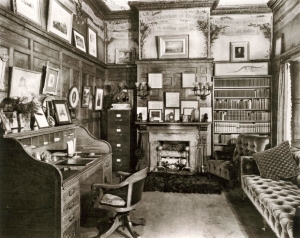
carnegie_studyThe study of Carnegie's mansion on 91st Street across from Central Park, where he spent the last years of his life giving away much of his fortune, is modest and warm. A visitor had some interesting observations.

Carnegie used to spill out of his study and manse (now the Cooper-Hewitt National Design Museum) and stroll around the Central Park reservoir a time or two on afternoons, perfectly open and accessible. That's another winning detail, to me. The reservoir loop was my last walk in Manhattan, summer-before-last. He'd have been a fun walking companion.

"This, then, is held to be the duty of the man of Wealth: First, to set an example of modest, unostentatious living, shunning display or extravagance; to provide moderately for the legitimate wants of those dependent upon him; and after doing so to consider all surplus revenues which come to him simply as trust funds, which he is called upon to administer, and strictly bound as a matter of duty to administer in the manner which, in his judgment, is best calculated to produce the most beneficial result for the community-the man of wealth thus becoming the sole agent and trustee for his poorer brethren, bringing to their service his superior wisdom, experience, and ability to administer-doing for them better than they would or could do for themselves." Gospel of Wealth

Patronizing, self-aggrandizing, irritating, hypocritcal: sure. People who own castles in Scotland can hardly proclaim their modest lack of ostentation. But if somebody has to be filthy-rich, it's too bad more of them can't be more like him. As patrons go, you could do worse.

Tuesday, August 4, 2009

Too happy?


Is Positive Psychology a victim of its own wide appeal? A new Chronicle essay by Jennifer Ruark ("An Intellectual Movement for the Masses: 10 years after its founding, positive psychology struggles with its own success") worries that the "movement" atrracts too many Fruit Loopy types.

It's not unreasonable to wonder where happy shades into goofy. But, weirdly, some apparently want to exclude practitioners from my academic turf, ground not commonly fought over except by those who would pull it out from under our feet:

"Critics said Seligman's proposal was too radical: He was overstepping the bounds of social science and trying to be a philosopher, telling people how to live their lives."

I hope people don't generally perceive philosophy's function as "telling people how to live," though of course we're all about having that conversation and soliciting (then critiquing, sure) a wide spectrum of views on the subject.

In any event, we really don't feel professionally threatened by Positive Psychology. Happy to have 'em on board, the more the merrier. But I note the stirrings of a backlash against Positive Psych, as seems implicit in this piece in the Times:

Can we only be happy in retrospect? Tim Kreider thinks so.

"I suspect there is something inherently misguided and self-defeating and hopeless about any deliberate campaign to achieve happiness. Perhaps the reason we so often experience happiness only in hindsight, and that chasing it is such a fool’s errand, is that happiness isn’t a goal in itself but is only an aftereffect. It’s the consequence of having lived in the way that we’re supposed to — by which I don’t mean ethically correctly so much as just consciously, fully engaged in the business of living. In this respect it resembles averted vision, a phenomena (sic.) familiar to backyard astronomers whereby, in order to pick out a very faint star, you have to let your gaze drift casually to the space just next to it; if you look directly at it, it vanishes. And it’s also true, come to think of it, that the only stars we ever see are not the “real” stars, those cataclysms taking place in the present, but always only the light of the untouchable past."

And then there's the Happy Meter: Obama makes us happy, blog analysts in Vermont say. Will this very post tip the meter even higher? But let's not get carried away trying to twitter our way to happiness. "We don't want people to be happy all the time; that would be Brave New World... We clearly need a balance of good and bad days to keep us healthy and balanced."

You can have some of my bad ones, Dr. Dodds, if you really think it'll do you some good. I think they're highly over-rated myself. (Here, have some of this tasty Miralax-laced-Gatorade.)

Monday, August 3, 2009

our comestible beginnings

Cooking (not language or tools or bipedalism etc.) made us human, Michael Pollan speculates. Not cooking makes us stooges of the gastro-industrial complex, and bad citizens of the biotic community.

Fascinating, but in my case pretty darn deflating. I'd rather we climbed the evolutionary ladder with aptitudes I actually posssess.

But I can confirm, anecdotally, the basic observation anchoring his concern in this essay: our kids like to watch, too. I found them tuned in to Emeril recently, drooling but not making a move towards the kitchen.

And asking for popcorn.

Speaking of corn: Michael Pollan did a terrific TED Talk too.

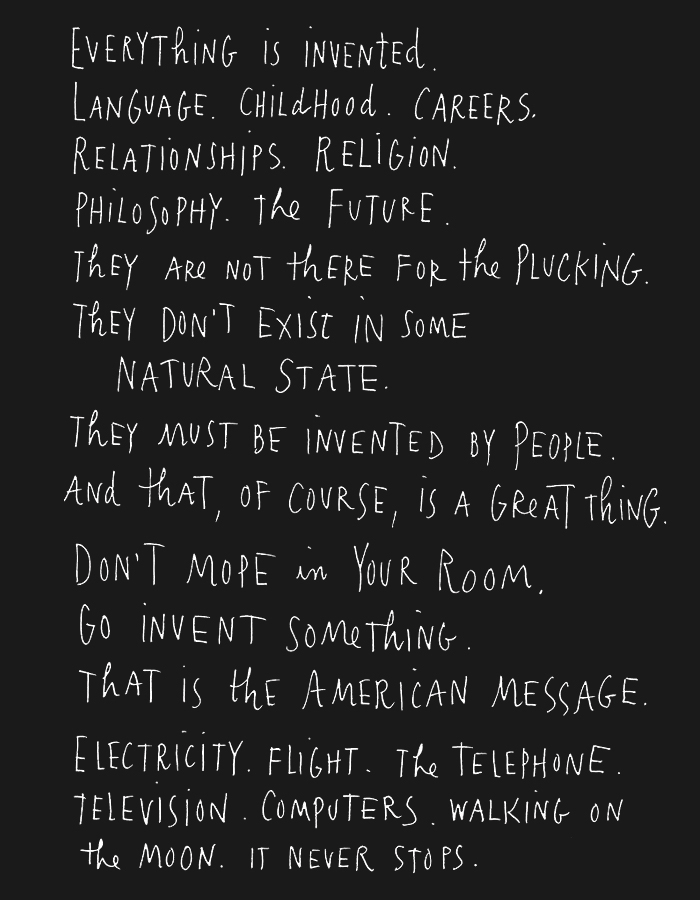
invent something

invented

Maira Kalman, "And the pursuit of happiness"


Sunday, August 2, 2009

"Can do"


Another terrific slideshow from Maira Kalman, this one on Ben Franklin (following Tom Jefferson).

Besides his flair for fun, he was a diligent ameliator. He began each day with "the morning question: what good shall I do this day?" And he checked his progress in the evening: "What good have I done today?"

Early to bed, early to rise, btw, meant 10 to 5.

Not a bad role model.

And not a bad TED Talk from Ms. Kalman:

Hoosier epiphany

Another way to respond to obnoxious altar calls. If it happened in Ft. Wayne, it could happen anywhere. Maybe even here...

Finding comfort with non-belief

Free-thinkers set goal of changing local attitudes

Free thought [is] “a philosophical viewpoint that holds that beliefs should be formed on the basis of science and logical principles and not be compromised by authority, tradition or dogma.” Free thought does encompass atheism and agnosticism, he says, but the group consists of people with many belief systems and anyone is welcome... The group also maintains a Web site at www.freethoughtfortwayne.org and a presence on Facebook and Twitter... The most recent addition: “Dial-an-Atheist,” once-a-month call-in editions of the show in which Chad Butterbaugh of Fort Wayne and others in the group field questions from viewers live.

“An atheist in the broadest sense is simply one who lacks belief in any god or gods – that’s ‘a’ as in ‘not’ or ‘without’ and ‘theism’ as in ‘belief in God or gods,’ ” says Butterbaugh, 29, introducing the June 15 edition, “What is an Atheist?”

“It’s a descriptive term, and that’s all. It’s not an insult, it’s not a club, and it’s not an indicator of some other big, broad philosophy,” Butterbaugh continues, with the bespectacled, earnest demeanor of a 19th-century law clerk.

“And under that definition, I would say that I am an atheist. Jake, comfortable saying that?”

“Oh yeah. I’m an atheist, definitely,” replies co-host Jake Doelling of Fort Wayne with a cheery smile.

“We want people to know we’re normal people. We have our own joys and fears and disappointments and sorrows like everybody else...”

Saturday, August 1, 2009

"Altar call"

We''ve really heard more than enough about the "worries" of angry gun-toting, tea-tossing Christian conservatives, spouting venom about the "Obama-Pelosi-Reed axis of evil," issuing "marching orders to slay the socialist monster" and "altar calls" imploring ill-informed Christian jihadists to smite the Democratic infidels. ("Altar call confronts worries of Christian conservatives," Nashville Tennessean August 1)

We've heard barely a peep, however, from politicians and the press in condemnation of such histrionic hate-mongering.

"Some of the audience wore [para-military] uniforms, and brought their guns."

Terrific. Our legislators said they could, after all.

The Tennessean has done part of its job, reporting the story. When will it do the rest of its job, and take an unequivocal editorial position against hateful and incendiary religious displays? When will its "religion reporting" stop providing an unchallenged platform for hate speech?

If your conscience needs a guide, Tennessean, look to the report Bill Moyers aired last week ("Rage on the airwaves," July 24) and then ask yourself what John Seigenthaler would do.

epicurean success


Has anyone had a better idea about happiness in 2,000 years? What's more important than "pleasure"?

KurzweilAI.net Accelerating Intelligence News