Monday, March 21, 2011
animals' place
1. Native peoples have traditionally perceived animals as co-creators of life, in many ways ______ to humans. (inferior, equal, superior)
2. Participation in the world of animals elicits what part of ourselves? What parts of ourselves do we project upon them?
3. What is bio-phobia? How do native cultures resist it? What is their "natural orientation"? What role do Shamans play in this?
4. How does "meaning pass from generation to generation" in an oral culture? What is "coming into being"?
5. What's the significance of "Coyote stealing fire from the shamans" and the Great Turtle myth of the Iroquois?
6. What is "indigenous" about Aldo Leopold's "Land Ethic"?
7. What do native peoples mean by "multiverse"?
8. What is the indigenous perspective on "human rights"?
9. What's the Navajo concept of ho'zho?
10. What ancient native pathway courses through middle Tennessee? What icon of contemporary mass culture is rooted in indigenous locomotion? Springs and waterfalls symbolize what?
11. Western science has tried to remove what from our understanding of the world? Is Mother Earth getting back at us for it?
Monday, March 14, 2011
pineal gland
Incorporeal volitions cannot move the corporeal pineal gland because this would violate the law of the conservation of energy. Descartes did not have this problem because he did not know this law...
As philosophy reduced the pineal gland to just another part of the brain and science studied it as one endocrine gland among many, the pineal gland continued to have an exalted status in the realm of pseudo-science. Towards the end of the nineteenth century, Madame Blavatsky, the founder of theosophy, identified the “third eye” discovered by the comparative anatomists of her time with the “eye of Shiva” of “the Hindu mystics” and concluded that the pineal body of modern man is an atrophied vestige of this “organ of spiritual vision.” This theory is still immensely popular today.My own view, to paraphrase Ray Stevens: every gland is beautiful, in its own way... but none of them is likely to reconcile metaphysically-distinct res extensa and res cogitans. It's part of the brain, whose works & wonders we've only just begun to grasp.
Oh, and about the symbolism of those pine cones: remember, futurists, the bristlecone pines from Clock of the Long Now?
Rings in some dead bristlecone trunks on the mountain [Mt. Washington in Nevada] go back 10,000 years... 'Find a bristlecone you like and hang out with it. Forget the present. Think about the past and the future.'Think, in other words, deeper than seven generations. Think really long-term, and don't despair.
==
* The way Clark phrased his question reminded me of this...
and this:
Monday, February 14, 2011
nature-culture
Nature does tend toward dissolution and entropy, yes, yes, but I can't help thinking she contains some countervailing tendency, too, some bent toward forms of ever-increasing complexity. Toward us and our creations, I mean. Second NatureIn A Place of My Own he builds a little house in which to think and dream. Like most of our human enterprises it "stands a little apart" from its natural surroundings.
==
Red Alert! ch7-conclusion
1. How much did the American bison population decline between the 17th & 19th centuries?
2. What does it mean concretely to "allow places to give us homes" and to live in a "coextensive present with the past and future"?
3. Have you lived in an "unimaginative house"? Has your conceptual/spiritual life been "boxed" by the experience? Does this attitude place too much confidence in architecture? Do we place too little?
4. Is there any way to live "green" in suburbia? Are "buffalo commons" and "earth lodges" realistic?
5. Are you personally fatalistic about "500 year floods"? Would you ever deliberately make your home in a flood plain? Do you expect the Army Corps of Engineers to consult indigenous peoples in the future?
6. Is childhood obesity a public policy issue? Or is it just a matter of "personal virtue"?
7. Are you making different food choices since becoming aware of the nutritional problems associated with fast food? Do you consciously choose local products? Do you see your food choices as ethical? Are you willing to pay more for more responsibly grown & distributed food?
8. What is T3C? Is it helpful or relevant? Is it possible to make a reliable present judgment about the ultimate impact of technologies? How does the will to bequeath "good stories" help us make wise choices?
9. Is it not possible to see the world as full of relatives and resources?
Tuesday, November 10, 2009
"Dining with the Devil"
Saturday, October 10, 2009
my place
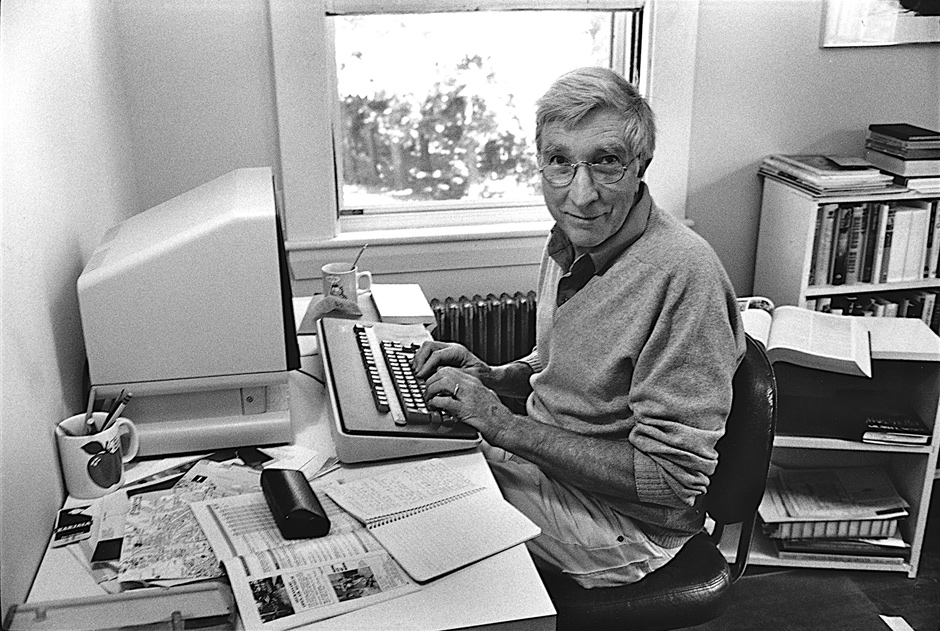
Man-cave, manspace... sounds silly, but by whatever name-- mine is Little House-- it's sacred. Michael Pollan was way ahead of the curve on this, as on so much else, in A Place of My Own.
Much that I treasure, including an Earth stove, a couple of comfy old recliners, a large old restored roll-top desk that's followed me everywhere forever, and books and files and photos and personal affects of all kinds, and wireless Internet access-- is here. If such spaces really reflect (as Sam Martin says) "who we are," then I probably ought to take better care of it.
Mustn't be too quick to discount the value of tension-free homeostasis, in a home away from home.
Friday, September 11, 2009
Socrates

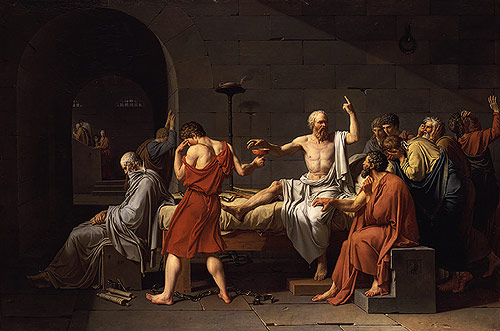
We're really beginning to look like an Art History seminar, aren't we? From the Thinker to the Wanderer, now to the courageously and cheerfully dying Questioner.
Alain de Botton found Socrates at the Met not long before me. Jacques-Louis David's 1786 "Death of Socrates" is an impressive, imposing piece, well worth postponing a Nesquick for. In Consolations of Philosophy he attests to another philosopher steeped in self-confidence against the onslaught of hysterical opposition, a rational confidence "grounded in philosophy," extending to us all "an invitation to intelligent skepticism."
Socrates was unpopular with the unreflective crowd, still a majority of his peers (and judges). But that didn't faze him, and it shouldn't faze us (though of course it often does). "Errors in our thought and way of life can [never] be proven simply by the fact that we have run into opposition. What should worry us is not the number of people who oppose us, but how good their reasons are for doing so." (That's an observation that should buoy the President's resolve on reforming health care, btw... but I hope he reads Michael Pollan on the subject too.)
This unwashed gadfly was prepared to hear (and evaluate) everyone's arguments. But he did not think that everyone's opinions were equally respectable. A bad argument is a bad argument, from whatever source. "One should respect the good ones..."
His accusers prosecuted him with atrocious arguments, yet he acceeded to the will of the majority and drank his hemlock. Bad choice, if you ask me. "We should not look to Socrates for advice on escaping a death sentence; we should look to him as an extreme example of how to maintain confidence in an intelligent position which has met with illogical opposition."
Monday, August 3, 2009
our comestible beginnings

Cooking (not language or tools or bipedalism etc.) made us human, Michael Pollan speculates. Not cooking makes us stooges of the gastro-industrial complex, and bad citizens of the biotic community.
Fascinating, but in my case pretty darn deflating. I'd rather we climbed the evolutionary ladder with aptitudes I actually posssess.
But I can confirm, anecdotally, the basic observation anchoring his concern in this essay: our kids like to watch, too. I found them tuned in to Emeril recently, drooling but not making a move towards the kitchen.
And asking for popcorn.
Speaking of corn: Michael Pollan did a terrific TED Talk too.
Tuesday, May 22, 2007
Little Houses (postscript)

Thoreau's only regret, Michael Pollan noted in A Place of My Own, was not putting a taller roof on it: "you want room for your thoughts to get into sailing trim... Our sentences want room to unfold."
And that's all the hook I need for this pic:

This was pre-new roof, of course. But for just a few minutes at least, my thoughts did have plenty of room to unfold, to follow the "centrifugal impulse... reaching out into the surrounding landscape." The trick is to do that with the roof on.
Sunday, May 20, 2007
"A Place of My Own"

The realtor passed along what turned out to be a tall tale about its antiquarian inception as slave quarters, but the truth is more prosaic: the daughter of its builder showed up unannounced one morning and corrected the record. It's older than Pollan's but by mere years, not epochally. No matter, though. It's still (to paraphrase CS&N) a very very very fine little house.
One problem, at this point: it's out of wireless Internet range. Will that be a hidden blessing? I'll keep you posted.
Saturday, March 24, 2007
"Gaia"
Lovelock may be right, but I don't like his tone. I much prefer the perspective of Michael Pollan, whose Botany of Desire is our next read. Pollan, too, affirms that we are a part of nature; but his version of the relation between humans and non-human nature also acknowledges its "co-evolutionary" character. Our interests and desires have not just injured Gaia, in important ways they have defined her. We don't have to think of ourselves as forever harboring a toxic threat to the arc of our planet’s evolutionary destiny; we are one of its adaptations, and the only one capable of articulating a planetary point of view that recognizes planetary health as inseparable from human self-interest.
Al Gore made clever use of the Gaia metaphor in his testimony before Congress this week, noting that when your child is sick you don't ignore her condition because a scif-fi author [Michael Crichton, of course] said it wasn't a problem; you treat it.
I like Gore's tone more than Lovelock's, too. As Senator Gore wrote, way back when:
"For civilization as a whole, the faith that is so essential to restore the balance now missing in our relationship to the earth is the faith that we do have a future. We can believe in that future and work to achieve it and preserve it, or we can whirl blindly on, behaving as if one day there will be no children to inherit our legacy. The choice is ours; the earth is in the balance."