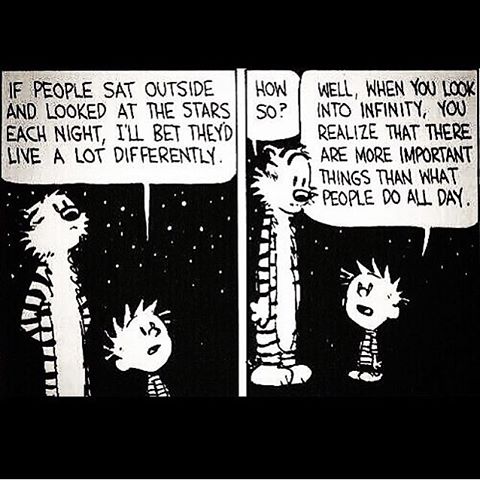
Long ago, our people believed in beings with great powers. These beings made the rains come, told the sun when to rise, and caused all life to be born, to grow, to die. -But those are just tales -- old superstitions.
Showing posts with label Star Trek. Show all posts
Showing posts with label Star Trek. Show all posts
Wednesday, November 28, 2012
Progress
"...send them back into the dark ages of superstition, and ignorance, and fear? No!" STNG, "Who Watches the Watchers"


Thursday, September 15, 2011
The Vulcan way
Lots of interesting group discussions in Intro yesterday, pertaining to Aristotle and Stoics and Skeptics and African and indigenous American philosophies.
Some wondered how Aristotle could speak so earnestly of living a life of virtue and at the same time, without irony, defend the Athenian institution of slavery. Same question arises much closer to home with Mr. Jefferson. ("All men are created equal," right? And women.) Can we let either of them off the moral hook, on the grounds that they were simply products of their time and place? Can we excuse ourselves, when a later age calls us to account for who knows what?
Then there are the extreme skeptics Pyrrho, Sextus Empiricus and their followers. (Can a skeptic really be a "follower," btw? Nowadays you can join the Skeptics Society. Should you?) How can the refusal to believe anything at all be therapeutic? Well, JMH says theirs was the philosophy of "no"... so maybe Sally Brown could explain it to us? She's not the most serene Stoic, but she does seem to enjoy not committing to any particular philosophical conclusion.
Interesting discussions surrounding indigenous American and African philosophy, too. Are we all related ("mitakuye oyasin"), and all a part of nature? Are we humans entitled to assert "dominion" over the rest of creation? Is personhood an "achievement"? How can a living soul split and reincarnate?
Most saliently, people in both classes were scratching their heads trying to understand why the old Greek & Roman Stoics insisted that "emotions are irrational judgments that make us frustrated and unhappy," and why both they and the Buddha counselled: "Minimize your desires and you will minimize your suffering."
I understand their consternation. The Vulcan way seems awfully cold. Can you really "live long and prosper" if you "form only limited attachments"? As Jonathan Haidt has written,
Some wondered how Aristotle could speak so earnestly of living a life of virtue and at the same time, without irony, defend the Athenian institution of slavery. Same question arises much closer to home with Mr. Jefferson. ("All men are created equal," right? And women.) Can we let either of them off the moral hook, on the grounds that they were simply products of their time and place? Can we excuse ourselves, when a later age calls us to account for who knows what?
Then there are the extreme skeptics Pyrrho, Sextus Empiricus and their followers. (Can a skeptic really be a "follower," btw? Nowadays you can join the Skeptics Society. Should you?) How can the refusal to believe anything at all be therapeutic? Well, JMH says theirs was the philosophy of "no"... so maybe Sally Brown could explain it to us? She's not the most serene Stoic, but she does seem to enjoy not committing to any particular philosophical conclusion.
Interesting discussions surrounding indigenous American and African philosophy, too. Are we all related ("mitakuye oyasin"), and all a part of nature? Are we humans entitled to assert "dominion" over the rest of creation? Is personhood an "achievement"? How can a living soul split and reincarnate?
Most saliently, people in both classes were scratching their heads trying to understand why the old Greek & Roman Stoics insisted that "emotions are irrational judgments that make us frustrated and unhappy," and why both they and the Buddha counselled: "Minimize your desires and you will minimize your suffering."
I understand their consternation. The Vulcan way seems awfully cold. Can you really "live long and prosper" if you "form only limited attachments"? As Jonathan Haidt has written,
When life is unpredictable and dangerous (as it was for Stoic philosophers, living under capricious Roman emperors), it might be foolish to seek happiness by controlling one’s external world. But now it is not… to cut off all attachments, "to shun the pleasures of sensuality and triumph in an effort to escape the pains of loss and defeat” is an overreaction.
Not many of us are likely ever to have to deal with a crazed homicidal Emperor, as Seneca did. But what if you found yourself at "Windows on the World" in the North Tower of the World Trade Center on the glorious morning of 9/11/01? Might Stoicism help you decide how to dispose of your last free moment on Earth?
Or what if you got a bad medical prognosis? This is something to premeditate, as did the Stoics.
In any case, detachment from conditions beyond one's control is only half the story for Stoical Vulcans. Their philosophy of IDIC urges "infinite diversity from infinite combinations."
Isn't that illogical, Captain? Maybe. But it's the way of our world at its best, so far as I can tell.
Friday, June 25, 2010
irresistible
Addiction has a bad name, and usually deserves it. Sometimes it can be channeled in positive ways. Probably not, though, in Robert Palmer's "Simply Irresistible" story, or Joel Fleischman's. (Did you know he was multi-lingual?) I mention them here self-indulgently, and in an attempt to discharge the memetic loop of that song in my brain triggered by thoughts on this topic. The song is just fun, and the video just went up on YouTube in time to echo my obsession.
Another example of irresistible, bio-chemical compulsion: the Star Trek crew's addiction to a game, secretly and sinisterly a weapon. Is this what gets people lining up for iPhones et al? Hope not.
Another example of irresistible, bio-chemical compulsion: the Star Trek crew's addiction to a game, secretly and sinisterly a weapon. Is this what gets people lining up for iPhones et al? Hope not.
Sunday, July 19, 2009
No Greater Challenge
Captain Picard would've been a good NASA philosopher.
This is the scene in which young Ensign Wesley Crusher tells Picard that "William James won't be on my Starfleet exams." Picard answers, "Nothing really important will be. Open yourself to the past—history, art, philosophy—and all of this might mean something."
Out of nostalgia (I guess) I've been following Wil ("Wesley") Wheaton's tweets. But I'm going to have to let him go. He actually thought it worthwhile, the other day, to inform the universe that he hates (literally) biting his tongue.
He won't miss me, he'll still have 968, 790 followers to regale with such riveting bits of ephemera from a mid-scale ex-celeb's stream of consciousness.
What would Jean-Luc say?
Sunday, May 10, 2009
Half-full

“A lot of science-fiction is nihilistic and dark and dreadful about the future, and ‘Star Trek’ is the opposite,” Mr. Nimoy said. “We need that kind of hope, we need that kind of confidence in the future. I think that’s what ‘Star Trek’ offers. I have to believe that — I’m the glass-half-full kind of guy.”
Thursday, May 7, 2009
Live Long and Prosper, Mr. President!
 Barack could be a Vulcan name...
Like Spock, part of what makes Obama so appealing is the fact that although he’s an outsider -- "proudly alien," as Leonard Nimoy once put it -- he uses that distance to cultivate a sense of perspective. And while we're drawn to Spock's exotic traits -- the pointy ears, green blood and weird mating rituals -- we take comfort in his soothing baritone, prominent nose and ordinary teeth...
"Bill Clinton promised a Cabinet that looked like America," Henry Jenkins said in a recent conversation. "Obama gave us one that looks like the Enterprise crew. In a matter-of-fact way, he's embraced diversity at every level. No Klingons yet -- but the administration is new."
Beam me up... Rahmy?
Subscribe to:
Posts (Atom)





 Charles Darwin (

 Posts
Posts