Showing posts with label pale blue dot. Show all posts

Friday, September 16, 2011

Who moved my wallpaper?

Kat did, replacing the desktop image in our classroom with a clever scene involving pious fish who can't imagine anyone but a God stooping to care for their fishbowl.

She's right, mine was a bit blurry. After all, it was taken from a distance of 3.7 billion miles.

It's really Carl Sagan's adjoining text, though, more than the image of a miniscule fraction of a dot, that's meant to convey clarity. So let me restore my sense of perspective, mine and Matthew Beckler's, here and now.
From this distant vantage point, the Earth might not seem of any particular interest. But for us, it's different. Look again at that dot. That's here, that's home, that's us. On it everyone you love, everyone you know, everyone you ever heard of, every human being who ever was, lived out their lives. The aggregate of our joy and suffering, thousands of confident religions, ideologies, and economic doctrines, every hunter and forager, every hero and coward, every creator and destroyer of civilization, every king and peasant, every young couple in love, every mother and father, hopeful child, inventor and explorer, every teacher of morals, every corrupt politician, every "superstar," every "supreme leader," every saint and sinner in the history of our species lived there – on a mote of dust suspended in a sunbeam... Pale Blue Dot

Wednesday, November 17, 2010

thin film of life

I love the coincident cosmopolitan serendipity of today's two FoL reports, converging as they did on Carl Sagan and Pale Blue Dot on our first day with Bill McKibben's Eaarth. Marie commented on Jeremy Rifkin's "empathic civilisation" and quoted the passage beginning: "There are places... where the natural world has all but disappeared." Our "thin film of life" is all we've got. Why do we fight over it so incessantly?


Then Jason played the Symphony of Science's "unbroken thread"... 


...heralding a more "glorious dawn."


Is there intelligent life on earth? Well, there was. Maybe there will be again, in the future.  


Or, maybe we should just say: there can be a future only if there is... only if we're still evolving.


P.S. I hunted for the Flaming Lips Bonnaroo video you said I'd like, Harrison, is this it? Guess you had to be there. But the Alan Watts "conversations" are unquestionably great.

Tuesday, January 26, 2010

"reflections on a mote of dust"


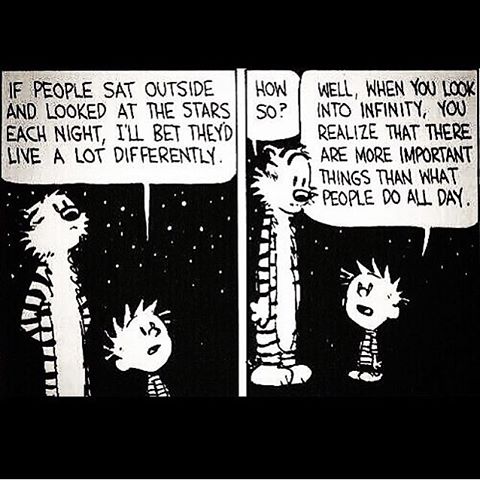
Some people say pictures like this (or this) make them feel small and insignificant. But shouldn't they make us feel large with  responsibility and opportunity? We're alive, we've won the cosmic lottery! "To live at all is miracle enough." How shall we spend the golden time that is our most precious gift? 


Carl Sagan: We succeeded in taking that picture [from deep space], and, if you look at it, you see a dot. That's here. That's home. That's us. On it, everyone you ever heard of, every human being who ever lived, lived out their lives. The aggregate of all our joys and sufferings, thousands of confident religions, ideologies and economic doctrines, every hunter and forager, every hero and coward, every creator and destroyer of civilizations, every king and peasant, every young couple in love, every hopeful child, every mother and father, every inventor and explorer, every teacher of morals, every corrupt politician, every superstar, every supreme leader, every saint and sinner in the history of our species, lived there on a mote of dust, suspended in a sunbeam.


The earth is a very small stage in a vast cosmic arena. Think of the rivers of blood spilled by all those generals and emperors so that in glory and in triumph they could become the momentary masters of a fraction of a dot. Think of the endless cruelties visited by the inhabitants of one corner of the dot on scarcely distinguishable inhabitants of some other corner of the dot. How frequent their misunderstandings, how eager they are to kill one another, how fervent their hatreds. Our posturings, our imagined self-importance, the delusion that we have some privileged position in the universe, are challenged by this point of pale light.


Our planet is a lonely speck in the great enveloping cosmic dark. In our obscurity -- in all this vastness -- there is no hint that help will come from elsewhere to save us from ourselves. It is up to us. It's been said that astronomy is a humbling, and I might add, a character-building experience. To my mind, there is perhaps no better demonstration of the folly of human conceits than this distant image of our tiny world. To me, it underscores our responsibility to deal more kindly and compassionately with one another and to preserve and cherish that pale blue dot, the only home we've ever known.* 


And:

We humans have set foot on another world in a place called the Sea of Tranquility, an astonishing achievement for creatures such as we, whose earliest footsteps three and one-half million years old are preserved in the volcanic ash of east Africa.** We have walked farCarl Sagan


* Excerpted from a commencement address delivered May 11, 1996. Image from Voyager 1, 1990.
**And this, from Kenya.

Wednesday, July 15, 2009

at home in the universe

Can naturalists and humanists be "spiritual," not religious? I've already enlisted Dan Dennett and Richard Dawkins as yea-sayers, and Carl Sagan. Varieties of Scientific Experience, based on his 1985 Gifford Lectures ("The Search for Who We Are"), deliberately mirrors William James's famous Gifford-based Varieties.

Sagan admired James. Both were passionate about the human quest to be at home in the universe, on our pale blue dot, "the only home we've ever known."

He was a very good advocate for NASA, for science and rationality, and for the evolutionary worldview. We do speak for Earth, we have walked far.

"Two billion years ago our ancestors were microbes; a half-billion years ago, fish; a hundred million years ago, something like mice; ten million years ago, arboreal apes; and a million years ago, proto-humans puzzling out the taming of fire. Our evolutionary lineage is marked by mastery of change. In our time, the pace is quickening."

A quickening evolutionary pace is not flatly incompatible with NASA's 40-year detour of distraction, but isn't it really time to refocus on our next "final frontier"?

KurzweilAI.net Accelerating Intelligence News