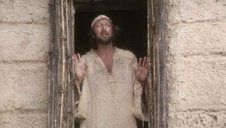
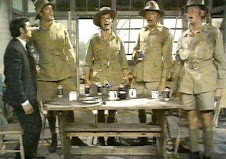
Bushra showed us the philosophers' football (soccer) match from Monty Python on Monday.
They're going for a re-match soon...
Thursday, April 29, 2010


Wednesday, April 28, 2010
So long
When you're tired of final report presentations you're tired of life. I don't want them to end. Yesterday's were outstanding, again.
Miso's latest interview reinforced our darkest fears about Islamic intransigence and opacity, but I'm clinging to the hope implicit in Greg Mortenson's humane vision: educate the women, and eventually the young men-- their sons-- will stop incinerating themselves and our world. Meanwhile, let's see what we can do about those pick-ups with their confederate flags and their blustery Know-Nothing patriotism.
Elizabeth and Miranda tried to share The Secret with us. I admit, I'm not the most open and receptive audience for that. I've tried, especially at home; but I'm too pragmatic to think that a wishing-cap world is more than a pipe-dream. I do agree that positive thinking is good, when it motivates positive action.
Kyle and Matt gave us their version of the atheism-spirituality synthesis. There was nothing in it to dispute, so far as I'm concerned. Once again my boy Dewey got a shout-out. Spirituality is all about human connectedness across time and space, "the continuous human community" etc. That's what I've been talkin' about!
And then Dean graced us with a poem, the last stanza of which provides a perfect coda:
But "There is no conclusion. What has concluded, that we might conclude in regard to it? There are no fortunes to be told, and there is no advice to be given.--Farewell!"
Sapere aude!
Miso's latest interview reinforced our darkest fears about Islamic intransigence and opacity, but I'm clinging to the hope implicit in Greg Mortenson's humane vision: educate the women, and eventually the young men-- their sons-- will stop incinerating themselves and our world. Meanwhile, let's see what we can do about those pick-ups with their confederate flags and their blustery Know-Nothing patriotism.
Elizabeth and Miranda tried to share The Secret with us. I admit, I'm not the most open and receptive audience for that. I've tried, especially at home; but I'm too pragmatic to think that a wishing-cap world is more than a pipe-dream. I do agree that positive thinking is good, when it motivates positive action.
Kyle and Matt gave us their version of the atheism-spirituality synthesis. There was nothing in it to dispute, so far as I'm concerned. Once again my boy Dewey got a shout-out. Spirituality is all about human connectedness across time and space, "the continuous human community" etc. That's what I've been talkin' about!
And then Dean graced us with a poem, the last stanza of which provides a perfect coda:
So rest my friend this final day,
Your body's all that's gone.
Your Spirit lives in memories,
For now, Old Friend, "So long."I'm so glad we had this time together...
But "There is no conclusion. What has concluded, that we might conclude in regard to it? There are no fortunes to be told, and there is no advice to be given.--Farewell!"
Sapere aude!
Tuesday, April 27, 2010
stairway from heaven
Or is that a stairway to heaven-on-earth, to eternity here-and-now? Julian Baggini, Atheism: A Brief Insight
Monday, April 26, 2010
philosophy funnies
I may regret this. But it may be tons of fun, too.
I try not to do the same course twice, or repeat myself in class more than necessary. We did Simon Critchley's Book of Dead Philosophers and Robert Richardson's William James for the first time this year, for instance.
So yesterday I signed off on a decision for Intro in the Fall: we'll read comic books. Sent the bookstore my order. They call them graphic novels now, but comics is exactly what they are. Is this pandering? I prefer to call it pedagogical experimentalism, and philosophy for beginners.
We'll do Logicomix too. Who'll have the last laugh?
Sunday, April 25, 2010
fuu-ture shock
The dawn blog is still slumbering, though it continues to register my tweets and "day-blog" posts (including this one) in its right margin, A glance at WordPress's so-called "support forums" shows I'm not alone, others have also mysteriously misplaced their "publish" option. I'll leave the geeks to their business, then. Fueled by sugar and starch and carbonation I'm sure they'll have us up and running over there again before you can say "gadget and widget."
So, here we are again this morning: sitting out back under the re-purposed port awning, birds in full voice all around, Old Sol peeking past the neighbors' gable, new possibilities pleading for recognition. After the rain and gloom of yesterday, this clear and magnificent dawn is especially reassuring.
Yesterday was stormy, so I didn't get to accept my student's invitation to attend the Laotian New Year festivities as his escorted guest. Rain check, please!
I did get to drive the Daughter Taxi, though, from Laser Quest to Love Circle to home to Love Circle... I really need to get that meter installed, I'm losing a lot of income running a free service. My wife insists this goes with the parental job description. I don't recall being quite so dependently mobile as a pre-driving teen, but then there's a lot I don't recall.
Didn't even get to enjoy many snatches of the Yanks-Angels game, after an inning or so the local weather team monopolized the airwaves with frightful satellite-tracking images and warnings that my responsible spouse took to heart. I'm a fatalist about weather, though about little else. Just don't ask me to duck and cover in the hallway, I'd rather be whisked to Oz.
I did find a few moments to spend with Bill McKibben's Eaarth: Making a Life on a Tough New Planet, which was officially released on Earth Day and just arrived in the mail. That's not a typo, the stuttering vowel signals that this isn't our grandparents' planet and it's not their "future" (or our grandchildrens') either. It's ours. What will we do with it today?
He's such a good writer, bearing such a sober message: the future is now.
So how did it happen that the threat to our fairly far-off descendants, which required that we heed an alarm and adopt precautionary principles and begin to take measured action lest we have a crisis for future generations, et cetera-- how did that suddenly turn into the Arctic melting away, the tropics expanding, the ocean turning acid? How did time dilate, and "100 or 200 years from now" become yesterday?Good question. The good news is, he thinks we do have a future. A fuu-ture. I'm eager to talk about it in "Future of Life" in the Fall, and on the radio soon too. Stay tuned for programming details.
Saturday, April 24, 2010
I am risen
My "experimental" dawn blog Up@dawn is a year old today... and for the first time in a year, it's balking at my attempt to publish. So here's what I was going to say there this morning:
That first cautious post of 4.24.09, "rise and shine," announced a simple plan to keep regular hours and harvest some early thoughts before they've withered under the critical glare of mid-day. The point was motivation, not so much to haul out of bed early-- I do that by inclination and habit anyway, most days-- but to capture some of those fleeting auroral moments before they evaporate forever; and then notch 'em (like old Thoreau said) on my stick.
My grad school mentor John Lachs taught me to write stuff down before doing anything else, and it's still the most effective writing strategy I know. Rise, write, wake, walk, work, re-write (and, oh yeah, don't forget in the meantime to enjoy life): the perambulating rhythm of it suits me, and I like the hours.
The urgencies of academic dailiness took the blog over, when school started in August. The topical agenda each week-day then largely reflected whatever we were to read and discuss in class. But we finished our last required text yesterday in Intro, so I can again pretty much let what Henry would have called the "genius" of every new dawn dictate these posts 'til class cranks up again.
That's a bit scary, but inviting too: I can't wait to see what's on my everyday liminal rising mind at daybreak. Often, not much; but once in a while something will dawn fresh. Least I can do is show up. As Nietzsche reminds, "There is many a dawn which has not yet shed its light." (Rig Veda)
Thursday, April 22, 2010
Happy 40th Earth Day!
Today is Earth Day. And it's also the 40th anniversary of the first Earth Day — held on this day in 1970 and widely considered to the birth of the modern environmental movement.
Earth Day's founder was a senator from Wisconsin, Gaylord Nelson. His goal was to force environmental issues onto the national agenda. Before 1970, stories about the environment were almost never reported. One Earth Day organizer said that back then, "Environment was a word that appeared more often in spelling bees than on the evening news."
In 1969, an oil pipe ruptured just off the coast of Santa Barbara, California, causing 200,000 gallons of crude oil to burst forth and then slowly leak out and spread over an 800-square-mile slick. It took 11 days to plug the hole. The oil poisoned seals and dolphins, whose corpses washed up onto California beaches, and it killed thousands of seabirds as well. Senator Nelson visited the site of the enormous ecological disaster and was outraged that nobody in Washington seemed to be concerned about the great devastation to the natural environment. And then he realized that many people simply didn't really know.
So he proposed a national "teach-in," an event to take place on universities campuses around the nation, one that would educate the public, raise awareness on environmental issues, and make politicians pay attention to these things, so that they would make laws to protect the environment in order to, as he said, "stem the tide of environmental disaster."
He saw how successful the anti-war protestors were at getting media coverage — and therefore, making politicians take notice — and he decided to base his campaign for environmental awareness on their model. He also hoped to infuse the same student anti-war energy into the environmental cause. He proposed setting aside one day a year as a national day of observance about environmental problems. The New York Times picked up the story in late September 1969, a great boon to the grassroots organizers of the campaign, who had no Internet to spread the word.
At first, Senator Nelson called it National Environment Teach-In Day, but his friend, a New York advertising executive suggested "Earth Day," especially catchy since it rhymes with "birthday," and that's what the press began to call it. Historian Adam Rome has called Earth Day the "most famous unknown event in modern American history."
About 20 million Americans participated in the first Earth Day on April 22, 1970. They gathered at assemblies in high school gyms, at university plazas, in suburban city parks. At the University of Wisconsin-Madison, where Gaylord Nelson had graduated from law school, people met up at 4:45 a.m. for an "Earth Service," where, according to one report, they "greeted the sunrise with a Sanskrit invocation and read together from Aldo Leopold, Rachel Carson, Thoreau, and the Bible." Girl Scouts distributed pamphlets that Wisconsin grad students had written, which gave household tips for helping to preserve the environment. Tens of thousands met up in Philadelphia's Fairmont Park — and stayed there for days — and 100,000 streamed into Fifth Avenue in New York City. People celebrated spring weather and gave impassioned political speeches about environmental issues.
Though unstructured and somewhat incohesive, Earth Day was hugely successful. Environmental issues found a prominent place on the political agenda. Earth Day in April 1970 helped lead to the creation of the Environmental Protection Agency by the end of that year (the EPA was created December 2, 1970), as well as to the passage of legislation like the Clean Air, Clean Water, and Endangered Species acts. Writer's Almanac


"Age of Wonder"
Happy Earth Day!
One of the things I really like about my daily 50-minute commute to school (and it's at least that long back again!) is, most days, the opportunity to hear a terrific Bob Edwards interview on XM satellite radio. Day before last, for instance, Richard Holmes spoke of The Age of Wonder. Sounds like Dawkins was right in Unweaving the Rainbow, to insist there's no need to fear science as a source of disenchantment with the world's natural poetry.
Holmes concludes: "We need a wider, more generous, more imaginative perspective. Above all, perhaps, we need the three things that a scientific culture can sustain: the sense of individual wonder, the power of hope, and the vivid but questing belief in a future for the globe."
One of the surprise stars of this story is Charles Darwin's grandpa Erasmus, who was already defending a sophisticated multiverse cosmology in the 18th century. And he was not a bad poet.
Wednesday, April 21, 2010
final reports begin
We had a great start today with final report presentations. Alex M. offered a thoughtful comparison of Tolkien's Ring with Plato's (Gyges'). Alex S. presented a very thorough and, to some, chilling peek at the brave new world of transhumanism and "living long enough to live forever." Both prompted calm, civil, instructive discussion. So did Kimberley's "Office" report.
But Chris's "Boondock Saints" report and his discussion question-- Do we need people like this [vigilantes who storm a courtroom to murder a defendant, convinced that they're doing God's work] in the world today?"-- provoked a degree of heat that I hope will cool to a reflective glow. I admit I got a bit heated myself.
Do we need armed vigilantes? Like a hole in the head. But we've got 'em in spades. Hobbes would've called them agents of the bellum omnium, representatives of the state of nature and destroyers of the social contract. Some of us think the best name for them is simply "terrorist."
Commenting on Alex's transhumanist report, I mentioned Ray Kurzweil's teenage game show debut in 1965. Was he already thinking about living forever?
Tuesday, April 20, 2010
Spring '11 student survey
What course(s) would you like to see offered at MTSU next Spring, or eventually? Click "reply" and rank your preferences, if any. Please indicate your current student status. (MTSU Students: pass this along to any of your peers you think might be interested in commenting.)
__ Native Wisdom and Environmental Responsibility. Environmental ethics course with an indigenous (esp. Native American) emphasis. What can we learn from traditional cultures about our relation to the land, the planet, and other forms of life? And what are the limits of "tribal" ethics?
__ Experimental Philosophy. The new "X-Phi" movement is really not new, American philosophy has always emphasized experimentalism. Empiricism has always sought "data." But maybe its time has come again?
__ Facts & Values. Is it really true, as David Hume said, that you can't get an "ought" from an "is"? Was Sam Harris right in his recent TED Talk and his forthcoming book to oppose that view? What are the implications of a thoroughly naturalized ethics?
__ Experience. How much deference do we owe to other persons' experience when it differs from, or even contradicts, our own? What kind(s) of pluralism should we defend and practice? We'll look at James's Varieties of Religious Experience, Sagan's Varieties of Scientific Experience, and Emerson's famous essay "Experience," among other sources.
__ [Your suggestion(s) here].
Subscribe to:
Posts (Atom)




 Charles Darwin (

 Posts