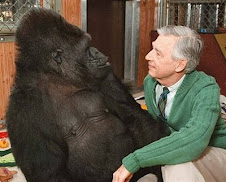
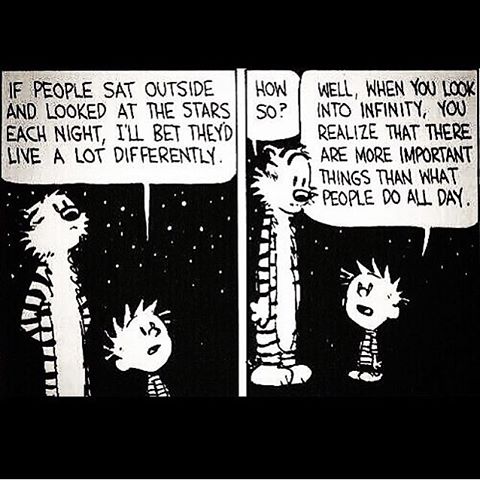
...out of an ethic of simple decency to one another, the unrelenting application of reason, and acceptance of what we truly are, our dreams will finally come home to stay.
Showing posts with label E.O. Wilson. Show all posts
Showing posts with label E.O. Wilson. Show all posts
Friday, April 27, 2012
Simple decency & unrelenting reason
The perennial existential questions persist, says E.O. Wilson in The Social Conquest of Earth: Where do we come from? What are we? Where are we going?


Monday, March 28, 2011
enjoying the end
I enjoyed our discussion of Gaian apocalypse (human apocalypse, I mean, at the behest of Gaia) in NW this afternoon. That's a strange thing to say but it's definitely in the spirit of James Lovelock's counsel that we enjoy life while we can. I've been humming this ever since:
Also enjoyed Matthew's presentation and his call for common ground. The Creation is a good example of the sort of dialogue we desperately need, if we're going to forestall the end. Cosmopolitanism too. (Did you hear Anthony Appiah on "On Being" yesterday?)
Also enjoyed Matthew's presentation and his call for common ground. The Creation is a good example of the sort of dialogue we desperately need, if we're going to forestall the end. Cosmopolitanism too. (Did you hear Anthony Appiah on "On Being" yesterday?)
Saturday, April 17, 2010
future of life
Native Americans understand implicitly the importance of biodiversity, of grasping our inter-dependency with the rest of nature and life. So does E.O. Wilson, who already wrote the book (The Future of Life) whose title I'm cadging for my eponymous Fall course.
Tuesday, May 1, 2007
The Mormons
"It’s great to hear people who believe in something and can articulate it without sounding crazy or defensive," fawned the Times reviewer of the new PBS documentary on Mormonism. Sorry, but if it's not crazy to affirm young Joseph Smith's hallucinations (he was just 21) as revealed truth then what is?
After last night's first installment (the conclusion airs tonight) I came away shaking my head in renewed astonishment, that so many sober and serious-sounding people could believe something so preposterous. If people will believe that, what won't they believe? It does not bode well for the democratic prospect. I remembered Mark Twain's sarcasm in Roughing It:
"Some people have to have a world of evidence before they can come anywhere in the neighborhood of believing anything, but for me when a man tells me that he has seen the engravings which are upon the plates and not only that, but an angel was there at the time and saw them see him and probably took his receipt for it, I am very far on the road to conviction no matter whether I have ever heard of that man before or not, and even if I do not know the name of the angel or his nationality either."
(The angel's name was Moroni, by the way.)
Then I remembered Julia Sweeney's "Letting Go of God," which begins by recounting a visit from a pair of eager young Mormon missionaries whose tale was so absurd that she started rethinking her own "mainstream" (Roman Catholic) credulities -- and realized that Virgin Births, trans-substantiation, redemptive crucifixion et al aren't so different, the stories have just been around longer.
My instinct in religion is to be tolerant even when I can't be open to the alleged revelation, but I'm coming around to the Dawkins-Harris hardline that we need to stop giving a free pass to incredible superstition and calling it, respectfully, religion when what it is is nonsense. (On this topic, watch for a future post on E.O. Wilson's recent overtures to Southern Baptists.)
For a refreshing perspective on the "latter-day Saints" take a look at www.postMormon.org. Unless you've already drunk the Kool-Aid yourself, you'll feel better about your species.
Addendum. Just watched part II, which on the whole took a more critically-independent stance and (for instance) acknowledged that Mormon "niceness" can mask a kind of spiritual violence. The spectacle of very young children being indoctrinated into the faith, singing about wanting to become missionaries and so forth, emphatically makes Dawkins' point that this is a form of child abuse. They are not "Mormon children" -- they are children of Mormon parents whose birthright to think for themselves has been unconscionably violated.
But, for the record: I too have found Mormons (and other religionists) to be good neighbors.
After last night's first installment (the conclusion airs tonight) I came away shaking my head in renewed astonishment, that so many sober and serious-sounding people could believe something so preposterous. If people will believe that, what won't they believe? It does not bode well for the democratic prospect. I remembered Mark Twain's sarcasm in Roughing It:
"Some people have to have a world of evidence before they can come anywhere in the neighborhood of believing anything, but for me when a man tells me that he has seen the engravings which are upon the plates and not only that, but an angel was there at the time and saw them see him and probably took his receipt for it, I am very far on the road to conviction no matter whether I have ever heard of that man before or not, and even if I do not know the name of the angel or his nationality either."
(The angel's name was Moroni, by the way.)
Then I remembered Julia Sweeney's "Letting Go of God," which begins by recounting a visit from a pair of eager young Mormon missionaries whose tale was so absurd that she started rethinking her own "mainstream" (Roman Catholic) credulities -- and realized that Virgin Births, trans-substantiation, redemptive crucifixion et al aren't so different, the stories have just been around longer.
My instinct in religion is to be tolerant even when I can't be open to the alleged revelation, but I'm coming around to the Dawkins-Harris hardline that we need to stop giving a free pass to incredible superstition and calling it, respectfully, religion when what it is is nonsense. (On this topic, watch for a future post on E.O. Wilson's recent overtures to Southern Baptists.)
For a refreshing perspective on the "latter-day Saints" take a look at www.postMormon.org. Unless you've already drunk the Kool-Aid yourself, you'll feel better about your species.
Addendum. Just watched part II, which on the whole took a more critically-independent stance and (for instance) acknowledged that Mormon "niceness" can mask a kind of spiritual violence. The spectacle of very young children being indoctrinated into the faith, singing about wanting to become missionaries and so forth, emphatically makes Dawkins' point that this is a form of child abuse. They are not "Mormon children" -- they are children of Mormon parents whose birthright to think for themselves has been unconscionably violated.
But, for the record: I too have found Mormons (and other religionists) to be good neighbors.
Saturday, March 31, 2007
“New Atheism”
Harvard’s “humanist chaplain” Greg Epstein disapproves of the atheist “fundamentalism” of Richard Dawkins and Sam Harris, according to the Associated Press:
Epstein and other humanists feel their movement is on the verge of explosive growth, but they are concerned that it will be dragged down by what they see as the militancy of New Atheism. "Humanism is not about erasing religion,” he said. It’s an embracing philosophy."
http://www.tennessean.com/apps/pbcs.dll/article?AID=2007703310370
Yes, but humanists should not uncritically embrace any belief anyone cares to entertain under the guise of religion, or automatically extend benign respect and deference. Steven Pinker is right: “It’s only the sense that religion deserves special respect – the exact taboo that Dawkins and Harris are arguing against – that makes people feel that those guys are being meanies when applying ordinary standards of evaluation to religion.”
On the other hand, Epstein is right to worry about tarnishing humanism as mean-spirited. (Remember Madalyn Murray O’Hare?) The times we live in will be far better served by friendly atheists like E.O. Wilson, reaching out to religionists for common ground in hopes of preserving the earth (The Creation: An Appeal to Save Life on Earth -- Norton '06; scroll to the bottom of this page to see YouTube video of Pinker, Dawkins, Harris, and Wilson)
But on the other other hand, I’m with Dawkins when he bemoans the abuse of children in the name of religious education. Children have a right to their native agnosticism, free of indoctrination. Philosophy can help with this, I am convinced. We need to be philosophizing with all our children from the beginning, arming them with the critical tools to think freely and creatively about their world and its future. More on this in future posts.
Epstein and other humanists feel their movement is on the verge of explosive growth, but they are concerned that it will be dragged down by what they see as the militancy of New Atheism. "Humanism is not about erasing religion,” he said. It’s an embracing philosophy."
http://www.tennessean.com/apps/pbcs.dll/article?AID=2007703310370
Yes, but humanists should not uncritically embrace any belief anyone cares to entertain under the guise of religion, or automatically extend benign respect and deference. Steven Pinker is right: “It’s only the sense that religion deserves special respect – the exact taboo that Dawkins and Harris are arguing against – that makes people feel that those guys are being meanies when applying ordinary standards of evaluation to religion.”
On the other hand, Epstein is right to worry about tarnishing humanism as mean-spirited. (Remember Madalyn Murray O’Hare?) The times we live in will be far better served by friendly atheists like E.O. Wilson, reaching out to religionists for common ground in hopes of preserving the earth (The Creation: An Appeal to Save Life on Earth -- Norton '06; scroll to the bottom of this page to see YouTube video of Pinker, Dawkins, Harris, and Wilson)
But on the other other hand, I’m with Dawkins when he bemoans the abuse of children in the name of religious education. Children have a right to their native agnosticism, free of indoctrination. Philosophy can help with this, I am convinced. We need to be philosophizing with all our children from the beginning, arming them with the critical tools to think freely and creatively about their world and its future. More on this in future posts.
Subscribe to:
Comments (Atom)





 Charles Darwin (


 Posts
Posts