Showing posts with label Jaron Lanier. Show all posts

Wednesday, July 13, 2011

Listen first, write later

There's a nice profile of Jaron Lanier in the current New Yorker by Jennifer Kahn. It's locked to non-subscribers, but still on the newsstands. In it he's very wise, in the way (as we learned last year in the "Future of Life" course*) of You Are Not a Gadget, on the importance of actually existing and creating as a human being in your own right and not being content merely to reflect passing currents  in the enveloping cyber-sea around you. Re-tweeters, attend:
If you listen first, and write later, then whatever you write will have had time to filter through your brain, and you'll be in what you say. This is what makes you exist. If you are only a reflector of information, are you really there?
(*NOTE TO SELF, on a possible future course. "Philosophy and the Internet: Staying Human in the Information Age")

In the Chronicle of Higher Education awhile back Lanier commented on techno-Utopia and New Atheism, shaking his head at
a new sort of "nerd" religion based around a core belief that a global brain is not only emerging but will replace humanity. It is often claimed, in the vicinity of institutions like Silicon Valley's Singularity University, that the giant global computer will upload the contents of human brains to grant them everlasting life in the computing cloud.
And,
There is right now a lot of talk about whether to believe in God or not, but I suspect that religious arguments are gradually incorporating coded debates about whether to even believe in people anymore.
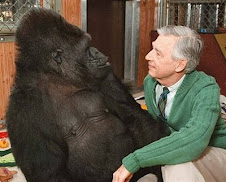
That's always the most important question. He still believes. Of course he does. Look again at that little girl.

Tuesday, November 16, 2010

"Bus, do your stuff"

Jaron Lanier seems to imagine the future of pedagogy as a ride on the Magic School Bus. [wiki] “In the future, I fully expect children to turn into molecules and triangles in order to learn about them…” Cool, take me into the ballgame. This was always my favorite episode, of course:


Monday, November 15, 2010

gadget quiz 5

1. (T/F) Lanier thinks of nature as a (very special) person.

2. (T/F) Lanier concedes that the new digital humanism he defends cannot rival The Singularity's "hope of an afterlife" achieved through technology.

3. What is neoteny, and what is it good for? What do children want, and where do they get it (besides parents and peers)?

4. What are Lanier's predictions for the future of software and of medical progress?

5. What's the most obvious aspect of digital culture? What's good and bad about childhood?

6. (T/F) Lanier enjoys verbal accounts of non-verbal experience.

7. What's Lanier's prediction for the future of education? What childhood-less species taunts us with clues about potential human futures?

8. Why is Lanier so excited about the possibility of "postsymbolic communication"? What are its implications for Platonic realism and metaphysics in general, and for our future?

Friday, November 5, 2010

"circle of empathy"

The phrase is commonly associated with ethicist Peter Singer, but Jaron Lanier uses it too.


You have to draw a Circle of Empathy around yourself and others in order to be moral. If you include too much in the circle, you become incompetent, while if you include too little you become cruel. This is the "Normal form" of the eternal liberal/conservative dichotomy.
Lanier's Third Law: You can't rely completely on the level of rationality humans are able to achieve to decide what to put inside the circle...
Best guess for Circle of Empathy: Danger of increasing human stupidity is probably greater than potential reality of machine sentience. Therefore choose not to place machines in Circle of Empathy. edge.org
Empathy is essential, but it's essential to extend it in the right directions.

Monday, November 1, 2010

virtual reality

On our first day with Jaron Lanier in FoL, I recall that I've been chewing this bone for quite some time now. What is "real"? Does your mind make it so? Does it matter which pill, blue or red, you swallow?


Thursday, October 21, 2010

global brain

Chris gave us a charming and original story (of his own composition) in FoL yesterday, about an emergent, distributed, conscious entity calling itself "Singy". I talked about it in one of my Intro classes today, in the context of a suggestion that maybe the web represents our next best hope for a new Renaissance. Intriguing.
Experts compare the Internet to a planet growing a global brain. As users, we represent the neurons. Texting, emails, and IM act as nerve endings, and electromagnetic waves through the sky become neural pathways. Like germinating seeds, this global brain continues to evolve and as some forward-thinkers believe, will not stop until it develops feelings and achieves consciousness. FutureBlogger
I think Jaron Lanier will have something to say about this, and about how we ought to be less eager to turn ourselves into neuron-gadgets. We'll see. Meanwhile, if we all get an unsolicited email of unknown provenance... we'll have to see about that too. Is the singularity near?

Friday, September 3, 2010

not so special


The Chronicle of Higher Education asked scholars and artists what they think will be the "defining idea of the next decade." Jaron Lanier (You Are Not a Gadget) responded:
Consider the common practice of students blogging, networking, or tweeting while listening to a speaker. At a recent lecture, I said: "The most important reason to stop multitasking so much isn't to make me feel respected, but to make you exist. If you listen first, and write later, then whatever you write will have had time to filter through your brain, and you'll be in what you say. This is what makes you exist. If you are only a reflector of information, are you really there?" Jaron Lanier: The End of Human Specialness
Consider, indeed.

Saturday, March 13, 2010

global mush

"Creativity requires periodic, temporary "encapsulation" as opposed to the kind of constant global openness suggested by the slogan "information wants to be free." Biological cells have walls, academics employ temporary secrecy before they publish, and real authors with real voices might want to polish a text before releasing it. In all these cases, encapsulation is what allows for the possibility of testing and feedback that enables a quest for excellence. To be constantly diffused in a global mush is to embrace mundanity." Jaron Lanier, author of You Are Not a Gadget

--One of the authors I look forward to reading in our Future of Life course next Fall.

KurzweilAI.net Accelerating Intelligence News