The concept of the project I find useful. Something you do in the present, and can remember doing in the past, and expect to do in the future, in order to create something. A work of art which need not be in the arts per se, but something human worth doing.
“That's existentialism, yes?” “Yes, I think that's right. I don't see how you can avoid it.” Kim Stanley Robinson, 2312
Showing posts with label Existentialism. Show all posts
Showing posts with label Existentialism. Show all posts
Thursday, August 2, 2012
Something human worth doing
You can avoid it, of course. Gotta choose. Give Sartre his due.


Tuesday, November 29, 2011
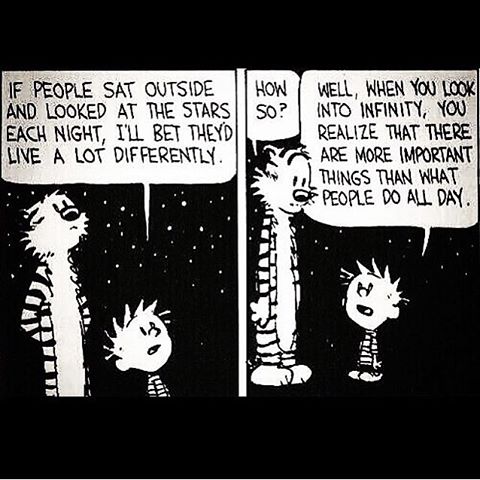
Calvin gets existential
I suggested Woody Allen as a more accessible version of Camus, in class yesterday; but maybe Calvin's even better. Thanks for posting this, Derrick.


Tuesday, July 14, 2009
"Waking Life"
"I am a philosopher. (As Kurt Vonnegut writes in Timequake, 'I have to be.') I am not a spiritual thinker, much less a spiritualist or a religious advocate of any kind. But it seems to me, at least as a philosopher, that if spirituality means anything it means thoughtfulness... Spirituality, like philosophy, involves those questions that have no ultimate answers... [it] puts at arms' length all of the clever philosophy that scoffs at the big questions or reduces them to mere puzzles and paradoxes." Robert C. Solomon, Spirituality for the Skeptic
Tuesday, April 24, 2007
Gratitude
David Halberstam died yesterday in an automobile accident in California. He was a first-rate journalist and author, best known for The Best and the Brightest. My favorite Halberstam work is The Children, an account of the courageous college students who organized protests in Nashville and elsewhere in the heyday of the Civil Rights movement. I also like his baseball books, especially his account of the 1964 season that culminated in a Cards-Yanks World Series. I'm grateful for Halberstam's life and contribution,.
Halberstam's death seems an appropriate occasion to express my gratitude for another personal hero who left us too soon, Robert Solomon.
I'm on record as being generally unimpressed by the the academic/philosophical/Continental expression of Existentialism, much preferring literary versions like Walker Percy's and Richard Ford's. But I make an exception for Solomon, the University of Texas philosopher who collapsed and died in a Swiss airport in January.
Gratitude was one of Solomon's recurrent themes:
Gratitude, I want to suggest, is not only the best answer to the tragedies of life. It is the best approach to life itself. This is not to say, as I keep insisting, an excuse for quietism or resignation. It is no reason to see ourselves simply as passive recipients and not as active participants full of responsibilities. On the contrary, as Kant and Nietzsche among many others insisted, being born with talents and having opportunities imposes a heavy duty on us, to exercise those talents and make good use of those opportunities. It is also odd and unfortunate that we take the blessings of life for granted -- or insist that we deserve them -- but then take special offense at the bad things in life, as if we could not possibly deserve those. The proper recognition of tragedy and the tragic sense of life is not shaking one's fist at the gods or the universe "in scorn and defiance" but rather, as Kierkegaard writes in a religious context, "going down one one's knees" and giving thanks. Whether or not there is a God or there are gods to be thanked, however, seems not the issue to me. It is the importance and the significance of being thankful, to whomever or whatever, for life itself.
-Robert C. Solomon, "Spirituality for the Skeptic" (New York: Oxford University Press, 2002)
Carlin Romano wrote last week in The Chronicle of Higher Education:
Above all, Solomon exuded appetite, endless appetite, for philosophy that matters, problems, in the Jamesian sense, that make a difference for real people.
Halberstam and Solomon, thankfully, left us a legacy of words and ideas by which we can continue to be instructed and inspired, and for which I am profoundly grateful.
Tuesday, March 27, 2007
Richard Ford
My old friend at ESU in Alabama (we go way back, to before the Sellars-Quine Kitchen Debate mentioned a couple of posts ago) and I recently were discussing a mutual favorite, novelist Richard Ford. Ford, A. noted, is a masterful chronicler of the often-riveting varieties of ways in which his Everyman heroes (and we) try and fail to lose ourselves in the everydayness of quotidian life. (Like me, I think, A. prefers the Existentialism of fiction to that of philosophy.)
Ford's Frank Bascombe has now taken the stage in three outstanding novels, with the publication last fall of Lay of the Land. He is an older, wiser, more secular Binx Bolling (Walker Percy's "seeker" in The Moviegoer), who comes at last to understand that "a practical acceptance of what's what, in real time and down-to-earth, is as good as spiritual if you can finagle it." And: "Here is necessity... to live it out."
Bascombe, now more-than-slightly past mid-life and momentarily weary of becoming, hungers for necessity ("something solid, the thing ‘character’ stands in for") and Permanence. The trouble is, "Permanence can be scary. Even though it solves the problem of tiresome becoming, it can also erode optimism, render possibility small and remote... down deep inside [to] become just an organism... This you need to save yourself from, or else the slide off the transom of life’s pleasure boat becomes irresistible and probably a good idea."
I met Ford about ten years ago, and expressed to him my admiration for a particular passage in the first Bascombe tale The Sportswriter (1986)--
"Real mystery—the very reason to read (and certainly write) any book—was to them [his teaching colleagues] a thing to dismantle, distill and mine out into rubble they could tyrannize into sorry but more permanent explanations; monuments to themselves, in other words. In my view all teachers should be required to stop teaching at age thirty-two and not allowed to resume until they're sixty-five, so that they can live their lives, not teach them away—live lives full of ambiguity and transience and regret and wonder, be asked to explain nothing in public until very near the end when they can't do anything else. Explaining is where we all get into trouble. . . "Some things can't be explained. They just are. . . . It is better not even to look so hard, to leave off explaining. Nothing makes me more queasy than to spend time with people who don't know that . . . for whom such knowledge isn't a cornerstone of life."
Such a stance is easier to sustain, of course, if you are a former teacher who has achieved subsequent success in other endeavors (fiction writing, for instance). But its wisdom occurs to me in the classroom just about every day, usually smack in the middle of an explanation.
In a future post I'll discuss the middle Bascombe book Independence Day (1995) and its striking parental wisdom -- striking in part because Ford is not a parent himself.
Subscribe to:
Posts (Atom)


 Charles Darwin (

 Posts