Thursday, May 26, 2022

"A Carnival Of Losses: Notes Nearing Ninety"

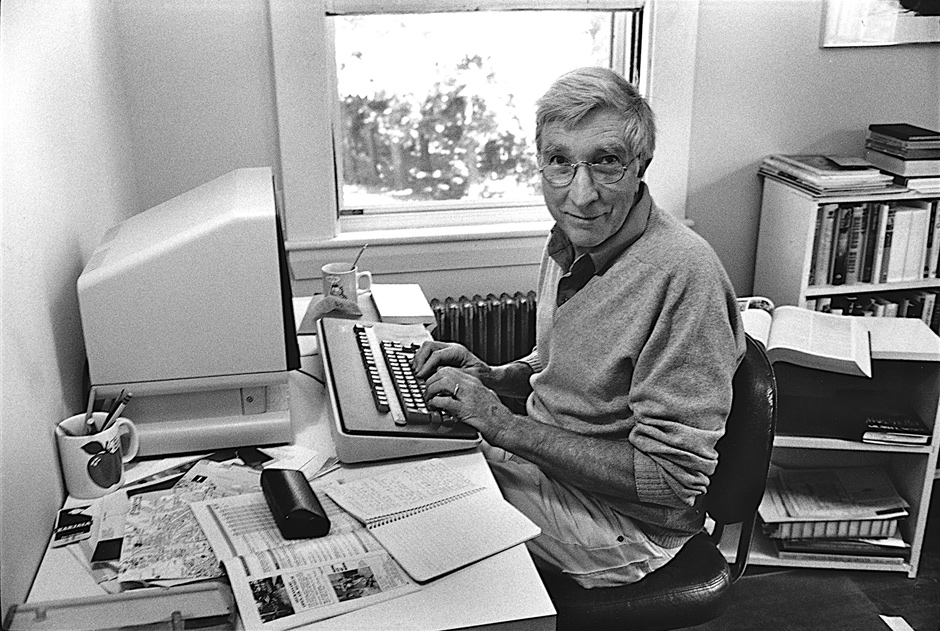
"Jane Kenyon was my student. She was smart, she wrote poems, she was funny and frank in class. After the term ended, because I knew she lived in a dormitory near me, one night I asked her to house-sit while I attended an hour-long meeting. (In Ann Arbor, 1970 was the year of breaking and entering.) When I came home, we went to bed. We enjoyed each other, libertine liberty as much as pleasures of the flesh. Later I asked her to dinner, which in that decade always included breakfast. Often we saw each other once a week, still dating others, then twice a week—then three or four times a week, seeing no one else. One night we spoke of marriage. Quickly we changed the subject, because I was nineteen years older, and if we married she would be a widow so long. We married in April 1972. We lived in Ann Arbor three years, then left Michigan for New Hampshire. She adored this old family house. For almost twenty years I woke before Jane and brought her coffee in bed. When she rose, she walked Gus the dog. Then each of us retreated to a workroom to write, at opposite ends of our two-story house. Mine was on the ground floor in front, next to Route 4. Hers was on the second floor in the rear, by Ragged Mountain’s old pasture. In the separation of our double solitude we each wrote poetry in the morning. We met for lunch, eating sandwiches and walking around without chatting. Then we took a twenty-minute nap, gathering energy for the rest of the day, and woke to our daily fuck. Afterward I felt like cuddling, but Jane’s climax released her into energy. She hurried from bed to workroom. For several hours afterward I went back to work at my desk. Late in the afternoon I read aloud to Jane for an hour. I read Wordsworth’s Prelude, Henry James’s The Ambassadors twice, the Old Testament, William Faulkner, seventeenth-century poets, Raymond Carver’s stories, more Henry James. Before supper I drank a beer and glanced at The New Yorker while Jane cooked, sipping a glass of wine. Slowly she made a good dinner—maybe veal cutlets with mushroom and garlic gravy, maybe summer’s asparagus from Jane’s plot across the street—then asked me to carry our plates to the table while she lit the candle. Through dinner we spoke of our separate days. Summer afternoons we spent beside Eagle Pond on a bite-sized beach among frogs, mink, and beaver. Jane lay in the sun tanning while I read magazines in a canvas sling chair. Every now and then we would plunge into the pond. Sometimes for an early supper we broiled sausage on a hibachi. After twenty-three years of an extraordinary marriage, twenty New Hampshire years living and writing together in our double solitude, Jane died of leukemia at forty-seven in 1995. Jane has been dead for more than two decades. Earlier this year I grieved for her in a way I had never grieved before. At eighty-six, I was sick and thought I was dying. Twenty and twenty-one years ago, every day of her dying for eighteen months, I stayed by her side. It was miserable that Jane should die so young, and it was redemptive that I could be with her every hour of every day. Last February I grieved again, this time that she would not sit over me as I died."

"A Carnival Of Losses: Notes Nearing Ninety" by Donald Hall: https://a.co/2hVlB1O

Donald Hall-"My most notable musical moment"

"Everyone who practices an art should love and live with another art. One learns about one’s own work by exposing oneself to a different passion. Mentioning a second art does not imply competence in practicing it. In eighth grade I flunked art, which was lamentable, because in art class I sat beside Mary Beth Burgess and I was sweet on her. Music is totally beyond me. My most notable musical moment took place on Ken Burns’s Baseball. He interviewed me about the game, about loving baseball, not about playing it. I had hung around major league players, writing books and essays about them, and for Ken I came up with twenty anecdotes. Then he asked me to sing “Take Me Out to the Ball Game,” telling me that all his interviewees would sing it. Ken Burns’s charm could persuade a monkey to breed with a daffodil. At his urging I tried singing “Take me out . . .” and heard my pitch waver capriciously up and down. Tuneless, ashamed, in my disgrace I forgot the lyrics. The highlight of Ken’s Baseball series, I swear, is the image of my mouth hanging open wide and silent. It looked like brain damage. In editing, Ken paid special attention to this image by holding it for two or three beats. I love painting, sculpture, sketches, and watercolors. I have my own collection, mostly prints and posters—Blake, Arp, Warhol, Marie Laurencin, de Kooning, Man Ray—and my favorite pastime is going to museums. Myself, I can draw one thing only, and I do it when I sign my baseball books. I draw a circle, with half-moon semicircles inside it, with a few short lines cutting into the semicircles. The perpetually lopsided circle (I am not Giotto), decorated by expressionist stitches, leaves space for dedication, autograph, and date. It was always poetry and not much else. To avoid math and science I took a classical diploma at Exeter—Latin and Greek, Virgil and Homer. At Harvard I majored in English but concentrated on poetry courses, avoiding prose when I could. One day, I don’t know why, I wandered into the Fogg Museum and found an exhibition of Edvard Munch. I was stunned by the power of this literary painter, and I went back and back to The Scream and its siblings. Two years later the same show turned up in Paris, at the Petit Palais, and during a long vacation from Oxford I walked every afternoon to see it again. It began my museum life, which lasted and extended. Years later I wrote a New Yorker Profile of Henry Moore and interviewed other English artists, from Barbara Hepworth to Francis Bacon. I learned lots about painting and sculpture, but maybe I learned most about poetry—for instance, by hearing Moore quote Rodin, who quoted a stonemason: “Never think of a surface except as the extension of a volume.”"

Essays After Eighty" by Donald Hall: https://a.co/a2CyVv8

Saturday, March 26, 2022

Sport - Profound or a Waste of Time? - The Philosophers' Magazine

"…if philosophers neglect our physicality then they have only a partial picture of our natures...

https://philosophersmag.com/essays/73-sport-profound-or-a-waste-of-time

Tuesday, March 8, 2022

Bread and roses

Rebecca Solnit's "In Praise Of" chapter in "Orwell's Roses", from my Spring Break leisure-reading list, includes this spirited defense--echoed yesterday in the Times by Margaret Renkl--of our "right to live, not simply exist."

"If roses represent pleasure, leisure, self-determination, interior life, and the unquantifiable, the struggle for them is sometimes not only against owners and bosses seeking to crush their workers but against other factions of the left who disparage the necessity of these things. The left has never been short on people arguing that it is callous and immoral to enjoy oneself while others suffer, and somewhere others will always be suffering. It’s a puritanical position, implying that what one has to offer them is one’s own austerity or joylessness, rather than some practical contribution toward their liberation. Underlying all this is a utilitarian ideology in which pleasures and beauties are counterrevolutionary, bourgeois, decadent, indulgent, and the desire for them should be weeded out and scorned. Would-be revolutionaries often argue that only the quantifiable matters, and that human beings should be rational creatures content with what should matter and fit into how things should be, rather than what does matter and how things are. The roses in “bread and roses” constituted an argument not only for something more, but for something more nuanced and elusive—as Rose Schneiderman put it, “The right to live, not simply exist.” It was an argument that what makes our lives worth living is to some degree incalculable and unpredictable, and varies from person to person. In that sense, roses also mean subjectivity, liberty, and self-determination." "Orwell's Roses" by Rebecca Solnit: https://a.co/fnDCKCX

It's a misdirected solidarity with suffering humanity NOT to smell the roses while we can. And, it's a hopelessly confused "utilitarian" who scorns pleasure and happiness in favor of bread (here symbolizing mere survival). Take that bread, says Solnit's next chapter, and make buttered toast. Live a little. Enjoy life's little breaks. That's no betrayal of suffering humanity.

Tuesday, January 18, 2022

Public philosophy

Since the millennium, there has been a huge increase in the visibility of philosophy, both online and off. There are, of course, books on philosophy, but also numerous popular live events, courses, podcasts, television and radio programmes, and newspaper columns. Philosophy today is as likely to be found on YouTube as it is in a bookshop or library. Just to mention a few examples of freely accessible online public philosophy initiatives: Michael Sandel's 'Justice' course, the BBC's History of Ideas animations, or the many popular philosophy podcasts, including History of Philosophy Without Any Gaps from Peter Adamson, Philosophy Bites from David Edmonds and Nigel Warburton, and the philosophy episodes of the BBC Radio 4 series In Our Time. This complex and heterogeneous phenomenon is generally called 'public philosophy'. It's philosophy done in public rather than behind the doors of seminar or lecture rooms, or in paywalled academic journals... (continues)

https://psyche.co/ideas/what-public-philosophy-is-and-why-we-need-it-more-than-ever

Monday, January 3, 2022

Lorenzo Washington's Other Music City

Jefferson Street Sound Museum brims with stories about the music scene that thrived in North Nashville before I-40. The museum faces an array of pressures, making a visit more important now than ever.
https://t.co/ILp89n0XCV https://t.co/Qvg07BJc9r
(https://twitter.com/NashvilleScene/status/1478058730537172995?s=02)

Saturday, January 1, 2022

be happy still

"Considering that, all hatred driven hence,
The soul recovers radical innocence
And learns at last that it is self-delighting,
Self-appeasing, self-affrighting,
And that its own sweet will is Heaven’s will;
She can, though every face should scowl
And every windy quarter howl
Or every bellows burst, be happy still."

Yeats, A Poem for My Daughter, stanza 9-in "Bewilderment: A Novel" by Richard Powers: https://a.co/0IrGQsH

KurzweilAI.net Accelerating Intelligence News