I just listened to an annoying radio interview with Jose Feliciano, who was asked if he worried that anyone in the world might ever tire of hearing "Feliz Navidad." The gist of his reply: only the atheists are likely to tire of this tune and its simple message ("I want to wish you a merry Christmas from the bottom of my heart" etc. etc. ad infinitum) - and atheists don't like anything anyway.
Well, Jose, we like plenty - thank you very much. And I do want to wish everyone a Merry Christmas. I don't believe a virgin ever birthed a savior, but I'm happy to celebrate the birth of anyone who brought or brings tidings of peace, love, and understanding. I'm sure Jose is not alone in thinking that atheists are only nattering nabobs of negativism. That's a misconception, and I'll be doing my best to correct it when I teach a course next Fall I'm tentatively calling "Atheism: Old and New." My mission: make it clear to students that renouncing belief in God is not tantamout to renouncing life and spirit and meaning and hope.
This is my first post in this forum since July - and that was itself a cameo appearance. I'll probably blog again, but never again (I think) on a self-imposed schedule. I have a cartoon on my office wall: "Thank goodness you're here," says the desk-bound Everyman to Mr. Death, "I never get anything done without a deadline."
In fact, deadlines per se don't motivate me, except negatively: I resist and defy and recoil. But perhaps thinking about death, in some strange way, does inspire. My last post concerned the very public death of Randy Pausch. What was much on my mind then, but unacknowledged, was my Dad's leukemia-induced decline. He passed in September, after nearly eight decades of a salutary life. That loss feels heavier today than it has most days since.
I've not consoled myself at all with thoughts of eternity or reunion in heaven, and cannot. In one of our last significant conversations, I shared with Dad an exchange between William James and his own fatally-ill father, in 1882:
"As for the other side, and Mother, and our all possibly meeting, I can't say anything..."
Well, I can say of such a reunion that I don't expect it and - if faith is a condition - don't deserve it. But my disbelief is not simply a negation, it is an affirmation of the life he lived on Earth, and the example he set for those of us who attended and will follow. It is a commitment to pass the torch he handed me and my siblings to my own children, to the best of my ability. I'm not looking for a transcendental bailout. I don't think he was either.
Thursday, December 25, 2008


Saturday, July 26, 2008
Randy Pausch
Professor Randy Pausch, whose "last lecture" and high-profile struggle with pancreatic cancer won wide admiration and sympathy, died yesterday.
I passed my copy of Randy’s book along to my Dad, recently diagnosed with leukemia. He was moved and inspired by it, as was I. We agreed that for a young man with small children to muster such a courageous response to a terminal diagnosis - stoical but also joyous and celebratory - is truly heroic. I’m so grateful that Randy was willing to share his story and his example with the world.
I passed my copy of Randy’s book along to my Dad, recently diagnosed with leukemia. He was moved and inspired by it, as was I. We agreed that for a young man with small children to muster such a courageous response to a terminal diagnosis - stoical but also joyous and celebratory - is truly heroic. I’m so grateful that Randy was willing to share his story and his example with the world.
Wednesday, June 4, 2008
Still here...
...and still trying to decide whether to blog or not to blog, after a five month hiatus. Life has been event ful and full without it, can't say I've missed this forum much. In fact, I probably wouldn't be posting at all if I (1) were teaching summer school and (2) didn't have projects and deadlines to procrastinate about.
 ful and full without it, can't say I've missed this forum much. In fact, I probably wouldn't be posting at all if I (1) were teaching summer school and (2) didn't have projects and deadlines to procrastinate about.
 But for the record, I am still living and breathing and attempting, sporadically, to think. Maybe I'll yet decide to share some of the results with the wide, distracted world.
Wednesday, January 2, 2008
Changing minds
Edge.org begins every year by posting a question and a diverse array of responses. This year the big question is: WHAT HAVE YOU CHANGED YOUR MIND ABOUT? WHY?
When thinking changes your mind, that's philosophy.When God changes your mind, that's faith.When facts change your mind, that's science. Science is based on evidence. What happens when the data change? How have scientific findings or arguments changed your mind?"
http://www.edge.org/q2008/q08_index.html
Lots of fascinating and provocative responses have already been submitted. Willingness to change - not for the sake of change alone, but for solid reasons - is a huge step forward for our species. I'm for it. Happy New Year!
When thinking changes your mind, that's philosophy.When God changes your mind, that's faith.When facts change your mind, that's science. Science is based on evidence. What happens when the data change? How have scientific findings or arguments changed your mind?"
http://www.edge.org/q2008/q08_index.html
Lots of fascinating and provocative responses have already been submitted. Willingness to change - not for the sake of change alone, but for solid reasons - is a huge step forward for our species. I'm for it. Happy New Year!
Saturday, December 22, 2007
"Pulling the Plug" (again)
Nice piece recently in Orion by Robert Michael Pyle -http://www.orionmagazine.org/index.php/articles/article/466
He pulled his own plug, more or less. He still goes online a couple times a week, but not at home:
I know I am missing out on some wonderful exchanges and capabilities. But I already weep over all the indoor hours when I could actually be out, combing the moss for waterbears or contemplating the profound mystery of where people get the time to read blogs, for gods’ sakes—is it at the complete expense of books?
When we read the blogs, how much do we misread? And how much do we misrepresent ourselves when we write them? I recently had an unpleasant exchange with a friend in reaction to one of his blog posts, in part because the medium does not lend itself to nuance and in part because, it seemed to me, my friend was engaged in a sort of performance - not a genuine and sincere communication. He was busy constructing a persona, not engaging in a real conversation. It pissed me off, but in an instructive way. I blog, therefore I bloviate. We must all take care not to damage human relationships in the course of framing ourselves as clever and sophisticated cultural observers - an unintended but not unforeseeable consequence of this form of discourse. The electronic-human interface does not necessarily have to make us shallow persons. Blogging doesn't have to be superficial. But it sure can be.
Bill McKibben was prophetic about this, as about so much else. Our vaunted Information Age truly is an "Age of Missing Information." But rather than pull the plug in a literal way, I'm going to continue tasking myself each day to pull away from the keyboard and the email and the blogs in responsible moderation. Our evolutionary health and day-to-day sanity and civility really depend on our learning to do this.
He pulled his own plug, more or less. He still goes online a couple times a week, but not at home:
I know I am missing out on some wonderful exchanges and capabilities. But I already weep over all the indoor hours when I could actually be out, combing the moss for waterbears or contemplating the profound mystery of where people get the time to read blogs, for gods’ sakes—is it at the complete expense of books?
When we read the blogs, how much do we misread? And how much do we misrepresent ourselves when we write them? I recently had an unpleasant exchange with a friend in reaction to one of his blog posts, in part because the medium does not lend itself to nuance and in part because, it seemed to me, my friend was engaged in a sort of performance - not a genuine and sincere communication. He was busy constructing a persona, not engaging in a real conversation. It pissed me off, but in an instructive way. I blog, therefore I bloviate. We must all take care not to damage human relationships in the course of framing ourselves as clever and sophisticated cultural observers - an unintended but not unforeseeable consequence of this form of discourse. The electronic-human interface does not necessarily have to make us shallow persons. Blogging doesn't have to be superficial. But it sure can be.
Bill McKibben was prophetic about this, as about so much else. Our vaunted Information Age truly is an "Age of Missing Information." But rather than pull the plug in a literal way, I'm going to continue tasking myself each day to pull away from the keyboard and the email and the blogs in responsible moderation. Our evolutionary health and day-to-day sanity and civility really depend on our learning to do this.
Thursday, November 22, 2007
Gratitude
Thanksgiving is one of my two favorite holidays, the other being Independence Day.
Richard Ford's wonderful novel The Lay of the Land (Knopf, '06) expresses much of my feeling about this day, and about the hard-won "acceptance" that comes with loving life while still deploring loss. I love and accept a lot, but not everything: so, on some accounts, I thus lack the deepest form of gratitude and spirituality. But I agree with Ford: "a practical acceptance of what's what, in real time and down-to-earth, is as good as spiritual if you can finagle it..."
Another of my favorite sources on this topic is the philosopher Loyal Rue, who has written:
By the grace of these improbable [cosmic] events we inherit the opportunity of a lifetime. Even if we cannot imagine some One to give thanks to, we are nonetheless rendered thankful by the bountiful conditions of our existence. And in the measure of our gratitude we acquire a sense of obligation. The more we learn about the Epic of Evolution the more we are motivated to repay the generosity of the past by seeding hope for the future. http://www.earthlight.org/personal26.html
In other words: pay it forward.
Richard Ford's wonderful novel The Lay of the Land (Knopf, '06) expresses much of my feeling about this day, and about the hard-won "acceptance" that comes with loving life while still deploring loss. I love and accept a lot, but not everything: so, on some accounts, I thus lack the deepest form of gratitude and spirituality. But I agree with Ford: "a practical acceptance of what's what, in real time and down-to-earth, is as good as spiritual if you can finagle it..."
Another of my favorite sources on this topic is the philosopher Loyal Rue, who has written:
By the grace of these improbable [cosmic] events we inherit the opportunity of a lifetime. Even if we cannot imagine some One to give thanks to, we are nonetheless rendered thankful by the bountiful conditions of our existence. And in the measure of our gratitude we acquire a sense of obligation. The more we learn about the Epic of Evolution the more we are motivated to repay the generosity of the past by seeding hope for the future. http://www.earthlight.org/personal26.html
In other words: pay it forward.
Saturday, October 27, 2007
John Lachs: Symposium and Retrospective
I've not dropped any coins into this bottomless well lately, but over the past two days I participated in a public event that merits blog-space if anything does.
Five good friends and I gathered as a panel symposium this afternoon to discuss a very special teacher, John Lachs, who has been educating Vanderbilt philosophy students since 1967. Last night he delivered a keynote address to the 39th annual meeting of the Tennessee Philosophical Association. Here's how I introduced him, followed by my contribution to the panel discussion:
Welcome to the 39th annual meeting of the TPA. We invite all of you who came out this evening for what promises to be an engaging, provocative keynote address by John Lachs, and those who came for the "spirited" reception to follow, to pick up a conference program near the entrance behind you. We’ll be at it all day tomorrow, starting at 9 am. We have sessions scheduled on a variety of topics. I’m particularly pleased that so many presenters heeded our suggestion and selected themes consonant with those of tonight’s speaker, and only regret that it won’t be possible to be everywhere at once tomorrow.
But tonight we’re all here, and I am delighted to introduce my mentor and friend John Lachs, one of the preeminent philosophers of his generation. Born in Hungary, educated at McGill and Yale Universities, he is Centennial Professor of Philosophy at Vanderbilt, where he has been for four decades now. He is the author of a great many articles and books including Intermediate Man, The Relevance of Philosophy for Life, In Love With Life, A Community of Individuals, and the forthcoming Leaving People Alone. He founded the Society for the Advancement of American Philosophy (SAAP). He is a respected public intellectual, enjoying lustrous name and reputation in this community and far beyond. Above all, he is an inspirational teacher who has shared the spark of his enthusiasm for learning and living with generations of grateful students – some of whom, I am pleased to note, have journeyed further than they otherwise would have for the opportunity to be here with him at this conference. Others, including a university president, have sent warmest regards and regrets.
It is unusual for the TPA keynote speaker to be met on his own turf. But this is a delightfully unusual evening. Join me in welcoming to the lectern, on his home field, Professor John Lachs. (10.26.07)
Welcome to our symposium on John Lachs, last night’s distinguished keynote speaker and – for each of us on this panel - an esteemed teacher, whose influence on our respective lives and careers in academia makes this opportunity to exchange reflections and reminisce about our mentor particularly gratifying.
The program notes that we were all graduate students here at Vanderbilt in the early ‘80s. We studied in Lachs’s seminars, were TAs in his ever-popular Intro to Ethics course, and worked closely with him in our respective paper chases. I’ll leave it to my colleagues each to express the specific nature and extent of Lachs’s impact on themselves, if they wish. (I don’t know what they’re going to say, they all preferred to approach this gathering in what I think we could call a Lachsian spirit of spontaneity.)
But I can tell you that his tutelage, and now his friendship, have profoundly marked me. I simply would not have succeeded without his patient sufferance and, when at last I got serious, his intense commitment to my success. But long before that, Lachs kindled the interest in American philosophy that is the core of my professional and philosophic identity. Gratitude alone seems insufficient as repayment. But, "from each according to ability..."
I'm also very grateful to my former classmates, now far-flung colleagues, for joining me here today. Some have traveled significant distances, and none missed a beat in accepting the invitation to do it. We’re all here because we want to profess in public our regard for a man whose instruction and example helped bring us to our calling.
For teaching is a calling, and of all my teachers it was Lachs whose enthusiastic practice of the academic philosopher’s vocation best exhibited what that can mean. He was (and is, and will continue to be) the opposite of the stereotypical university "free rider" he so deliciously pans in A Community of Individuals: the shirking recycler of the same old stale lecture material who knows only four good reasons to teach: May, June, July, and August. Lachs knows that "the aim of teaching is the creation of human beings," and that "its essential condition is inter-generational faith." Older people genuinely caring about younger people, generation after generation, sounds like a small achievement. It is not. It is how our species evolves, and – come to think of it – it is how people like us can best repay our gratitude to people like John Lachs: we can "pay it forward."
When I first started thinking about my remarks today I compiled a laundry list of categories into which I began sorting all the ways John Lachs’s style of caring has been important to me. There were at least a half dozen. But I’ve asked my peers to hold their opening remarks to about five minutes, so to set the right example for them I’m just going to mention one now myself: immediacy.
Lachs was always talking about immediacy. I didn’t really get it until one day in about 1986, at a SAAP meeting in Lexington, KY. Lachs had generously allowed some of us penurious grad students to share his hotel room. Before going down to Saturday morning’s opening session, Lachs caught me in the act of shamelessly enjoying a cartoon on television. He was amused, and I started to feel a bit embarrassed about this inadvertent display of what I thought must have looked like ripened immaturity on my part. But he simply affirmed my delight – another distinctive Lachsian word – in this particular form of immediacy. I got it; I finally began to understand what Lachs meant by saying that we have it in our power to regard our acts as so many ends, not just intermediate steps on the way to some perpetually-postponed future fulfillment. That moment nourished several themes that eventually coalesced in my work.
Others wanted to join this panel. One older Lachs alumnus who wanted to be here today was his colleague John Stuhr, whose son is a freshman at Emory University in Atlanta. It's Parent's Weekend there, and so this time the son won out.
Another who could not be here, owing to the especially-insistent demands of his own academic vocation, sent along some remarks that he requested we share. Here they are:
"In my intellectual development and professional choices, no one has been more instrumental and instructive than John Lachs. A masterful teacher and remarkable scholar who in rigor of thought and analysis maintains the essential human quality of sympathy and understanding. His scholarly work ranges through many fields of inquiry: naturalism, ethics, American philosophy, George Santayana, contemporary philosophical issues, many social and philosophical inquiries into the condition of human society, to name a few. He has a publication record that is hard to surpass, a teaching record that is unparalleled in my experience, and the ability to draw the interests of both graduate and undergraduate students.
He spoke at my inauguration as President of Richard Stockton College, and to this day, his remarks are the most requested from that occasion. He captured the essence of being a president in a few short remarks that will be found on the Stockton website for as long as I am president.
On a professional note, he is the model teacher/scholar we all hope to become. On a personal note, he is that faculty member who makes the unusual progression from being a mentor and advisor to being a friend and colleague who not only respects your independence and difference but also encourages it. No better friend and colleague can I imagine. And my sentiments are shared by all of his students, past and present. We are ever grateful." --Herman J. Saatkamp, Jr. President The Richard Stockton College of New Jersey
My time has expired. Up next...
(10.27.07)
There followed a parade of pals, who were in turns funny, perceptive, profound, and gracious. All expressed gratitutde for Lachs's example and instruction.
Lachs was in the room. Invited to comment on these proceedings, he averred that he now knows how it feels to attend one's own funeral. But we came not to bury. As another friend is fond of saying, we were simply saying some things that "needed to be brung out." I'm very glad we did.
Five good friends and I gathered as a panel symposium this afternoon to discuss a very special teacher, John Lachs, who has been educating Vanderbilt philosophy students since 1967. Last night he delivered a keynote address to the 39th annual meeting of the Tennessee Philosophical Association. Here's how I introduced him, followed by my contribution to the panel discussion:
Welcome to the 39th annual meeting of the TPA. We invite all of you who came out this evening for what promises to be an engaging, provocative keynote address by John Lachs, and those who came for the "spirited" reception to follow, to pick up a conference program near the entrance behind you. We’ll be at it all day tomorrow, starting at 9 am. We have sessions scheduled on a variety of topics. I’m particularly pleased that so many presenters heeded our suggestion and selected themes consonant with those of tonight’s speaker, and only regret that it won’t be possible to be everywhere at once tomorrow.
But tonight we’re all here, and I am delighted to introduce my mentor and friend John Lachs, one of the preeminent philosophers of his generation. Born in Hungary, educated at McGill and Yale Universities, he is Centennial Professor of Philosophy at Vanderbilt, where he has been for four decades now. He is the author of a great many articles and books including Intermediate Man, The Relevance of Philosophy for Life, In Love With Life, A Community of Individuals, and the forthcoming Leaving People Alone. He founded the Society for the Advancement of American Philosophy (SAAP). He is a respected public intellectual, enjoying lustrous name and reputation in this community and far beyond. Above all, he is an inspirational teacher who has shared the spark of his enthusiasm for learning and living with generations of grateful students – some of whom, I am pleased to note, have journeyed further than they otherwise would have for the opportunity to be here with him at this conference. Others, including a university president, have sent warmest regards and regrets.
It is unusual for the TPA keynote speaker to be met on his own turf. But this is a delightfully unusual evening. Join me in welcoming to the lectern, on his home field, Professor John Lachs. (10.26.07)
Welcome to our symposium on John Lachs, last night’s distinguished keynote speaker and – for each of us on this panel - an esteemed teacher, whose influence on our respective lives and careers in academia makes this opportunity to exchange reflections and reminisce about our mentor particularly gratifying.
The program notes that we were all graduate students here at Vanderbilt in the early ‘80s. We studied in Lachs’s seminars, were TAs in his ever-popular Intro to Ethics course, and worked closely with him in our respective paper chases. I’ll leave it to my colleagues each to express the specific nature and extent of Lachs’s impact on themselves, if they wish. (I don’t know what they’re going to say, they all preferred to approach this gathering in what I think we could call a Lachsian spirit of spontaneity.)
But I can tell you that his tutelage, and now his friendship, have profoundly marked me. I simply would not have succeeded without his patient sufferance and, when at last I got serious, his intense commitment to my success. But long before that, Lachs kindled the interest in American philosophy that is the core of my professional and philosophic identity. Gratitude alone seems insufficient as repayment. But, "from each according to ability..."
I'm also very grateful to my former classmates, now far-flung colleagues, for joining me here today. Some have traveled significant distances, and none missed a beat in accepting the invitation to do it. We’re all here because we want to profess in public our regard for a man whose instruction and example helped bring us to our calling.
For teaching is a calling, and of all my teachers it was Lachs whose enthusiastic practice of the academic philosopher’s vocation best exhibited what that can mean. He was (and is, and will continue to be) the opposite of the stereotypical university "free rider" he so deliciously pans in A Community of Individuals: the shirking recycler of the same old stale lecture material who knows only four good reasons to teach: May, June, July, and August. Lachs knows that "the aim of teaching is the creation of human beings," and that "its essential condition is inter-generational faith." Older people genuinely caring about younger people, generation after generation, sounds like a small achievement. It is not. It is how our species evolves, and – come to think of it – it is how people like us can best repay our gratitude to people like John Lachs: we can "pay it forward."
When I first started thinking about my remarks today I compiled a laundry list of categories into which I began sorting all the ways John Lachs’s style of caring has been important to me. There were at least a half dozen. But I’ve asked my peers to hold their opening remarks to about five minutes, so to set the right example for them I’m just going to mention one now myself: immediacy.
Lachs was always talking about immediacy. I didn’t really get it until one day in about 1986, at a SAAP meeting in Lexington, KY. Lachs had generously allowed some of us penurious grad students to share his hotel room. Before going down to Saturday morning’s opening session, Lachs caught me in the act of shamelessly enjoying a cartoon on television. He was amused, and I started to feel a bit embarrassed about this inadvertent display of what I thought must have looked like ripened immaturity on my part. But he simply affirmed my delight – another distinctive Lachsian word – in this particular form of immediacy. I got it; I finally began to understand what Lachs meant by saying that we have it in our power to regard our acts as so many ends, not just intermediate steps on the way to some perpetually-postponed future fulfillment. That moment nourished several themes that eventually coalesced in my work.
Others wanted to join this panel. One older Lachs alumnus who wanted to be here today was his colleague John Stuhr, whose son is a freshman at Emory University in Atlanta. It's Parent's Weekend there, and so this time the son won out.
Another who could not be here, owing to the especially-insistent demands of his own academic vocation, sent along some remarks that he requested we share. Here they are:
"In my intellectual development and professional choices, no one has been more instrumental and instructive than John Lachs. A masterful teacher and remarkable scholar who in rigor of thought and analysis maintains the essential human quality of sympathy and understanding. His scholarly work ranges through many fields of inquiry: naturalism, ethics, American philosophy, George Santayana, contemporary philosophical issues, many social and philosophical inquiries into the condition of human society, to name a few. He has a publication record that is hard to surpass, a teaching record that is unparalleled in my experience, and the ability to draw the interests of both graduate and undergraduate students.
He spoke at my inauguration as President of Richard Stockton College, and to this day, his remarks are the most requested from that occasion. He captured the essence of being a president in a few short remarks that will be found on the Stockton website for as long as I am president.
On a professional note, he is the model teacher/scholar we all hope to become. On a personal note, he is that faculty member who makes the unusual progression from being a mentor and advisor to being a friend and colleague who not only respects your independence and difference but also encourages it. No better friend and colleague can I imagine. And my sentiments are shared by all of his students, past and present. We are ever grateful." --Herman J. Saatkamp, Jr. President The Richard Stockton College of New Jersey
My time has expired. Up next...
(10.27.07)
There followed a parade of pals, who were in turns funny, perceptive, profound, and gracious. All expressed gratitutde for Lachs's example and instruction.
Lachs was in the room. Invited to comment on these proceedings, he averred that he now knows how it feels to attend one's own funeral. But we came not to bury. As another friend is fond of saying, we were simply saying some things that "needed to be brung out." I'm very glad we did.
Saturday, September 15, 2007
Soul
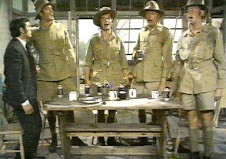
Do humans possess an immortal soul? The corporate board depicted in Monty Python's Meaning of Life discussed this: "...soul does not exist ab initio as orthodox Christianity teaches; it has to be brought into existence by a process of guided self-observation. However, this is rarely achieved owing to man's unique ability to be distracted from spiritual matters by everyday trivia."
I say: we should enjoy our distractions, should also attend to spiritual matters (which on my view may often coincide with those distractions), and -- as we learn from the pitiable Mr. Creosote -- should resist gluttony.
I say: we should enjoy our distractions, should also attend to spiritual matters (which on my view may often coincide with those distractions), and -- as we learn from the pitiable Mr. Creosote -- should resist gluttony.
Saturday, September 8, 2007
"Yes, we're all individuals"
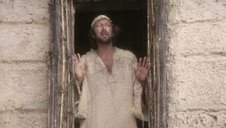
The Fall semester has about found its legs now, two weeks in. I'm doing something a little different in my Intro classes: on Fridays we're using Open Court's Monty Python and Philosophy, to supplement the week's more conventional approach. This week we read about "The Life of Brian" and took a look at a few clips, most pointedly the one in which Brian Cohen -- the mistaken Messiah -- insists to the multitude at his window that "you're all individuals" who don't need to follow anyone. I usually trot that clip out when explicating Emerson's Self-reliance, but it turns out to be a perfect comment on Plato's Euthyphro too.
The logic & critical thinking class has been fun, stocked as it is with lots of pre-law students who love to argue. And, as Monty Python reminds us, an argument isn't just saying "no it isn't!" (Yes it is!) (No, it ISN'T!!)
The logic & critical thinking class has been fun, stocked as it is with lots of pre-law students who love to argue. And, as Monty Python reminds us, an argument isn't just saying "no it isn't!" (Yes it is!) (No, it ISN'T!!)
Saturday, August 18, 2007
Summer's end
I'm back, this time from my formerly remote-and-off-the-grid Little House. It was, I suppose, a Luddite summer fantasy to imagine remaining unplugged -- though I'm still not sure I yet have anything vital to communicate to Maine, Texas, and the wider world. But classes are about to resume so I'll be expected to think at least a bit, and so long as I'm obliged to communicate in public I may as well keep this spot warm. The signal out here is low, though, so now I can blame failures to communicate (or communicate well) on the state of wireless technology. My new whine: it's the router.
Anyway: summer was great, we loved Manhattan -- Broadway, the Yankees, the museums -- but it's time to get on with a milder and busier season. (Easier said than done, though this is forecast to be our first sub-100 degree day in a couple of weeks.)
And what would Thoreau say about my air-conditioned, web-connected, cellular-accessible redoubt? Sorry, Henry. Guess I've been seduced by the dark side.
Anyway: summer was great, we loved Manhattan -- Broadway, the Yankees, the museums -- but it's time to get on with a milder and busier season. (Easier said than done, though this is forecast to be our first sub-100 degree day in a couple of weeks.)
And what would Thoreau say about my air-conditioned, web-connected, cellular-accessible redoubt? Sorry, Henry. Guess I've been seduced by the dark side.
Subscribe to:
Posts (Atom)


 Charles Darwin (

 Posts
Posts