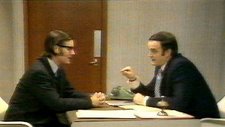
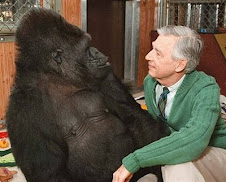
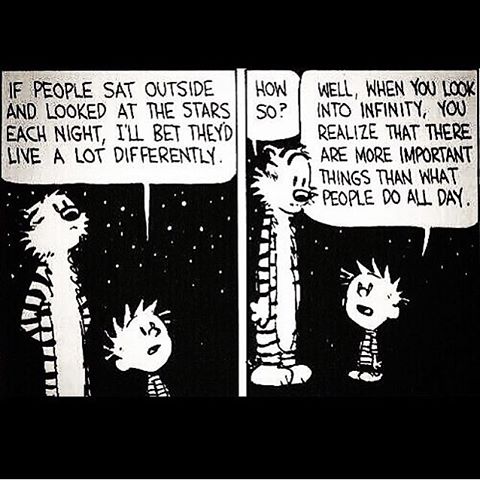
I once taught a course called "The Meaning of Life" -- lots of fun, if ultimately inconclusive. But on the last day of class we looked at a clip from my all-time-favorite TV show "Northern Exposure" which implied that the M.o.L. is "that old-time rock-&-roll" (music and lyrics by Bob Seger). The point was less literal, of course: we all need to find the particular music of our lives and "dance" to it. Anyway, Terry Eagleton has a new book on the subject. Here's a review excerpt.
Eagleton finally plumps for happiness, currently enjoying a revival among economists, philosophers and even politicians. But he points out with Aristotle that happiness comes in many and devious forms. . . Happiness disengaged from selfishness and allied to the Greek love for humanity (agape) passes muster, at times almost lyrically so.
The meaning of life is thus not "what you make of it". It is not a passing pleasure, which humans share with animals. Indeed it is not even an answer to a question, but rather "a matter of living life in a certain way". It is an ethical construct and involves treating others as you want them to treat you, caring for those close to you, helping strangers, thinking long term.
The meaning of life to Eagleton is like a jazz band, individuals engaged on a collective endeavour in pursuit of happiness through the mutuality of love.
--Simon Jenkins, in The Guardian -- http://books.guardian.co.uk/reviews/politicsphilosophyandsociety/0,,2030253,00.html
NOTE to the invisible (hypothetical?) readers of this blog: With the end of Spring Break and my return to reality (and a very large stack of ungraded essays), Delight Springs shifts to a slower pace of publication. New posts will now appear on Tuesdays and Saturdays. But as always, feel free to comment on any of these bottled messages whenever they find you.
Tuesday, March 13, 2007


Saturday, March 10, 2007
Safe at home!
The odyssey concludes...
A 3-hour drive from Columbia, SC brought me to the mountainside doorstep of my old friend and former grad school roomie D., who led me to an excellent little bistro in Sylva, NC called "Guadalupe" (the beer selection was outstanding, I can particularly recommend the "Duck-Rabbit" and "Highland" Porters). Then we took in a gorey movie I might rather have missed, "The 300." In this version of ancient Greek history, centering on the battle of Thermopolae, the blood-lusty, death-dealing Spartans never retreat, never surrender, commit collective suicide in the name of warrior "honor," and all the while are portrayed as exponents of reason and freedom. Times reviewer A.O. Scott said it was as violent as "Apocalypto" and twice as stupid. But it was nice to pay just $5 for a movie, even if I lost count of decapitations, eviscerations, and variations on the declaration that freedom isn't free. I'm betting this film is popular in the Bush White House.
A restful night's sleep, capacious breakfast, and much engaging conversation followed, and then I was on the road again, arriving safely home in mid-afternoon to a welcome greeting that confirmed the truism about absence and the heart. Before I had a chance to unpack a thing I was whisked off by my elder daughter to her baseball practice. It's good to be useful again.
My march through Georgia, Florida, and the Carolinas topped 2,000 miles; the restorative value of it all was priceless. And it's great to be home.
A 3-hour drive from Columbia, SC brought me to the mountainside doorstep of my old friend and former grad school roomie D., who led me to an excellent little bistro in Sylva, NC called "Guadalupe" (the beer selection was outstanding, I can particularly recommend the "Duck-Rabbit" and "Highland" Porters). Then we took in a gorey movie I might rather have missed, "The 300." In this version of ancient Greek history, centering on the battle of Thermopolae, the blood-lusty, death-dealing Spartans never retreat, never surrender, commit collective suicide in the name of warrior "honor," and all the while are portrayed as exponents of reason and freedom. Times reviewer A.O. Scott said it was as violent as "Apocalypto" and twice as stupid. But it was nice to pay just $5 for a movie, even if I lost count of decapitations, eviscerations, and variations on the declaration that freedom isn't free. I'm betting this film is popular in the Bush White House.
A restful night's sleep, capacious breakfast, and much engaging conversation followed, and then I was on the road again, arriving safely home in mid-afternoon to a welcome greeting that confirmed the truism about absence and the heart. Before I had a chance to unpack a thing I was whisked off by my elder daughter to her baseball practice. It's good to be useful again.
My march through Georgia, Florida, and the Carolinas topped 2,000 miles; the restorative value of it all was priceless. And it's great to be home.
Friday, March 9, 2007
Anhedonia & consummatory experience
I commented in public on two philosophy papers this morning, one concerned with John Dewey's notion of "consummatory experience" and the other with the phenomenon of "anhedonia" -- the loss of zest, spring, joy, delight -- and what French philosopher Gabriel Marcel might have to teach William James about it. I was concerned to make just a couple of points:
1. Consummatory experiences are better had & enjoyed than talked about & analyzed.
2. The more consummatory experiences you have, the less likely you are to experience anhedonia.
I made those points, but not (of course) so concisely. This being an academic philosophy conference, and philosophy being a discipline that trades chiefly in words, I was expected to talk at much greater length about those two points and others besides. I did not disappoint.
But I hope my confreres will do what I did yesterday: go outside, breath the fresh air, take in some new sights, walk around... even if you don't have a consummatory moment, you'll still feel better and will be far less vulnerable to the dreaded anhedonia (which, btw, our French speaker pronounced not as rhyming with "Caledonia" but instead with the greater stress on the penultimate syllable -- so I learned at least one thing this morning).
I also related my experiences of the past week, which to my mind show that it is indeed possible to chase down your consummations (or at least become open to them) if you want to.
Next stop: the mountainous environs of Asheville, NC. Then, to invoke the inevitable baseball metaphor, I'll round 3d and head for home.
1. Consummatory experiences are better had & enjoyed than talked about & analyzed.
2. The more consummatory experiences you have, the less likely you are to experience anhedonia.
I made those points, but not (of course) so concisely. This being an academic philosophy conference, and philosophy being a discipline that trades chiefly in words, I was expected to talk at much greater length about those two points and others besides. I did not disappoint.
But I hope my confreres will do what I did yesterday: go outside, breath the fresh air, take in some new sights, walk around... even if you don't have a consummatory moment, you'll still feel better and will be far less vulnerable to the dreaded anhedonia (which, btw, our French speaker pronounced not as rhyming with "Caledonia" but instead with the greater stress on the penultimate syllable -- so I learned at least one thing this morning).
I also related my experiences of the past week, which to my mind show that it is indeed possible to chase down your consummations (or at least become open to them) if you want to.
Next stop: the mountainous environs of Asheville, NC. Then, to invoke the inevitable baseball metaphor, I'll round 3d and head for home.
Thursday, March 8, 2007
Lakeland
Wow! Lakeland is a perfect baseball venue. I'd never attended a "real" game there before, just an informal intrasquad game years ago at which I recall Sparky Anderson being vocally managerial. This time I paid for admission to Joker Marchant Stadium and opted for a spot on the left-field "berm," the angled hillock just behind the fences. It was a lovely vantage from which to see a game (not to mention batting practice, during which I came oh-so-close to snagging a HR ball more than once). The Tigers hosted the Braves, into extra innings ( I confess to leaving before the resolution of the 4-4 tie, with concerns about Orlando gridlock -- not unreasonable concerns, as it happens.) Detroit looks good this year, with the addition of Gary Sheffield. BTW: Lakeland offers the best selection of non-Budweiser products of any place I've been in the Grapefruit League (or in the majors, come to think of it). First time I've ever been able to tell a Brit fan at a baseball game where he could find some Boddington's.
Leaving 2007 Spring Training behind, I'm in a reminiscent mood. My 1st-ever Spring Training was the last time the Cards were reigning champs, '83. I remember an upstart rookie outfielder named Andy van Slyke pounding a long home run against Joacquin Andujar, the '82 Series star, in one of those serendipitously-discovered free intrasquad games at the Cards' old St. Pete facility. (Andujar, who once said his favorite word in English is "youneverknow," responded with a mock finger-wag at van Slyke).
Time to join my philosophy colleagues and talk shop. In preparation I spent some quality time out of the conference hall today, wandering our host city -- Columbia SC. What a beautiful old town, with the 200+ year-old University campus nestled in the middle of things and a short stroll from the new River Greenway. I went to school in a different Columbia, not without its own sense of history -- but this one's unique in its own way. (How else could it be?)
When I leave here I'm looking forward to encountering another old friend -- a fellow academic who shares my ironic regard for our common profession, and (like Groucho & me) wonders what kind of club would have someone like us for members -- on the trek home, in the other Carolina. What a terrific week it's been -- but I miss my family. Just about time to go.
Leaving 2007 Spring Training behind, I'm in a reminiscent mood. My 1st-ever Spring Training was the last time the Cards were reigning champs, '83. I remember an upstart rookie outfielder named Andy van Slyke pounding a long home run against Joacquin Andujar, the '82 Series star, in one of those serendipitously-discovered free intrasquad games at the Cards' old St. Pete facility. (Andujar, who once said his favorite word in English is "youneverknow," responded with a mock finger-wag at van Slyke).
Time to join my philosophy colleagues and talk shop. In preparation I spent some quality time out of the conference hall today, wandering our host city -- Columbia SC. What a beautiful old town, with the 200+ year-old University campus nestled in the middle of things and a short stroll from the new River Greenway. I went to school in a different Columbia, not without its own sense of history -- but this one's unique in its own way. (How else could it be?)
When I leave here I'm looking forward to encountering another old friend -- a fellow academic who shares my ironic regard for our common profession, and (like Groucho & me) wonders what kind of club would have someone like us for members -- on the trek home, in the other Carolina. What a terrific week it's been -- but I miss my family. Just about time to go.
Wednesday, March 7, 2007
"Darwin's God"
From Sunday's NYT Magazine, "Darwin's God" (I'm just catching up, having been precoccupied with my own transcendental pursuits here in Florida)--
Call it God; call it superstition; call it... “belief in hope beyond reason” — whatever you call it, there seems an inherent human drive to believe in something transcendent, unfathomable and otherworldly, something beyond the reach or understanding of science...
Lost in the hullabaloo over the neo-atheists [meaning Dawkins, Dennett, & Sam Harris -- though none of them is "neo" in this regard] is a quieter and potentially more illuminating debate. It is taking place not between science and religion but within science itself, specifically among the scientists studying the evolution of religion. These scholars tend to agree on one point: that religious belief is an outgrowth of brain architecture that evolved during early human history. What they disagree about is why a tendency to believe evolved, whether it was because belief itself was adaptive or because it was just an evolutionary byproduct, a mere consequence of some other adaptation in the evolution of the human brain.
Which is the better biological explanation for a belief in God — evolutionary adaptation or neurological accident?
I'm not sure that's 's quite the right question, but I incline to James's observation as the beginning of an answer: the impulse to transcendence is not about God, it's about life. People reach for religious and other magic because they want a more intense and satisfying experience of mortal life (and the quest for immortality is satisfying for them). Transcendence is a natural phenomenon, and the invocation of transcendent entities, powers, potentialities, etc., is natural too. This is what I've called "global naturalism."
More on this later, I have miles to go and one more stop on my baseball junket.
Call it God; call it superstition; call it... “belief in hope beyond reason” — whatever you call it, there seems an inherent human drive to believe in something transcendent, unfathomable and otherworldly, something beyond the reach or understanding of science...
Lost in the hullabaloo over the neo-atheists [meaning Dawkins, Dennett, & Sam Harris -- though none of them is "neo" in this regard] is a quieter and potentially more illuminating debate. It is taking place not between science and religion but within science itself, specifically among the scientists studying the evolution of religion. These scholars tend to agree on one point: that religious belief is an outgrowth of brain architecture that evolved during early human history. What they disagree about is why a tendency to believe evolved, whether it was because belief itself was adaptive or because it was just an evolutionary byproduct, a mere consequence of some other adaptation in the evolution of the human brain.
Which is the better biological explanation for a belief in God — evolutionary adaptation or neurological accident?
I'm not sure that's 's quite the right question, but I incline to James's observation as the beginning of an answer: the impulse to transcendence is not about God, it's about life. People reach for religious and other magic because they want a more intense and satisfying experience of mortal life (and the quest for immortality is satisfying for them). Transcendence is a natural phenomenon, and the invocation of transcendent entities, powers, potentialities, etc., is natural too. This is what I've called "global naturalism."
More on this later, I have miles to go and one more stop on my baseball junket.
Tuesday, March 6, 2007
Delight in Bradenton, Venice
6:50 pm E.T. My last full day of Spring Training, reluctantly concluded (but happily consummated). Pirate City remains charming and little-known (you can stand in the middle of an array of four diamonds, a few steps behind each home plate, as b.p., infield practice, and intra-squad games are going on). Phils beat Bucs in Bradenton, another gorgeous day-game (they announced the weather back in PA: 20 degrees, more snow expected), Ryan Howard smashed a double off the centerfield wall. Then, another rejuvenating beach walk (Venice Beach this time). It'll be hard to leave in the morning, but I need to reach Jacksonville by nightfall -- unfortunately my old friend near J'ville will be heading out of town in the a.m. But there should be just enough time to spare for a stop at the Tigers' place in Lakeland -- and I'll try to resist the impulse to stay for the game at 1. It sure was nice -- symmetrically so -- when my Cards avenged 1968 last October (thanks to the incredible lack of throwing-to-1st prowess on the part of the Tigers' pitching staff) and at the same time softened the blow of 2004 -- and did it with a team that probably couldn't have bested the '68 Cards once in ten tries. Just goes to show that baseball is indeed a funny game. As Casey Stengel said, there comes a time in everyone's life, and I've had plenty of 'em...
More delight in Sarasota
Is there a better setting for catching up with an old friend than in the left-field grandstand of Ed Smith Stadium on a 75-degree afternoon in Sarasota? Not in my experience. It was nice to see the home team rally for a 9-8 win against the Phils, too... though again, this is not about winning and losing -- it's about being, and (in the language of John Dewey) consummating, or fulfilling, or delighting in the possibilities of experience inherent in the nature of a live creature who also has language.
The post-game walk on Siesta Beach was pretty fulfilling too, timed to end just as the sun dipped into the Gulf.
And the hot tub before bed was more than delightful.
It's off to Pirate City now. My home-town AAA team is no longer a Pirate affiliate, as they were when I last visited this region three years ago. But I do know some of the players, sort of -- they were checking in ahead of me at the Days Inn when I first hit Bradenton the other day. (That's a Days Inn to avoid, btw.) The great thing about Pirate City is its accessibility. People have been bemoaning the impending departure of the Dodgers from their Vero Beach home, because it affords greater fan access than any other Spring facility. But the Bucs' place -- while no Dodger Town -- is plenty accessible too.
Time to get out there.
The post-game walk on Siesta Beach was pretty fulfilling too, timed to end just as the sun dipped into the Gulf.
And the hot tub before bed was more than delightful.
It's off to Pirate City now. My home-town AAA team is no longer a Pirate affiliate, as they were when I last visited this region three years ago. But I do know some of the players, sort of -- they were checking in ahead of me at the Days Inn when I first hit Bradenton the other day. (That's a Days Inn to avoid, btw.) The great thing about Pirate City is its accessibility. People have been bemoaning the impending departure of the Dodgers from their Vero Beach home, because it affords greater fan access than any other Spring facility. But the Bucs' place -- while no Dodger Town -- is plenty accessible too.
Time to get out there.
Monday, March 5, 2007
Greetings from sunny Florida!
Venice, FL. It's another lovely day in baseball paradise, at my friend's home south of Sarasota (where I'm meeting another friend at noon for the Reds' game at Ed Smith Stadium). Made my way here after yesterday's game at old McKechnie Field in Bradenton -- Reds whupped the Bucs, but Spring Training isn't about who wins & loses, it's about delighting in the atmospherics, the sun, the possibilities and the hope springing eternal... And here's the sort of thing that can only happen at a Spring Training game: on entering McKechnie Field I was greeted by a retiree renting seat cushions, who abandoned his spiel when he noticed my tee-shirt from "Chocorua, New Hampshire" -- he not only knew the place well, he also knew of William James and the fact that WJ had a summer home there (the place James loved because it had so many windows and doors, "all opening out"). We talked about James, Chocorua, philosophy, etc. for several minutes while his rental business took a holiday. That has never happened to me in a big league ballpark.
The roadtrip through Georgia was uneventful (if you don't count my purchase of pecan brittle made in Plains, GA and sold in Cordele) but not unpleasant. This was the trip when I finally fell in love with XM satellite radio, and (when at last I had to stop the music) was reminded of what a magnificent service is provided by audible.com. (If you haven't heard Richard Dawkins and his wife Lala Ward reading The God Delusion you have something to look forward to).
Lest I forget, I have three more days here and then it's back to the real world (or my version of it), specifically Columbia, S.C., where I am expected to have responsible things to say about John Dewey's notion of "consummatory experience" and William James's projected view of what French philosopher Gabriel Marcel said about the difference between problems and mysteries. More on that later, right now I have beaches and baseballs to attend to.
The roadtrip through Georgia was uneventful (if you don't count my purchase of pecan brittle made in Plains, GA and sold in Cordele) but not unpleasant. This was the trip when I finally fell in love with XM satellite radio, and (when at last I had to stop the music) was reminded of what a magnificent service is provided by audible.com. (If you haven't heard Richard Dawkins and his wife Lala Ward reading The God Delusion you have something to look forward to).
Lest I forget, I have three more days here and then it's back to the real world (or my version of it), specifically Columbia, S.C., where I am expected to have responsible things to say about John Dewey's notion of "consummatory experience" and William James's projected view of what French philosopher Gabriel Marcel said about the difference between problems and mysteries. More on that later, right now I have beaches and baseballs to attend to.
Friday, March 2, 2007
The Cat's 50... & some baseball chatter
Dr. Seuss's wonderful, horrible, subversive, playful, delightful "Cat in the Hat" is celebrating his 50th birthday today -- (not that there's anything especially meaningful or important about that particular number, from my perspective!) -- and that calls for a tip of the stripey hat to a character who taught more kids to love reading than anyone else I know. We read that and many other Seuss stories (my favorite was The Lorax: "I speak for the trees!) in our household just a few years back. I miss those years, and treasure them. I thank Mr. Geisel for helping to subvert my children, and teach them that it's ok to have fun on a rainy day even, or especially, if the adults don't get it.
In the Cat's honor I'm hittin' the road this afternoon, headed eventually to a philosophy gig in South Carolina... but it's Spring Break, so pleasure precedes business: I'm taking the long way, via St. Pete, Bradenton, Sarasota, Ft. Myers, Kissimmee...
It's been too long since last I heard the crack of the bat up close. My best Spring Training moment ever, by the way, is not the lone foul ball I ever caught in my bare hands while juggling dog & beer (in March '91 at St. Pete's Al Lang Field, when the Cards' still played there and not on Jupiter; it was shanked by Dale Sveum of the Philadelphia Phillies, and I plucked it in the right field grandstand where the Bay view is rivaled only by San Francisco's PacBell Park (or whatever their corporate masters are making them call it now).
Nope, the best moment was in March 2000, in Jupiter (got the preposition right that time): Ray Lankford made up for Mark McGwire's snub of my then-5 year old daughter's request for an autograph by walking behind the batting cage where he'd just cracked his Louisville Slugger... and handing it to her. Nice guy, Ray.
By the way, have you seen the doctored Derek Jeter baseball card? Someone digitally implanted the president and Mickey Mantle in the front row while Derek swings. Thanks to computers you just can't trust your own eyes anymore, can you?
Coming to this space soon, news from the Grapefruit league. (Still haven't ever done the Cactus, maybe next year.) The gravitational pull of the Volvo parked outside is palpable, with Jim Morrison ready to sing me out of town with "Roadhouse Blues" just as soon as I can finish inflicting two more midterm exams. Too bad everyone can't enjoy a Spring Break.
In the Cat's honor I'm hittin' the road this afternoon, headed eventually to a philosophy gig in South Carolina... but it's Spring Break, so pleasure precedes business: I'm taking the long way, via St. Pete, Bradenton, Sarasota, Ft. Myers, Kissimmee...
It's been too long since last I heard the crack of the bat up close. My best Spring Training moment ever, by the way, is not the lone foul ball I ever caught in my bare hands while juggling dog & beer (in March '91 at St. Pete's Al Lang Field, when the Cards' still played there and not on Jupiter; it was shanked by Dale Sveum of the Philadelphia Phillies, and I plucked it in the right field grandstand where the Bay view is rivaled only by San Francisco's PacBell Park (or whatever their corporate masters are making them call it now).
Nope, the best moment was in March 2000, in Jupiter (got the preposition right that time): Ray Lankford made up for Mark McGwire's snub of my then-5 year old daughter's request for an autograph by walking behind the batting cage where he'd just cracked his Louisville Slugger... and handing it to her. Nice guy, Ray.
By the way, have you seen the doctored Derek Jeter baseball card? Someone digitally implanted the president and Mickey Mantle in the front row while Derek swings. Thanks to computers you just can't trust your own eyes anymore, can you?
Coming to this space soon, news from the Grapefruit league. (Still haven't ever done the Cactus, maybe next year.) The gravitational pull of the Volvo parked outside is palpable, with Jim Morrison ready to sing me out of town with "Roadhouse Blues" just as soon as I can finish inflicting two more midterm exams. Too bad everyone can't enjoy a Spring Break.
Thursday, March 1, 2007
Stewart Brand's new shade of green
Stewart Brand, the Whole Earth Catalog publisher (and instigator of Earth's first full-frontal photo portrait), online pioneer, former Merry Prankster, and free-thinking '60s icon, wants to know "where are the green biotech hackers?" He says we should -- and predicts that environmentalists soon will -- embrace nuclear power, genetic engineering, and biotech. He says population is not going to be a problem, nor will urban sprawl. ("An Early Environmentalist, Embracing New 'Heresies'," NYTimes, 2.27.07)
Is he nuts? I don't know, but after re-reading Bill McKibben's classic End of Nature in our environmental ethics class I'm struck by this Brand observation:
"My trend has been toward more rational and less romantic as the decades go by. I keep seeing the harm done by religious romanticism, the terrible conservatism of romanticism, the ingrained pessimism... It builds in a certain immunity to the scientific frame of mind."
I have a lot of respect for McKibben, but I can't warm to his Deep Ecology version of romanticism according to which nature's meaning is her independence of all things human. When he urges that we remain God's creatures rather than aspiring to godhood ourselves, I wonder if there isn't a saner intermediate position: we don't have to be gods, to be responsible global citizens and effective caretakers of the planet (for a change). We are the part of nature that can -- but too rarely does -- think about how to clean up after itself. McKibben makes clear, in this book, in Enough, and probably in his forthcoming Deep Economy -- that he thinks we must rein ourselves in, stop growing, stop re-engineering the planet and ourselves, declare "halt!"
I'm with Stewart Brand on this: "you have to keep trying new things," like biotech, and sometimes you have to rehabilitate old ones -- maybe even nukes.
Is he nuts? I don't know, but after re-reading Bill McKibben's classic End of Nature in our environmental ethics class I'm struck by this Brand observation:
"My trend has been toward more rational and less romantic as the decades go by. I keep seeing the harm done by religious romanticism, the terrible conservatism of romanticism, the ingrained pessimism... It builds in a certain immunity to the scientific frame of mind."
I have a lot of respect for McKibben, but I can't warm to his Deep Ecology version of romanticism according to which nature's meaning is her independence of all things human. When he urges that we remain God's creatures rather than aspiring to godhood ourselves, I wonder if there isn't a saner intermediate position: we don't have to be gods, to be responsible global citizens and effective caretakers of the planet (for a change). We are the part of nature that can -- but too rarely does -- think about how to clean up after itself. McKibben makes clear, in this book, in Enough, and probably in his forthcoming Deep Economy -- that he thinks we must rein ourselves in, stop growing, stop re-engineering the planet and ourselves, declare "halt!"
I'm with Stewart Brand on this: "you have to keep trying new things," like biotech, and sometimes you have to rehabilitate old ones -- maybe even nukes.
Subscribe to:
Posts (Atom)


 Charles Darwin (

 Posts
Posts