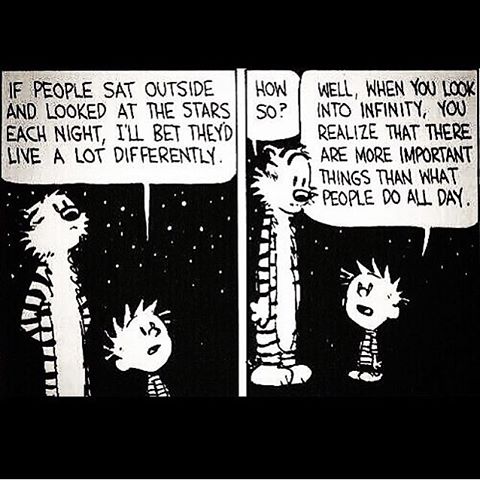
"Truth matters because we are the only species we know of that has the ability to find it out. In a way that makes it almost a duty to do so." Ophelia Benson, Jeremy Stangroom
“Is there a God?” is the most central and profound question that humans ask. With the New Atheists gaining a loud voice in today’s world, it is time to revisit the long-standing intellectual tradition on the side of faith.'Is there a god?' is not the most central and profound question that humans ask; far from it; at this stage of the game it could better be called the most futile time-wasting childish infatuated question that humans ask. The voice the 'New Atheists' have gained, if they have gained one, is really not all that loud compared to the voice the Old Theists have had and continue to have for the last however many thousands of years, so I really don't see why so many people feel compelled to pitch such a huge fit about a few atheists finally plucking up the nerve to say atheist things aloud instead of under their breath in a closet when no one is home. I really don't. I really don't see why so many people are so god damn truculent about having to share a minuscule corner of the discourse with atheists. I don't see why our 'gaining a voice' is treated as some kind of foul presumption...
 A while back I gave Karen Armstrong credit for being right about the centrality of compassion in all creditable spiritual worldviews, religious, secular, and ethical. But I want to be clear: she's not right to credit all historical religions with actually practicing and defending (as opposed to just preaching) compassion and tolerance themselves. They don't all do even that. Ophelia Benson, as usual, is blunt about this. Here she's quoting (and skewering) Robert Wright, whose Evolution of God is on our reading list in "Atheism & Spirituality":
All the great religions have shown time and again that they're capable of tolerance and civility when their adherents don't feel threatened or disrespected.
Bullshit. All the great religions have shown time and again that when they have unquestioned power, they use it, and they don't use it for tolerance and civility, they use it for social control and for their own protection and well-being. Robert Wright should take a few minutes to ponder the tolerance and civility of the Irish Catholic church.
OK, point granted: compassion is still a goal and an ideal, not an institutional value to be found and consistently cherished in the church-centered mainstream. I agree. But Karen's still right to urge the pursuit of that goal. No reason why atheists shouldn't be happy to endorse it too.
Give Ms. Armstrong partial credit, and please sign her charter. It's not disloyal, Randians, to live for the sake of one another as well as for ourselves.


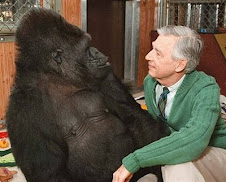
"Hello, babies. Welcome to Earth. It's hot in the summer and cold in the winter. It's round and wet and crowded. At the outside, babies, you've got about a hundred years here. There's only one rule that I know of, babies—God damn it, you've got to be kind." God Bless You, Mr. Rosewater (and see Mr. Rogers, below)

"Love may fail, but courtesy will prevail."
Jailbird, prologue

When asked in 1978 about his writing process, Updike said, “I’ve never believed that one should wait until one is inspired because I think that pleasures of not writing are so great that if you ever start indulging them, you will never write again.”
After the birth of his third child, he had rented an office above a restaurant in Ipswich, and spent several hours each morning writing there. Throughout his 50-year career, he remained devoted to that schedule, writing about three pages every morning after breakfast, sometimes more if things were going well. He said: “Back when I started, our best writers spent long periods brooding in silence. Then they’d publish a big book and go quiet again for another five years. I decided to run a different kind of shop.” WA


 | Alain de Botton (@alaindebotton) |
Why ‘Earthrise’ Matters thebookoflife.org/why- | |
 | Five Books (@five_books) |
The 'father of science fiction' HG Wells suffered terribly from class anxiety. Huxley and Woolf thought him 'vulgar' == Five books on... | |


 Charles Darwin (@cdarwin)1/11/15, 6:51 AM
"And maybe this is what I have learned more than anything from my great-great-grandfather: to keep my eyes and my mind open, to enjoy the wonders of nature and never cease to ask questions." Sarah Darwin, foreword to "A Modest Genius: The story of Darwin's life and how his ideas changed everything" by Hanne Strager


 Posts
All Comments
Posts
All Comments


 Posts
All Comments
Posts
All Comments