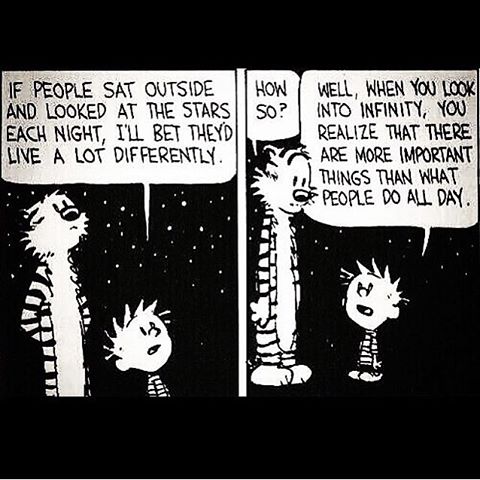
Does my impulse to share make me no better than a proselytizing missionary, desperately seeking personal/ideological validation through tribal association?
Maybe. It certainly makes me human.
(See the whole Oatmeal cartoon here.)


“If the day and the night are such that you greet them with joy, and life emits a fragrance like flowers and sweet-scented herbs, is more elastic, more starry, more immortal — that is your success.”Happy Birthday, Henry David Thoreau: On Defining Your Own Success | Brain Pickings

Besides books immediately relevant to Sagan’s work as a scientist and educator in cosmology and astrophysics, he took great care to also touch on history, philosophy, religion, the arts, social science, and psychology..."Carl Sagan's Reading List | Brain Pickings
"...you've been goin' on & on, talkin' & talkin'...I've never seen anybody that knows everything... And it doesn't hurt to listen, once in a while."
The impulse to read Self-Reliance is significant here, as is the holiday itself —my favorite secular one for being public and for its implicit goal of leaving us only as it found us: free.And we're as free as can be this year on the 4th, in the Magic Kingdom.
...in the more than thirty-five animated features Disney has released since 1937, there is scarcely a mention of God as conceived in the Christian and Jewish faiths shared by most people in the Western world and many beyond.It may be a commercial decision, to embrace the godless form of magic, but wouldn't you rather wish on a star than suborn your soul to servility?" God-free in Tennessee


"Hello, babies. Welcome to Earth. It's hot in the summer and cold in the winter. It's round and wet and crowded. At the outside, babies, you've got about a hundred years here. There's only one rule that I know of, babies—God damn it, you've got to be kind." God Bless You, Mr. Rosewater (and see Mr. Rogers, below)

"Love may fail, but courtesy will prevail."
Jailbird, prologue

When asked in 1978 about his writing process, Updike said, “I’ve never believed that one should wait until one is inspired because I think that pleasures of not writing are so great that if you ever start indulging them, you will never write again.”
After the birth of his third child, he had rented an office above a restaurant in Ipswich, and spent several hours each morning writing there. Throughout his 50-year career, he remained devoted to that schedule, writing about three pages every morning after breakfast, sometimes more if things were going well. He said: “Back when I started, our best writers spent long periods brooding in silence. Then they’d publish a big book and go quiet again for another five years. I decided to run a different kind of shop.” WA


 | Alain de Botton (@alaindebotton) |
Why ‘Earthrise’ Matters thebookoflife.org/why- | |
 | Five Books (@five_books) |
The 'father of science fiction' HG Wells suffered terribly from class anxiety. Huxley and Woolf thought him 'vulgar' == Five books on... | |


 Charles Darwin (@cdarwin)1/11/15, 6:51 AM
"And maybe this is what I have learned more than anything from my great-great-grandfather: to keep my eyes and my mind open, to enjoy the wonders of nature and never cease to ask questions." Sarah Darwin, foreword to "A Modest Genius: The story of Darwin's life and how his ideas changed everything" by Hanne Strager


 Posts
All Comments


 Posts
All Comments