Tuesday, August 31, 2010

welcome to philosophy

We had a little fun in the Future class yesterday, with a useful quote from the Kung-fu Panda about history and mysteries and the gift of the present. (I know, it's not that funny. But Older Daughter loves it.)

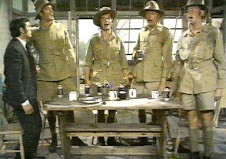
Today it'll be Intro to Philosophy's turn for howls of derisive laughter. Or not. But in case you miss any of the Bruces' scintillating dialogue, here are a few of the less objectionable words:
Second BruceI'd like to welcome the pommy bastard to God's own earth, and I'd like to remind him that we don't like stuck-up sticky-beaks here.
AllHear, hear! Well spoken, Bruce!
Fourth BruceNow, Bruce teaches classical philosophy, Bruce teaches Haegelian philosophy, and Bruce here teaches logical positivism, and is also in charge of the sheepdip.
Third BruceWhat's does new Bruce teach?
Fourth BruceNew Bruce will be teaching political science - Machiavelli, Bentham, Locke, Hobbes, Sutcliffe, Bradman, Lindwall, Miller, Hassett, and Benet.
Second BruceThose are cricketers, Bruce!
Fourth BruceOh, spit!
Third BruceHowls of derisive laughter, Bruce!
Fourth BruceIn addition, as he's going to be teaching politics, I've told him he's welcome to teach any of the great socialist thinkers, provided he makes it clear that they werewrong.
They all stand up.
AllAustralia, Australia, Australia, Australia, we love you. Amen!
They sit down.
Fourth BruceAny questions?
Second BruceNew Bruce - are you a pooftah?
Fourth BruceAre you a pooftah?
MichaelNo!
Fourth BruceNo right, well gentlemen, I'll just remind you of the faculty rules: Rule one - no pooftahs. Rule two, no member of the faculty is to maltreat the Abbos in any way whatsoever - if there's anybody watching. Rule three - no pooftahs. Rule four - I don't want to catch anyone not drinking in their room after lights out. Rule five - no pooftahs. Rule six - there is no rule six! Rule seven - no pooftahs. That concludes the reading of the rules, Bruce.
First BruceThis here's the wattle - the emblem of our land. You can stick it in a bottle or you can hold it in your hand.
AllAmen!
Fourth BruceGentlemen, at six o'clock I want every man-Bruce of you in the Sydney Harbour Bridge room to take a glass of sherry with the flying philosopher, Bruce, and I call upon you, padre, to close the meeting with a prayer.
First BruceOh Lord, we beseech thee etc. etc. etc., Amen.
AllAmen!
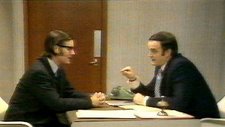
And here's the argument clinic.

I was looking forward to projecting all this onto the impressive new 25-foot screen in our formerly low-tech classroom, but-- and isn't this funny?!-- the installers didn't hang it correctly. It fell over the weekend and crushed our lectern. Ha. Ha.Ha.

I'd complain... but if you complain it does no good, you might as well not bother. (etc.)

And several butchers' aprons.

Monday, August 30, 2010

"one thing that makes us unique"

A seminal quotation in my own thinking about the future, from Dan Dennett. We are descended from remote ancestors for whom we were-- are-- the future they worked to secure. We're all links in the same chain. Will someone look back to us, someday, in gratitude?

Saturday, August 28, 2010

this

"This" is why theists and atheists will never finally resolve their differences, based on the appearances of things, and ought to resolve to let them stand. "Respect one another's mental freedom," as WJ would say.

Friday, August 27, 2010

mindset

This is the time of year when our late Dean, John McDaniel, would send around the latest Beloit College "Mindset List" to remind us all just how dated our own references have become, relative to our incoming students' stock of living memories. 


Had to look it up myself this year. A few items I'll bet the Dean would've noticed:
2. Email is just too slow, and they seldom if ever use snail mail.

4. Al Gore has always been animated.

9. Had it remained operational, the villainous computer HAL could be their college classmate this fall, but they have a better chance of running into Miley Cyrus’s folks on Parents’ Weekend.

13. Parents and teachers feared that Beavis and Butt-head might be the voice of a lost generation.
14. Doctor Kevorkian has never been licensed to practice medicine.
15. Colorful lapel ribbons have always been worn to indicate support for a cause.
16. Korean cars have always been a staple on American highways.

20. DNA fingerprinting and maps of the human genome have always existed.
21. Woody Allen, whose heart has wanted what it wanted, has always been with Soon-Yi Previn.

27. Computers have never lacked a CD-ROM disk drive.
28. They’ve never recognized that pointing to their wrists was a request for the time of day.
29. Reggie Jackson has always been enshrined in Cooperstown.

31. The first home computer they probably touched was an Apple II or Mac II; they are now in a museum.
32. Czechoslovakia has never existed.

35. Once they got through security, going to the airport has always resembled going to the mall.

38. Bud Selig has always been the Commissioner of Major League Baseball.

46. Nirvana is on the classic oldies station.
65. They first met Michelangelo when he was just a computer virus.
66. Galileo is forgiven and welcomed back into the Roman Catholic Church.
67. Ruth Bader Ginsburg has always sat on the Supreme Court.


Thursday, August 26, 2010

R.I.P., WJ


On August 26, 1910 [in Chocorua, N.H.] at two-thirty in the afternoon, with Alice holding his head, William James died. At the end there had been, Alice noted, “no pain and no consciousness.” (Robert Richardson, William James)

But, Mr. Blood, remind us again:
There is no conclusion. What has been concluded, that we might conclude in regard to it? There are no fortunes to be told, and there is no advice to be given. — Farewell!

A century later, William James’s death was not his end. He remains vitally related to the wider life of the ages.

And what a terrific party we had in his honor in Chocorua (and Cambridge) week before last. He– his “wider self”– was there. (As were his great-grandsons Robertson and Henry.) 

His brother Henry was correct: William James “is a possession,” and not a few of us are “still living upon him.”

golden age

Another fondly-recalled summer read: Edward Bellamy's 19th century utopian dream, Looking Backward, in which a Bostonian goes to sleep in 1887 and awakes in 2000 to a socialist paradise. I read this one on my iPod too, at the beach. (A free Stanza download.)

The author said it was "written in the belief that the Golden Age lies before us and not behind us."  A very pleasant summer dream indeed, and arguably a more "rational" optimism-- or at least, more flattering of human virtues-- than that portrayed in another of my beach reads, Matt Ridley's Rational Optimist...


Should we be optimists because the golden age awaits our species-evolution beyond commerce and acquisitiveness, as Bellamy proposed? Or because, as Ridley has it, self-interest places us all in the employ of one another and perpetually grows the pie-trough from which we all sup?


I know this : it's easier to be an optimist at the beach than at the Senate retreat. But this morning, I'm optimistic about school too.

Wednesday, August 25, 2010

Zinn history


One of my summer reading pleasures this year was Howard Zinn's A People's History of the United States. Zinn was a controversial figure among professional historians. I can't speak to the question of his alleged improprieties as a scholar, but it was terrific and enlightening hammock entertainment. 

He passed away earlier this year. Yesterday was his birthday.

Howard Zinn, (books by this author) was born in Brooklyn, New York (1922). He's the author of A People's History of the United States (1980). It has sold more than a million copies and continues to sell about 100,000 copies each year.
Zinn wrote more than 20 books, including the memoir You Can't Be Neutral on a Moving Train (1994). Last year, he said: "I think it's very important to bring back the idea of socialism into the national discussion to where it was at the turn of the [last] century before the Soviet Union gave it a bad name. Socialism had a good name in this country. Socialism had Eugene Debs. It had Clarence Darrow. It had Mother Jones. It had Emma Goldman. It had several million people reading socialist newspapers around the country. Socialism basically said, hey, let's have a kinder, gentler society. Let's share things. Let's have an economic system that produces things not because they're profitable for some corporation, but produces things that people need. People should not be retreating from the word socialism because you have to go beyond capitalism." Writer's Almanac

Tuesday, August 24, 2010

just imagine

Interesting reflections on the philosophical uses of imagination, from Oxford don Timothy Williamson last week in The Stone. Like Williamson, and unlike some of my colleagues, I have great respect for the novelistic imagination as a vehicle for ideas and critical thinking. 


In New Hampshire, for instance, I mentioned Rebecca Goldstein's novel 36 Arguments for the Existence of God, about an "atheist with a soul" who strikes me as a Jamesian who's read his "Will to Believe." What so impresses me about that essay, and about James in general, is his vast well of sympathy for beliefs not necessarily his own. That's the power of the philosophic mind attuned to possibilities, only a fraction of which will ever be actualized or validated in our own personal experience.


Williamson, though, says something near the end of his essay I think a Jamesian could quarrel with:
Today, if someone claims that science is by nature a human activity, we can refute them by imaginatively appreciating the possibility of extra-terrestrial scientists.
Umm, no. We can extend and deepen their claim, not refute it, by noting that human activities bear the potential to open us up imaginatively to worlds we've barely begun to dream of.


How did Emily Dickinson put it? "The brain is wider than the sky..."


Monday, August 23, 2010

faith, truth, & evidence

Just read a tweet that reminds me how much I enjoyed presenting the "Will to Believe" essay it fell to me (as session chair) to read last Sunday in Chocorua, NH for the "Footsteps" Symposium. Its author Mark Franklin was unable to attend, so I got to collect by proxy the many expressions of admiration directed his way for his excellent work. The spotlight was all his, but I lucked into basking in it. 


The re-tweet from @DJGrothe asserted, in the dogmatic form imposed by 140 characters (if not in fact by a dogmatic frame of mind, on this issue), 
that faith, belief without evidence, is something to be admired is probably the most dangerous idea in the world today.
Mark's paper, to the contrary, pointed out very persuasively that sometimes,
by deciding not to commit ourselves until sufficient evidence arises, we might actually end up working at cross purposes with our own truth-seeking aspirations... 
Waiting for conclusive evidence that you can scale the heights, defeat the enemy, win the Presidency, or meet the deadline (to pick a few random cases) is liable to be self-defeating. Truth isn't out there waiting to be found, it's waiting to be made. Or not. Truth happens. 


Yes, we can. Well, maybe we can. Who knows? -In advance, nobody does. That's why James wrote that
 a rule of thinking which would absolutely prevent me from acknowledging certain kinds of truth if those kinds of truth were really there, would be an irrational rule.
It's just not always as simple or black and white as "faith versus evidence." So many of the contentious squabbles surrounding so-called New Atheism  would benefit from a deliberate and reflective reading of "Will to Believe," and an appreciation that many "faith-heads" (Dawkins' term of opprobrium) value truth too.


But few of the more prominent contenders seem to have bothered reading it at all.

Mark's excellent essay, along with audio of the entire Symposium on MP3 CD-ROM (and video of much of it), is available for purchase at www.conferencerecording.com. 


Tell your local librarian.


Saturday, August 21, 2010

Stonewall

In light of my recent infatuation with certain houses-- 95 Irving Street in Cambridge, and the "14 doors opening out" summer home they now call "Stonewall," in Chocorua, New Hampshire, specifically-- Alain de Botton's Architecture of Happiness offers some interesting insights.
John Ruskin proposed that we seek two things of our buildings. We want them to shelter us. And we want them to speak to us - to speak to us of whatever we find important and need to be reminded of.
What a load of expectation to place on any mere human construction. But those two buildings in New England reminded me how important it is to have a place to hang not just your hat, but your head too.

I toured Stonewall a week ago this afternoon, with a group of Jamesian pilgrims. The stone wall in this image is not the wall, where James and his metaphysical idealist bete noire Josiah Royce perched for their staged debate-it's out back, just to the right.


KurzweilAI.net Accelerating Intelligence News