Tuesday, December 7, 2010

promotion

It was an interesting day in my little corner of academia, yesterday.

First the good news:
On-campus Memo from Dean, College of Liberal Arts
"After careful consideration, I have recommended that you be promoted to the rank of Associate Professor..."
Then the reality check, at the Faculty Senate meeting. A review of the "2011-12 State Appropriations Distribution Recommendation" shows our campus being, as our Senate President put it, "reamed" by the Tennessee Higher Education Commission's funding formula. No other school in our system comes close to suffering a $565,000+ "redistribution." UT-Knoxville, on the other hand, is a big winner. Our loss is their gain, almost precisely.

What a surprise.

I'm grateful for my personal promotion, but my institution could stand some more effective promoting too.

happy

1. Heidegger said he was a ___________ like his teacher Husserl, but most consider him an ____________ like Sartre. His invented term for persons was _______, or "there-Being."

2. Jean-Paul Sartre said ______ precedes ________, leaving us free to invent ourselves. Those who deny their freedom are guilty of ___ _____.

3. Simone de Beauvoir opened up a new wave of ________ that questioned philosophy's commitment to women's freedom. She wrote __________, one of the most influential books of the 20th century.

4. (T/F) "One must consider Sisyphus happy," according to Albert Camus.

5. According to Postmodernists, _______ no longer exists.

6. ___ ___ philosophy shows a continuing need and hunger for philosophy.

Monday, December 6, 2010

Enough

Will we choose to stay human, to pursue our happiness in the old unscientific way, in this engineered age? Bill McKibben hopes so. His Enough remains one of the best statements of a kind of Russell Stone-like humanist rebellion against the science of happiness.

generosity 2

1. What does Powers seem to think of "collective wisdom"?

2. Does Stone hope to emulate Thassa's happiness?

3. What idea about "the entire human race" and its aggregated prognosticating powers has now become "commonplace"?

4. In the Julian Barnes epigraph for Part Three, what happens to myth?

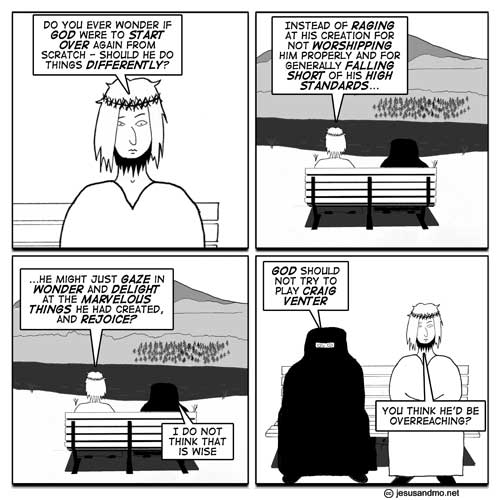
5. How is Kurton not like Craig Venter?

6. What does the Australian novelist think genetic enhancement represents the end of?

7. What might Stone's hypothetical book be about?

8. To what are we "tuned by a billion years of natural engineering"?

9. What's "the secret of Happiness" (according to the popular press)?

10. What or who is Kurton's "design template for the future"?

11. The strongest critique of genetically-engineered happiness comes from _________.

12. Age 21 is young enough to know that there's no what?

generous wisdom

Maybe the smartest line in Generosity, so far:
...tomorrow will be there, as soon as you need it.
But also good is: "The secret of happiness is meaningful work." Or is it simply to fall into the orbit of someone who's already happy, and bask in their glow? Isn't that resignation?

Saturday, December 4, 2010

Thursday, December 2, 2010

attn: USN

University School of Nashville (USN) has released its Evening Classes catalog for 2011. Course #601 looks good...
Description: Are you more likely to scan headlines, Facebook, or a blog than dig deep into a new novel? Have the simple pleasures of yesteryear been usurped by YouTube videos? Amidst the trills and beeps of the digital age, can we rediscover our attention span? Our world is overrun with distraction and the manic pace makes it increasingly difficult to connect with the natural world. If your psychic inbox is full, join author, MTSU philosophy professor and USN dad, PHIL OLIVER as he examines this information overload and considers how we might participate in our technologically-evolving world, while still retaining our attentive powers and our sanity.
It'll be on Feb. 15, 7 pm.

Freud & friends

1. Frege launched what "turn" in philosophy?

2. What "atoms" was Russell trying to reduce the world's complexity to? What did he and Whitehead try to reduce arithmetic to? What was their Hegelian peers' response?

3. Who was the founder of "Phenomenology," the study of ________?

4. Wittgenstein's Tractatus says sentences picture _____, and implies in its conclusion that there _____ (is, is no) meaningful experience beyond the bounds of philosophy, language, and reason.

5. In Wittgenstein's later philosophy, a form of _______, the fundamental unit is the __________.

6. Who showed there will always be unprovable sentences in any formal system?

7. How was Sigmund Freud both pro- and anti-Enlightenment? What, on his view, causes unhappiness?

8. To what did Max Weber attribute capitalism?

9. Whitehead and ________ were major figures in the development of "process philosophy," which rejected static metaphors of eternity and timelessness and emphasized ______ instead of objects.

Wednesday, December 1, 2010

not afraid

It's the birthday of director and screenwriter Woody Allen, (books by this author) born Allen Stewart Konigsberg in Brooklyn (1935)...

As a teenager, he started reading classics by Faulkner and Nietzsche because he was embarrassed when he took girls on dates and they asked him about writers whom he'd never read. But he told them jokes. When he was 15, he started submitting his best jokes to gossip columnists. He went to NYU, but he got an F in English and a C-plus in film, and he was expelled because he never went to class...

Woody Allen said, "I hate reality. But where else can you get a good steak dinner?"


And, "It's not that I'm afraid to die, I just don't want to be there when it happens."

generosity

1. The Camus epigraph in Richard Powers' Generosity says what about the future? Kay Jamison says what is contagious?

2. How is our time characterized by a "runaway first person"? What are the "new facts"?

3. Who is "Thomas Kurton"? (Hint: he seems to have much in common with Craig Venter and Ray Kurzweil.)

4. What does Kurton think of "grandeur in this view of life" (etc.)? Does he want to live forever?

5. (T/F) "Drugs that eliminate the need for sleep" and "untraceable performance enhancers" are among the topics treated on "The Genie and the Genome."

6. What is hypomania?

7. What does Thassadit mean? What does "generosity" mean?

8. What's Tomkin's objection to germline engineering and "designer children"? Why does Kurton like it?

9. What are Thassadit's distinctive personal traits, or symptoms?

10. What does Kurton think people would pay $50,000 for?


KurzweilAI.net Accelerating Intelligence News